Credits and licences
- #1 — vueltaalhuerto illustration
- #2 — vueltaalhuerto illustration
- #3 — vueltaalhuerto illustration
- #4 — vueltaalhuerto illustration
- #5 — vueltaalhuerto illustration
- #6 — vueltaalhuerto illustration
- #7 — vueltaalhuerto illustration
- #8 — vueltaalhuerto illustration
Incense plant (Plectranthus coleoides)
and 4 more names
Coleus forsteri, variegated plectranthus, candle plant, plectranthusIncense plant (Plectranthus coleoides) is planted from March to May. Grow it in sun or partial shade, 30 cm apart, with moderate watering. Dates are for a mild temperate climate in the northern hemisphere; the calendar below adjusts them to your zone.
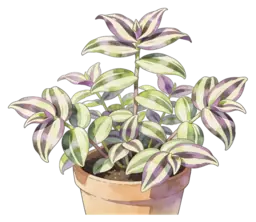
The incense plant (Plectranthus coleoides, often in its variegated form ‘Marginatus’) is a bushy, somewhat trailing member of the mint family, about 30 to 60 cm, with square stems and rounded, downy, scalloped leaves that are green with a creamy white margin. When brushed they release a resinous, slightly minty scent reminiscent of incense, hence the name. In summer or autumn, given enough light, it produces spikes with whorls of small, pale bluish-lilac tubular flowers, discreet but pleasant. It is grown in a pot or hanging basket, in a bright room indoors or on a sheltered terrace in frost-free climates. A note on the name: the plant sold as Plectranthus coleoides ‘Marginatus’ is actually a variegated form of Plectranthus forsteri (now Coleus forsteri), from New Caledonia and Fiji; the true Plectranthus coleoides is a species from southern India that is hardly ever grown. It is an ornamental, aromatic plant, very rewarding and fast-growing, whose tips are pinched out to make it branch. It is often said to keep mosquitoes or other insects away, but I have not found solid evidence of this, so treat it purely as a decorative plant. LEGAL AND SAFETY NOTICE: I have not found reliable toxicological data specific to Plectranthus coleoides; another plant of the genus, ‘Swedish ivy’ (Plectranthus australis), is considered non-toxic to dogs, cats and horses, but other sources disagree and there is no consensus on its safety. What to do: do not use it in infusions, food or home remedies, keep it out of reach of children and pets, and consult a doctor or a vet if someone eats a significant amount; people with sensitive skin may notice irritation when handling the stems, so wear gloves if this happens to you. Legal status: I have not found this species listed in the CITES Convention or in the Spanish Catalogue of Invasive Alien Species (Royal Decree 630/2013), so in Spain it can be freely sold, kept and grown; in very mild climates it can escape from cultivation, so do not dump prunings in the countryside.
Family and origin: Mint family (Lamiaceae) · native to New Caledonia, Fiji and the Loyalty Islands (the plant grown under this name is Plectranthus forsteri ‘Marginatus’; the true P. coleoides comes from southern India) · More plants from Oceania
01In your area
How will it do in your home?
Year calendar
| Task | J | F | M | A | M | J | J | A | S | O | N | D |
|---|---|---|---|---|---|---|---|---|---|---|---|---|
| Plant / transplantMar–May | no | no | yes | yes | yes | no | no | no | no | no | no | no |
| CuttingsMar–Sep | no | no | yes | yes | yes | yes | yes | yes | yes | no | no | no |
Its life cycle at a glance
Swipe and tap a stage to see its details.
02Care
Care through the year
Sun and aspectSun and shade · 4 h of sun · East, or south with light shade during the middle of the day
- Too little sun
- Ideal range
- Plenty of sun
East, or south with light shade during the middle of the day
Gentle sun: Morning or afternoon sun. Midday summer sun stresses and scorches it.
Bright light without direct midday sun, which can scorch the downy leaves. It is sensitive to cold: to be safe, keep it above about 10 °C and do not leave it outdoors when temperatures fall below 5 °C.
- TipTurn the pot every week so it grows evenly towards the light.
WateringMoist but never waterlogged · summer: every 4 to 7 days
- Summerevery 4 to 7 days0.6 L per plant/week
- Spring / Autumnevery 4-5 days0.3 L per plant/week
- Winterevery 10 to 14 days0.1 L per plant/week
Moist but never waterlogged: Water before the surface is completely dry. Never puddles.
Keep the potting mix slightly moist but never waterlogged; water when the surface looks dry 1 or 2 cm down. Empty the saucer 15 minutes after watering, because excess water rots the roots.
When to water? Push your finger 2 cm into the soil next to the base of the plant:
- Damp: soil sticks to your finger. Do not water today. The moisture is fine.
- Cool but clean, no mud. Water early tomorrow if it stays like this, or this evening.
- Dry and dusty. Water now, and deeply. This is not where it likes to be.
- TipIf the stems become leggy and the leaves lose their cream edge, it needs more light; if the leaves turn yellow and drop, it is being overwatered.
- TipAdjust watering to the light and the season: in winter almost all of them need much less water.
- Common mistakeOverwatering is the number one killer: let it dry out as the species requires.
Potting mix and feedingpH 6–7.5 · Multi-purpose compost lightened with perlite
Multi-purpose compost lightened with perlite.
70 % multi-purpose compost · 20 % perlite · 10 % coir.
High: always a pot with a drainage hole and a shallow saucer.
This plant prefers a pH between 6.0 and 7.5 (slightly acidic to slightly alkaline).
- Repot every 2-3 years into a pot a finger's width wider, not much more.
- A handful of worm castings a year keeps the potting mix alive.
- Reusing old potting mix without refreshing it compacts and rots the roots.
- No drainage in the pot = waterlogged roots = dead plant.
- TipPlant it in a pot with drainage holes, in multi-purpose potting mix lightened with perlite (around 30 %) so that it drains well.
- Common mistakePots without drainage waterlog the roots and rot the plant.
Common mistakes and tips
- TipWatch for whitefly, mealybug and red spider mite.
- TipSizes, temperatures and timings are approximate.
03Propagation
Make new plants
It is very easily propagated from stem cuttings: cut tips 8 to 10 cm long with several pairs of leaves, remove the lower leaves and stand them in a glass of water or put them straight into moist potting mix; they root in one or two weeks. When the roots are about 2 to 3 cm long, move them into a pot.
Seeds: how to germinate them~14 days
04Uses and health
What it is used for, and with what care
SAFETY NOTICE: there are no reliable toxicological data specific to Plectranthus coleoides or to P. forsteri ‘Marginatus’, the plant usually sold under that name; another plant of the genus (‘Swedish ivy’, Plectranthus australis) is considered non-toxic, but other sources disagree, so it cannot be stated that it is harmless. To be safe, do not use it in infusions or food, keep it out of reach of children and pets, and consult a doctor or a vet if someone eats a significant amount. If it irritates your skin when you handle it, wear gloves.
- Properties
- An ornamental, aromatic houseplant; it is not grown for any health effect and has no safe medicinal or culinary uses.
- Uses
- It is not edible. Do not use it in food, infusions or home remedies.
For guidance only; this is not medical treatment and does not replace advice from a doctor or vet.
05Companions and related plants