
Credits and licences
- #1 — vueltaalhuerto illustration
- #2 — vueltaalhuerto illustration
- #3 — vueltaalhuerto illustration
- #4 — vueltaalhuerto illustration
- #5 — vueltaalhuerto illustration
- #6 — vueltaalhuerto illustration
- #7 — vueltaalhuerto illustration
- #8 — vueltaalhuerto illustration
- #9 — vueltaalhuerto illustration
- #10 — vueltaalhuerto illustration
Galangal (Alpinia galanga)
and 4 more names
Alpinia galanga, galanga, blue ginger, khaGalangal (Alpinia galanga) is sown in seed trays from February to March, and planted out from April to May. It is harvested from November to February (about 300 days to the first harvest). Grow it in sun or partial shade, 40 cm apart, with plenty of watering. Dates are for a mild temperate climate in the northern hemisphere; the calendar below adjusts them to your zone.
What else to sow in February and March
A tropical perennial in the ginger family that forms a clump of upright canes 1.5 to 2 m tall, with long, glossy, lance-shaped leaves arranged in two rows. It grows from a thick rhizome, pale cream with brown rings and pink tips, aromatic, with a hot, resinous flavour with hints of pine and citrus, which is the part used fresh, sliced or chopped, in Thai, Indonesian and Malaysian cooking, in soups, curries and spice pastes. It rarely flowers outside the tropics, and when it does it produces spikes of greenish-white flowers with a white lip striped with red, and small red fruits. It needs warmth, humidity and rich soil, and does not withstand cold: in Spain it is grown in a large pot, in a greenhouse or in very warm spots on the coast and in the Canary Islands. Do not confuse it with ginger (Zingiber officinale) or lesser galangal (Alpinia officinarum), which have a different flavour and aroma.
Family and origin: Ginger family (Zingiberaceae) · native to South-East Asia (probably Indonesia and Malaysia) · More plants from Southeast Asia
01In your area
How will it do in your garden?
Year calendar
| Task | J | F | M | A | M | J | J | A | S | O | N | D |
|---|---|---|---|---|---|---|---|---|---|---|---|---|
| Seed trayFeb–Mar | no | yes | yes | no | no | no | no | no | no | no | no | no |
| Plant / transplantApr–May | no | no | no | yes | yes | no | no | no | no | no | no | no |
| HarvestNov–Feb | yes | yes | no | no | no | no | no | no | no | no | yes | yes |
| Divide the clumpMar–Apr | no | no | yes | yes | no | no | no | no | no | no | no | no |
Its life cycle at a glance
Swipe and tap a stage to see its details.
02Planting
Where and how to plant it
Sow the seed 4 cm deep; leave 40 cm between plants and 60 cm between rows; give it a stake from the start.
40 cm between plants · 60 cm between rows
Seed at a depth of 4 cm; seedlings go in with the root ball level with the soil.
- In a square-foot bed
- 1 plant every 4 squares30 × 30 cm squares
- Transplanting
- Apr–May
- Seed tray
- Feb–Mar
- Germination
- ~30 days
- TipKeep pieces with buds to plant the following spring, in a dry, mild place.
- TipThe growing cycle, spacing, yield and minimum temperature are a rough guide.
03Care
Care through the year
Sun and aspectSun and shade · 5 h of sun · shade in summer
- Too little sun
- Ideal range
- Plenty of sun
East, or south with light shade during the middle of the day
Moderate sun: Copes with full sun, but give it some shade during heatwaves.
Plenty of light but no strong direct midday sun, which scorches its leaves; light shade in the afternoon suits it. It cannot stand the cold: sources recommend a minimum of 15 to 16 °C for good growth, and below about 8 °C it stops growing and the leaves are damaged; the dormant rhizome copes poorly with cold and wet. Move the pot indoors or into a greenhouse as soon as nights drop below 10 °C.
WateringConstantly moist · summer: daily or every 2 days above 30 °C
- Summerdaily or every 2 days above 30 °C3.5 L per plant/week
- Spring / Autumnevery 3-4 days1.6 L per plant/week
- Winterevery 2 weeks if dry0.4 L per plant/week
Constantly moist: The soil should always feel cool and damp. Ideal with mulch and drip irrigation. Mulch: straw or dry plant material cuts watering by 30-50 %.
Regular, generous watering while it is growing, with the mix always moist but never waterlogged, because the rhizome rots. It appreciates humid air and a mulch. When the leaves turn yellow in autumn, cut back on watering and, if it overwinters indoors, water very little. It needs a wide pot, of at least 10 litres, with good drainage and a loose, slightly acidic mix rich in organic matter.
When to water? Push your finger 2 cm into the soil next to the base of the plant:
- Damp: soil sticks to your finger. Do not water, although for this plant it is just right — check again tomorrow.
- Cool but clean, no mud. Water today: it likes to stay constantly moist.
- Dry and dusty. Water urgently and add mulch to hold in moisture.
- Common mistakeWatering in fits and starts can crack and deform the tubers.
Soil and feedingpH 5.5–6.5 · Loose, deep, stone-free soil
Loose, deep, stone-free soil.
High: constant moisture deforms the root.
This plant prefers a pH between 5.5 and 6.5 (slightly acidic to neutral).
- TipUse a wide, deep pot with rich, loose soil, and put the plant in a warm, sheltered spot.
- TipFeed every two or three weeks in summer with a balanced fertiliser or with well-rotted compost.
- TipKeep anything that pokes out covered with soil: light turns tubers green.
Common mistakes and tips
- TipIt is used in cooking in moderate amounts, as a spice.
04Harvest
Harvesting and storing
Harvest in Nov–Feb; the first, about 300 days after sowing.
- TipIt is harvested after ten to twelve months, when the leaves turn yellow and dry: dig up the rhizome, wash it and use it fresh; you can cut off a piece earlier.
- Common mistakeHarvesting in waterlogged soil or leaving them in the sun: they rot or turn green.
05Propagation
Make new plants
It is propagated mainly by dividing the rhizome, which is the usual method among growers, and with more difficulty from seed. To divide, choose a firm piece with buds (the pink tips), cut it into sections 3 to 5 cm long with at least one bud each, leave them to dry for a day so that the cuts heal, and plant them buds upwards about 4 or 5 cm deep in a loose, warm mix, from March to May; the buds take several weeks to sprout. The seed, which is almost never produced in cultivation, is sown fresh at 22-30 °C in a moist seed tray, barely covered, and germinates poorly and very erratically, so most plants are raised from rhizomes. Rhizomes from the greengrocer sometimes carry sprouting inhibitors: buy rhizomes intended for planting.
06Uses and health
What it is used for, and with what care
In culinary amounts there are no known risks for most people. In large amounts or as supplements it can cause digestive upsets, and it is not advised without medical advice during pregnancy and breastfeeding, with anticoagulant medication or before an operation. There are no reliable data on its toxicity to dogs and cats, so do not give them galangal and consult a vet if they eat a significant amount. Do not confuse it with lesser galangal (Alpinia officinarum) or with ginger.
- Properties
- The rhizome provides flavour and aroma and has been used for centuries as a spice in South-East Asia. In the region's traditional medicine it has been credited with digestive uses, but there is not enough evidence of health benefits and no therapeutic uses are given here.
- Uses
- The fresh rhizome is used peeled and sliced, chopped or crushed in soups, curries, spice pastes and broths, especially in Thai, Indonesian and Malaysian cooking; it is harder than ginger and has a hotter, more resinous flavour, and it is usually removed from the dish before eating because it is fibrous. It is also sold dried or ground. The leaves and tender shoots are used in some Asian cuisines. Wash and peel the rhizome before using it.
For guidance only; this is not medical treatment and does not replace advice from a doctor or vet.
07Companions and related plants
What to plant it with
Good companions
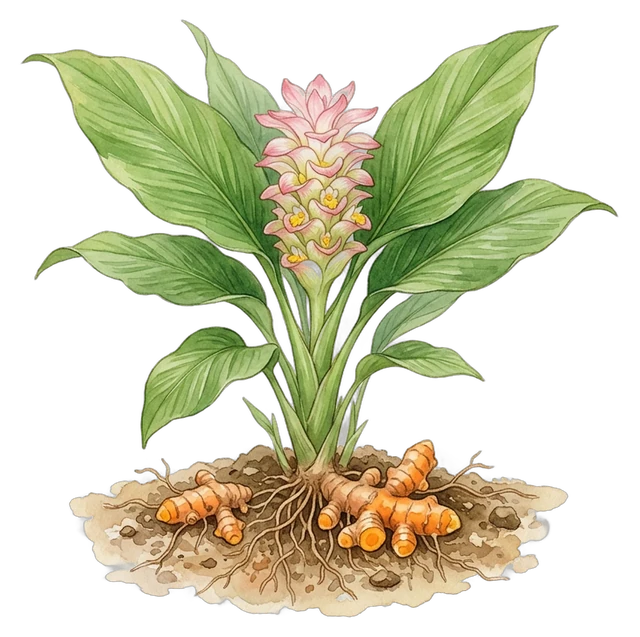
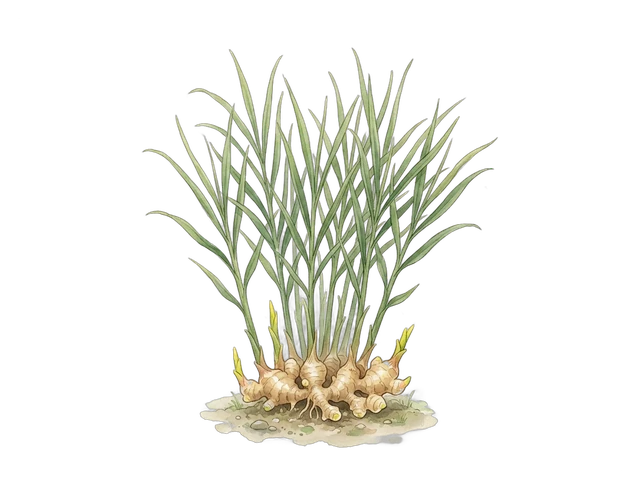
Group it in the same bedPlants with the same watering or the same sun
They are not essential companions, but you will not have to water or position them differently.