Credits and licences
- #1 — vueltaalhuerto illustration
- #2 — vueltaalhuerto illustration
- #3 — vueltaalhuerto illustration
- #4 — vueltaalhuerto illustration
- #5 — vueltaalhuerto illustration
- #6 — vueltaalhuerto illustration
- #7 — vueltaalhuerto illustration
- #8 — vueltaalhuerto illustration
- #9 — vueltaalhuerto illustration
Croton (Codiaeum variegatum)
and 4 more names
Codiaeum variegatum, croton Petra, croton Iceton, croton ExcellentCroton (Codiaeum variegatum) is planted from April to June. Grow it in full sun, 60 cm apart, with moderate watering. Dates are for a mild temperate climate in the northern hemisphere; the calendar below adjusts them to your zone.
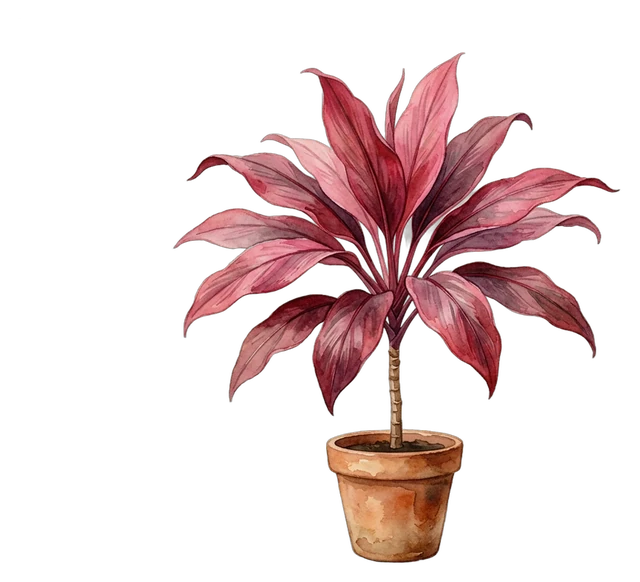
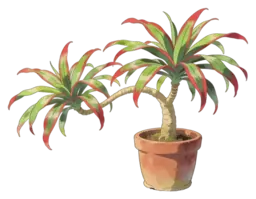
The croton (Codiaeum variegatum) is a tropical shrub with leathery, glossy leaves in very bright colours: green, yellow, orange, red, bronze and almost black, in blotches, veins or margins that vary with the variety and the light. The leaves can be broad, narrow, lobed, wavy or twisted, giving many cultivated forms, such as ‘Petra’, ‘Iceton’ or ‘Excellent’, which are sold in shops. In a pot it reaches between 60 cm and 1.5 m; outdoors, in frost-free climates such as Spain's warm coast or the Canary Islands, it can reach 3 m or more. In the leaf axils it produces long sprays of tiny, inconspicuous creamy-white flowers, followed by small capsules. It needs plenty of light to keep its colour, warmth and humidity, and does not tolerate cold or draughts; in poor light it loses its colouring and turns green. It is an ornamental plant, for indoors or sheltered outdoor spots; it is not eaten. LEGAL AND SAFETY NOTICE: the whole plant, and especially the milky latex of the stems and leaves and the seeds, is irritant and toxic: the sap can cause dermatitis and redness of the skin and eyes, and if chewed or swallowed it causes a burning mouth, nausea, vomiting and diarrhoea; it is toxic to dogs, cats and horses. What to do: wear gloves and goggles when pruning or taking cuttings (the latex stains and can irritate), wash any splashes with soap and water, keep the plant out of the reach of children and pets and do not use it in herbal teas or remedies; in the event of any ingestion or contact with the eyes, see a doctor or vet. Legal status: I have found no record of Codiaeum variegatum being listed in the CITES Convention (which does include other members of the spurge family, such as many succulent Euphorbia) or in the Spanish Catalogue of Invasive Alien Species (Real Decreto 630/2013, a Spanish royal decree), so in Spain it can be freely sold, kept and grown; only buy nursery-grown plants.
Family and origin: Spurge family (Euphorbiaceae) · native to South-East Asia (Malaysia and Indonesia), the western Pacific islands and northern Australia, in tropical forests and coastal areas · More plants from Southeast Asia
01In your area
How will it do in your home?
Year calendar
| Task | J | F | M | A | M | J | J | A | S | O | N | D |
|---|---|---|---|---|---|---|---|---|---|---|---|---|
| Plant / transplantApr–Jun | no | no | no | yes | yes | yes | no | no | no | no | no | no |
| CuttingsApr–Aug | no | no | no | yes | yes | yes | yes | yes | no | no | no | no |
Its life cycle at a glance
Swipe and tap a stage to see its details.
02Care
Care through the year
Sun and aspectFull sun · 5 h of sun · shade in summer
- Too little sun
- Ideal range
- Plenty of sun
South or south-west, with nothing casting shade at midday
Moderate sun: Copes with full sun, but give it some shade during heatwaves.
Very bright light, with some gentle direct morning sun, to keep its colours; in low light the leaves lose their colouring and turn green. It is sensitive to cold: keep it above about 12 to 15 °C and do not leave it outdoors below 10 °C or near draughts.
- TipTurn the pot every week so it grows evenly towards the light.
WateringMoist but never waterlogged · summer: every 4 to 6 days
- Summerevery 4 to 6 days0.6 L per plant/week
- Spring / Autumnevery 4-5 days0.3 L per plant/week
- Winterevery 8 to 12 days0.1 L per plant/week
Moist but never waterlogged: Water before the surface is completely dry. Never puddles.
Keep the potting mix slightly moist and water when the surface feels dry 2 or 3 cm down; empty the saucer. In winter, with less light and cooler temperatures, water much less. Prolonged dryness makes the lower leaves drop. It appreciates humidity.
When to water? Push your finger 3 cm into the soil next to the base of the plant:
- Damp: soil sticks to your finger. Do not water today. The moisture is fine.
- Cool but clean, no mud. Water early tomorrow if it stays like this, or this evening.
- Dry and dusty. Water now, and deeply. This is not where it likes to be.
- TipKeep the humidity up by misting or grouping plants together, and wipe the dust off the leaves with a damp cloth.
- TipIf it drops its lower leaves, this is usually due to cold, draughts, lack of light or irregular watering.
- TipAdjust watering to the light and the season: in winter almost all of them need much less water.
- Common mistakeOverwatering is the number one killer: let it dry out as the species requires.
Potting mix and feedingpH 5.5–6.5 · Multi-purpose compost lightened with perlite
Multi-purpose compost lightened with perlite.
70 % multi-purpose compost · 20 % perlite · 10 % coir.
High: always a pot with a drainage hole and a shallow saucer.
This plant prefers a pH between 5.5 and 6.5 (slightly acidic to neutral).
- Repot every 2-3 years into a pot a finger's width wider, not much more.
- A handful of worm castings a year keeps the potting mix alive.
- Reusing old potting mix without refreshing it compacts and rots the roots.
- No drainage in the pot = waterlogged roots = dead plant.
- TipPlant it in a pot with drainage holes, in houseplant potting mix lightened with perlite or coir, and place it in the brightest spot in the house, away from draughts and radiators.
- TipFeed it every 15 days in spring and summer with liquid fertiliser at half strength.
- Common mistakePots without drainage waterlog the roots and rot the plant.
Pruning
- TipPinch out the stem tips so that it branches.
Common mistakes and tips
- TipWatch out for red spider mite and mealybugs.
- TipSizes, temperatures and timings are a guide only.
03Propagation
Make new plants
Propagated from stem cuttings with several leaves: in spring or summer, cut tips 10 to 15 cm long, leave the cut to dry for a few hours (the latex seals it), dip them in rooting hormone if you like and plant them in a light, moist potting mix, with warmth and high humidity, or root them in a glass of water; they take in a few weeks. It can also be air-layered. Seed-raised plants do not usually come out the same as the parent.
04Uses and health
What it is used for, and with what care
SAFETY WARNING: the milky latex of the stems and leaves and the seeds are irritant and toxic: the sap can cause dermatitis and redness of the skin and eyes, and if chewed or swallowed it causes a burning mouth, nausea, vomiting and diarrhoea; it is toxic to dogs, cats and horses. Wear gloves and goggles when pruning or taking cuttings, wash any splashes with soap and water, keep it out of the reach of children and pets, and consult a doctor or vet in the event of any ingestion or contact with the eyes.
- Properties
- An ornamental plant; it has no safe medicinal or culinary uses.
- Uses
- It is not edible. Do not use it in food, herbal teas or home remedies.
For guidance only; this is not medical treatment and does not replace advice from a doctor or vet.
05Companions and related plants