Credits and licences
- #1 — vueltaalhuerto illustration
- #2 — vueltaalhuerto illustration
- #3 — vueltaalhuerto illustration
- #4 — vueltaalhuerto illustration
- #5 — vueltaalhuerto illustration
- #6 — vueltaalhuerto illustration
- #7 — vueltaalhuerto illustration
- #8 — vueltaalhuerto illustration
- #9 — vueltaalhuerto illustration
Coastal rosemary (Westringia fruticosa)
and 2 more names
Westringia 'Blue Gem', native rosemaryCoastal rosemary (Westringia fruticosa) is planted from March to May and from September to October. It flowers from March to June. Grow it in full sun, 100 cm apart, with little watering. Dates are for a mild temperate climate in the northern hemisphere; the calendar below adjusts them to your zone.
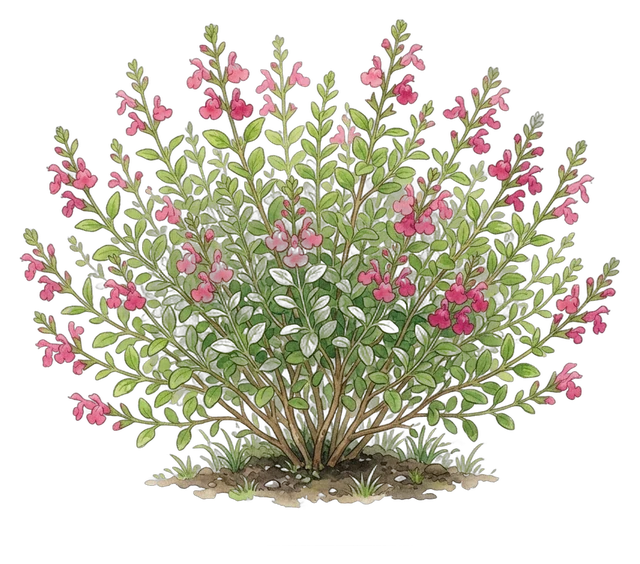
A rounded, dense evergreen shrub, 1 to 2 m tall and wide (less in compact cultivars such as ‘Blue Gem’), with narrow, greyish-green leaves that are silvery underneath, arranged in threes around the stem, so they look like rosemary leaves, although they do not smell the same and are not eaten. It flowers almost all year round, most strongly in spring and autumn, with small, two-lipped flowers, white or bluish mauve with tiny spots in the throat, depending on the cultivar. It copes very well with wind, salt, drought and poor soils, so it is widely used in Mediterranean coastal gardens, low hedges, banks and planters. It is not an edible plant, despite the name ‘rosemary’. It should not be confused with rosemary (Salvia rosmarinus), which it resembles and shares gardens with. It is not among the invasive alien species regulated in Spain or the EU.
Family and origin: Mint family (Lamiaceae) · native to East coast of Australia (New South Wales and Queensland), on dunes and cliffs · More plants from Oceania
01In your area
How will it do in your garden?
Year calendar
| Task | J | F | M | A | M | J | J | A | S | O | N | D |
|---|---|---|---|---|---|---|---|---|---|---|---|---|
| Plant / transplantMar–May, Sep–Oct | no | no | yes | yes | yes | no | no | no | yes | yes | no | no |
| FloweringMar–Jun | no | no | yes | yes | yes | yes | no | no | no | no | no | no |
| PruningMar–Jun, Sep | no | no | yes | yes | yes | yes | no | no | yes | no | no | no |
| CuttingsJun–Sep | no | no | no | no | no | yes | yes | yes | yes | no | no | no |
Its life cycle at a glance
Swipe and tap a stage to see its details.
02Planting
Where and how to plant it
Leave 1 m between plants and 1 m between rows.
1 m between plants · 1 m between rows
Seedlings are planted with the root ball level with the soil.
- Transplanting
- Mar–May, Sep–Oct
- Common mistakePlanting too deep smothers the crown of the plant.
03Care
Care through the year
Sun and aspectFull sun · 8 h of sun · South or south-west, with nothing casting shade at midday
- Too little sun
- Ideal range
- Plenty of sun
South or south-west, with nothing casting shade at midday
Strong sun: Loves full midday sun and high temperatures.
Full sun and heat; in shade it becomes leggy and flowers less. It withstands wind and salty air, so it is a good choice on the coast. In areas with frost, give it the protection of a south-facing wall, or move it somewhere sheltered if it is in a pot.
WateringLet it dry out between waterings · summer: once a week in the first year; after that, hardly at all
- Summeronce a week in the first year; after that, hardly at all3 L per plant/week
- Spring / Autumnevery 10-14 days1.2 L per plant/week
- Winterhardly ever0.5 L per plant/week
Let it dry out between waterings: A Mediterranean favourite: better thirsty than overwatered. Mulch: straw or dry plant material cuts watering by 30-50 %.
Water regularly in the first year until it is established, then let it get by on rainfall, except in long droughts. It needs well-drained soil: waterlogging, especially in winter, rots its roots. In a pot, water when the potting mix has dried out deep down.
When to water? Push your finger 5 cm into the soil next to the base of the plant:
- Damp: soil sticks to your finger. Do not water yet. It has more than enough; wait for it to dry out more.
- Cool but clean, no mud. Wait another 1-2 days before watering.
- Dry and dusty. Water now, but moderately. Do not overdo it: it prefers thirst to excess.
- TipAvoid overwatering and watch out for scale insects.
- TipThe figures for height, temperature and watering are a guide only.
- TipWater generously in the first year until it is established; after that it looks after itself.
Soil and feedingpH 6–8 · Deep soil with good drainage
Deep soil with good drainage.
Medium/high.
This plant prefers a pH between 6.0 and 8.0 (slightly acidic to alkaline).
- Water generously in the first year until it is established.
- A thick mulch all year round, not touching the trunk.
- TipPlant it in well-drained soil, or in a pot with a mineral potting mix.
- TipFeed sparingly; a slow-release fertiliser in spring is enough.
PruningWhen: Mar–Jun, Sep
Pruning time for this plant: Mar–Jun, Sep.
- TipPrune lightly and regularly, one to three times a year, after flowering, to keep it compact: if you let it grow unpruned and then cut it back very hard, it is left with bare stems and regrows poorly.
- TipDo not plant it next to natural areas, and do not dump prunings in the countryside.
- TipFormative pruning after flowering keeps the shape compact.
- Common mistakePruning at the wrong time removes the year's flower buds.
04Propagation
Make new plants
It is easily propagated from semi-ripe cuttings, 8 to 10 cm long, taken from late spring to September and set in a sandy, free-draining potting mix, with humid air and gentle warmth; they root in about three to six weeks. Cultivars such as ‘Blue Gem’ do not come true from seed, so they are propagated only by cuttings.
05Uses and health
What it is used for, and with what care
There is no reliable data on its toxicity to people, dogs and cats. Some nurseries describe it as harmless to pets, but we have not found a veterinary source that confirms this. As a precaution, do not use it as a seasoning or in infusions, and do not let children or animals chew the leaves or stems.
- Properties
- A very tough ornamental shrub that is good for bees. It has no home medicinal uses.
- Uses
- It is not edible. Although it is called ‘Australian rosemary’, its leaves are not aromatic and are not used in cooking.
For guidance only; this is not medical treatment and does not replace advice from a doctor or vet.
06Companions and related plants