
Credits and licences
- #1 — vueltaalhuerto illustration
- #2 — vueltaalhuerto illustration
- #3 — vueltaalhuerto illustration
- #4 — vueltaalhuerto illustration
- #5 — vueltaalhuerto illustration
- #6 — vueltaalhuerto illustration
- #7 — vueltaalhuerto illustration
- #8 — vueltaalhuerto illustration
- #9 — vueltaalhuerto illustration
Alocasia cucullata (Chinese taro, Buddha's palm)
and 3 more names
dwarf elephant ear, elephant ear, alocasiaAlocasia cucullata (Chinese taro, Buddha's palm) is planted from March to June. Grow it in sun or partial shade, 50 cm apart, with moderate watering. Dates are for a mild temperate climate in the northern hemisphere; the calendar below adjusts them to your zone.
A clump-forming plant with several stems, 50 to 100 cm tall, with glossy, bright green, heart- or arrow-shaped leaves about 20 to 30 cm long, with an elongated tip and prominent veins, held on long, straight leaf stalks. It grows from an underground rhizome that produces offsets, and over time forms a dense clump. The flower is a yellowish-green spathe hooded around a cream spadix, rarely seen indoors, and it leaves a cluster of red berries. The name 'cucullata' refers to this hooded spathe. It prefers warm, humid, bright conditions, and in winter it may lose leaves if it is cold. WARNING: a toxic plant. It contains calcium oxalate crystals in all its parts, and the sap and the water the leaves exude from their edges irritate the skin and eyes; eating it causes intense pain and burning in the mouth and throat, drooling and vomiting in people, dogs and cats. It is not edible: do not use it in cooking. Keep it out of reach of children and pets and wash your hands after handling it. In warm, humid climates it can escape into the wild: do not plant it near watercourses or natural areas.
Family and origin: Arum family (Araceae) · native to South and South-East Asia, from Sri Lanka and the Himalayas to southern China and Indochina (its exact wild origin is uncertain); now widely grown and naturalised in other warm regions, such as the Pacific islands and Central America · More plants from South Asia
01In your area
How will it do in your home?
Year calendar
| Task | J | F | M | A | M | J | J | A | S | O | N | D |
|---|---|---|---|---|---|---|---|---|---|---|---|---|
| Plant / transplantMar–Jun | no | no | yes | yes | yes | yes | no | no | no | no | no | no |
| Divide the clumpApr–Jul | no | no | no | yes | yes | yes | yes | no | no | no | no | no |
Its life cycle at a glance
Swipe and tap a stage to see its details.
02Care
Care through the year
Sun and aspectSun and shade · 4 h of sun · shade in summer
- Too little sun
- Ideal range
- Plenty of sun
East, or south with light shade in the middle of the day
Gentle sun: Morning or afternoon sun. Midday summer sun stresses and scorches it.
Bright, indirect light, near an east- or west-facing window, without strong direct sun, which scorches the leaves. In low light it becomes leggy and the leaf stalks lengthen. It needs warmth: 18 to 28 °C, and it should not drop below about 12 °C. In the cold it stops growing and may lose its leaves.
- TipTurn the pot every week so it grows evenly towards the light.
WateringMoist but never waterlogged · summer: every 4 to 6 days
- Summerevery 4 to 6 days0.6 L per plant/week
- Spring / Autumnevery 4-5 days0.3 L per plant/week
- Winterevery 10 to 14 days, with much less water0.1 L per plant/week
Moist but never waterlogged: Water before the surface is completely dry. Never puddles.
Water generously in spring and summer to keep the potting mix moist without waterlogging, and empty the saucer. In winter, cut watering to a minimum, because in the cold the rhizome rots. If you overwater, the plant releases drops from the edges of its leaves, which irritate the skin. It appreciates high humidity.
When to water? Push your finger 2 cm into the soil next to the base of the plant:
- Damp: soil sticks to your finger. Do not water today. The moisture is fine.
- Cool but clean, no mud. Water early tomorrow if it stays like this, or this evening.
- Dry and dusty. Water now, and deeply. This is not where it likes to be.
- TipTemperatures, watering and timings are approximate.
- TipAdjust watering to the light and the season: in winter almost all of them need much less water.
- Common mistakeOverwatering is the number one killer: let it dry out as the species requires.
Potting mix and feedingpH 5.5–7 · Multi-purpose compost lightened with perlite
Multi-purpose compost lightened with perlite.
70 % multi-purpose compost · 20 % perlite · 10 % coir.
High: always a pot with a drainage hole and a shallow saucer.
This plant prefers a pH between 5.5 and 7.0 (slightly acidic to neutral).
- Repot every 2-3 years into a pot a finger's width wider, not much more.
- A handful of worm castings a year keeps the potting mix alive.
- Reusing old potting mix without refreshing it compacts and rots the roots.
- No drainage in the pot = waterlogged roots = dead plant.
- TipPlant it in a pot with drainage holes and a light, airy potting mix of peat or coir with perlite and bark.
- TipFeed every three or four weeks, from spring to summer, with a diluted balanced fertiliser.
- Common mistakePots without drainage waterlog the roots and rot the plant.
Common mistakes and tips
- TipWipe the leaves with a damp cloth.
- TipWatch out for red spider mite and scale insects, especially in dry conditions.
- TipAlways wash your hands after touching it.
03Propagation
Make new plants
It is propagated mainly by dividing the rhizome. In spring or summer, take the plant out of its pot, clean the roots and separate sections or offsets that have at least one growing point and their own roots; plant each piece in its own pot. Wear gloves: the sap is irritant. It cannot be propagated from leaf cuttings.
- TipRepot every two years, or divide it when it fills the pot.
04Uses and health
What it is used for, and with what care
WARNING: all parts contain calcium oxalate crystals. Chewing it causes intense pain and burning in the mouth and throat, drooling, vomiting and swelling, in people as well as dogs and cats. The sap and the drops released from the leaf edges irritate the skin and eyes. Keep it out of reach of children and pets, wear gloves when dividing it and, if any is eaten, see a doctor or vet.
- Properties
- An ornamental plant with showy leaves. It has no home medicinal uses.
- Uses
- It is not edible. It is a toxic plant: it must not be used in cooking. In some parts of its native region the rhizomes have been cooked after lengthy treatment, but this is a risky use that we do not recommend.
For guidance only; this is not medical treatment and does not replace advice from a doctor or vet.
05Companions and related plants
What to plant it with
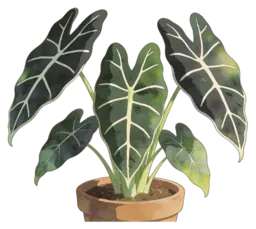
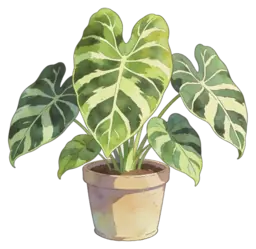
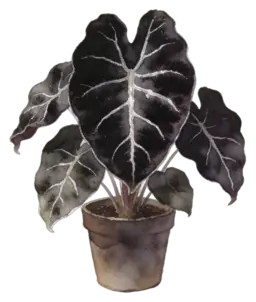
Compare with similar varieties
| Variety | Sowing | Harvest | Days | Spacing | Difficulty |
|---|---|---|---|---|---|
| Alocasia 'Black Velvet' | — | — | — | 30 cm | Moderate |
| Alocasia 'Polly' | — | — | — | 30 cm | Moderate |
| Alocasia cucullata (Chinese taro, Buddha's palm) | Mar–Jun | — | — | 50 cm | Moderate |
| Alocasia micholitziana 'Frydek' (green velvet alocasia) | Apr–Jun | — | — | 50 cm | Moderate |
| Alocasia zebrina | — | — | — | 40 cm | Moderate |