
Credits and licences
- #1 — vueltaalhuerto illustration
- #2 — vueltaalhuerto illustration
- #3 — vueltaalhuerto illustration
- #4 — vueltaalhuerto illustration
- #5 — vueltaalhuerto illustration
- #6 — vueltaalhuerto illustration
- #7 — vueltaalhuerto illustration
- #8 — vueltaalhuerto illustration
- #9 — vueltaalhuerto illustration
- #10 — vueltaalhuerto illustration
Agave titanota
Agave titanota is sown in seed trays from March to May, and planted out from April to June and in September. Grow it in full sun, 60 cm apart, with little watering. Dates are for a mild temperate climate in the northern hemisphere; the calendar below adjusts them to your zone.
What else to sow in March, April and May
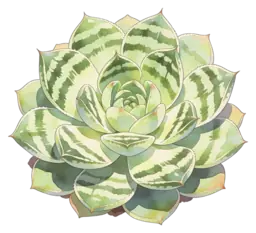
Agave titanota is a compact agave from the state of Oaxaca, in Mexico, that grows on limestone slopes. It forms a rosette 40 to 60 cm across, of thick, stiff, very broad leaves of a chalky bluish-white colour, with large, hooked, dark brown teeth along the margin and a strong terminal spine; with light and cold, the edge and teeth take on a reddish tinge. It grows slowly and gradually forms a clump with offsets. After many years it sends up a flower spike over 2 m tall with greenish-yellow flowers, and the mother rosette dies. The variety ‘White Ice’ has almost white leaves and is the most sought-after in nurseries. It is an uncommon agave, and some of the plants sold as titanota are hybrids with close relatives such as Agave kerchovei and Agave oteroi. LEGAL AND SAFETY WARNING: The IUCN classifies Agave titanota as an endangered species, so buy only nursery-grown plants and do not collect plants, offsets or seeds in the wild; we have not found it listed in the CITES appendices, but it is worth checking the official database (Species+) if you are importing a plant from outside the EU. It is not in the Spanish Catalogue of Invasive Alien Species (RD 630/2013), which only includes the common century plant (Agave americana), although some agaves do go wild: do not throw trimmings, offsets or seeds out into the countryside. Risks: the spines and hooked teeth are particularly hard and can cause deep wounds, the sap is irritant and can cause dermatitis, and it is harmful if swallowed, also to dogs and cats. Wear thick gloves and goggles when handling it, and keep it out of reach of children and pets.
Family and origin: Asparagus family (Asparagaceae) · native to Limestone slopes of Oaxaca, in southern Mexico · More plants from Mesoamerica
01In your area
How will it do in your garden?
Year calendar
| Task | J | F | M | A | M | J | J | A | S | O | N | D |
|---|---|---|---|---|---|---|---|---|---|---|---|---|
| Seed trayMar–May | no | no | yes | yes | yes | no | no | no | no | no | no | no |
| Plant / transplantApr–Jun, Sep | no | no | no | yes | yes | yes | no | no | yes | no | no | no |
| Divide the clumpApr–Jun | no | no | no | yes | yes | yes | no | no | no | no | no | no |
Its life cycle at a glance
Swipe and tap a stage to see its details.
02Planting
Planting and transplanting
- TipBuy plants labelled with the species name: many seed-grown plants of uncertain origin are hybrids.
03Care
Care through the year
Sun and aspectFull sun · 8 h of sun · South or south-west, with nothing casting shade at midday
- Too little sun
- Ideal range
- Plenty of sun
South or south-west, with nothing casting shade at midday
Strong sun: Loves full midday sun and high temperatures.
Plenty of light; in full sun it keeps its colour and compact shape. Sources give very different cold figures; to be safe, leave it outside only with light frosts (down to about -5 °C) and in dry soil, and if in a pot protect it from frost.
- Common mistakeLack of light makes them stretch and go soft (etiolation).
WateringLet it dry out between waterings · summer: every 5-7 days
- Summerevery 5-7 days0.2 L per plant/week
- Spring / Autumnevery 10-14 days0.1 L per plant/week
- Winteronly in extreme drought (once a month)0 L per plant/week
Let it dry out between waterings: A Mediterranean favourite: better thirsty than overwatered.
Water little, only when the potting mix is completely dry, and hardly at all in winter; too much water is what harms it most. Avoid wetting the centre of the rosette in cold weather.
When to water? Push your finger 5 cm into the soil next to the base of the plant:
- Damp: soil sticks to your finger. Do not water yet. It has more than enough; wait for it to dry out more.
- Cool but clean, no mud. Wait another 1-2 days before watering.
- Dry and dusty. Water now, but moderately. Do not overdo it: it prefers thirst to excess.
- TipWatch for mealybugs, agave snout weevil and rot from waterlogging.
- TipThe size, cold and watering figures are approximate.
- TipWater thoroughly and leave long gaps: better thirsty than overwatered.
- Common mistakeWatering often rots the crown and the roots.
Soil and feedingpH 6–8 · Very gritty, free-draining mix
Very gritty, free-draining mix.
30 % multi-purpose compost · 40 % coarse sand · 30 % perlite or pumice.
Very high: standing moisture rots them.
This plant prefers a pH between 6.0 and 8.0 (slightly acidic to alkaline).
- Multi-purpose compost on its own with no drainage: rot sets in quickly.
- Watering the rosette or the leaves marks them and causes rot.
- TipGrow it in a pot or rock garden with a very free-draining mineral mix (half cactus compost and half grit or pumice), in full sun.
- TipIt grows slowly and needs no feeding: once in spring with cactus fertiliser is enough.
- TipVery free-draining mix (with sand/perlite) and pots with a drainage hole.
04Propagation
Make new plants
It is propagated mainly by offsets: in spring or summer, carefully separate the pups that grow around the mother rosette, wearing gloves, let them dry for a few days and plant them in a mineral potting mix. It forms offsets over time, often tight against the mother rosette; the variety ‘White Ice’ is kept true by offsets, because from seed it can vary. It can also be grown from seed: the black, flat, shiny seeds are sown in spring in a seed tray with a sandy mix at about 20 to 28 °C, and they germinate within a few weeks; the seedlings grow slowly. Seed-grown plants can vary, and if other agaves of the group (A. kerchovei, A. oteroi) are nearby, hybrids may result.
Seeds: how to germinate them~14 days
05Uses and health
What it is used for, and with what care
The sap contains saponins and calcium oxalate crystals that irritate the skin, mouth and stomach. Handle it with gloves and keep it out of reach of children and pets; the spines and leaf teeth cause wounds. It is a threatened species in its country of origin: buy nursery-grown plants.
- Properties
- An ornamental plant, with no recommended medicinal or food uses.
- Uses
- It is not edible: do not use it in home preparations. Other agaves are used in Mexico, but there is no reliable data on this one and its sap is irritant.
For guidance only; this is not medical treatment and does not replace advice from a doctor or vet.
06Companions and related plants
What to plant it with
Compare with similar varieties
| Variety | Sowing | Harvest | Days | Spacing | Difficulty |
|---|---|---|---|---|---|
| Foxtail agave (Agave attenuata) | — | — | — | 120 cm | Easy |
| Squid agave (Agave bracteosa) | Mar–May | — | — | 40 cm | Easy |
| Agave chiapensis | Mar–May | — | — | 80 cm | Easy |
| Thread agave (Agave filifera) | Mar–May | — | — | 50 cm | Easy |
| Agave macroacantha | Mar–May | — | — | 60 cm | Easy |
| Agave nigra (Sharkskin agave) | Apr–Jun, Sep | — | — | 60 cm | Easy |
| Parry's agave (Agave parryi) | Mar–May | — | — | 60 cm | Easy |
| Butterfly agave (Agave potatorum) | Mar–May | — | — | 60 cm | Easy |
| Agave pygmaea ‘Dragon Toes’ (dragon toes agave) | Mar–May | — | — | 40 cm | Easy |
| Pulque agave (Agave salmiana) | Mar–May | — | — | 300 cm | Easy |
| Agave titanota | Mar–May | — | — | 60 cm | Moderate |
| Thorn-crested agave (Agave univittata) | Mar–May | — | — | 70 cm | Easy |
| Agave univittata ‘Quadricolor’ (four-colour agave) | Mar–May | — | — | 60 cm | Easy |
| Queen Victoria agave (Agave victoriae-reginae) | Mar–May | — | — | 40 cm | Moderate |
| Agave × romanii | Apr–Jun, Sep | — | — | 40 cm | Easy |