
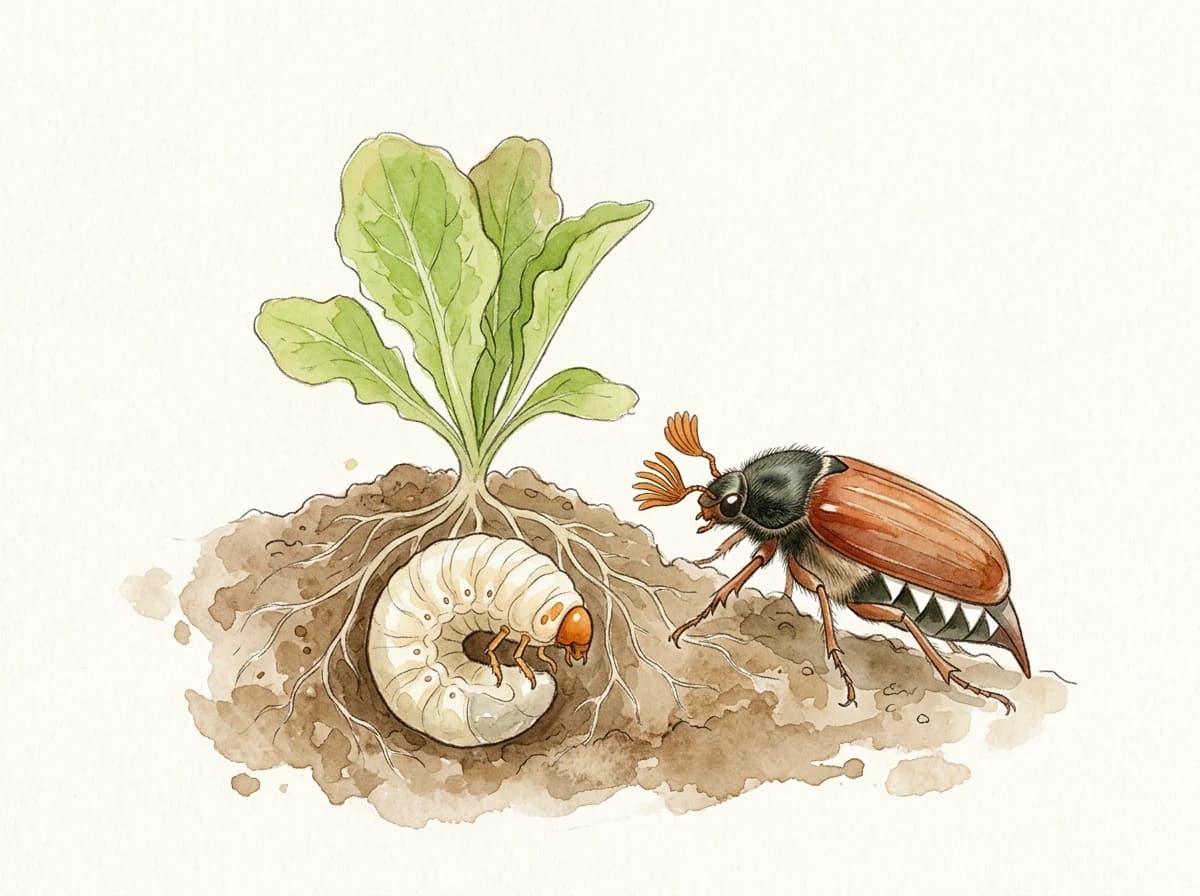
White grubs (chafer grubs)
Also known as: white grub, white grubs, chafer grub, chafer grubs, cockchafer grub, June beetle grub, Melolontha, Amphimallon, Anoxia, lawn grubs
White, C-shaped larvae of several chafer beetles that live underground for two to four years, eating the roots of lawn, strawberries, lettuces and young plants. The plant wilts and pulls up with no resistance. The most useful thing is to pick them out when digging and let birds and hedgehogs do the rest.

How to recognise it at every stage
Shares your gardenIt likes the roots of your lawn, strawberries and lettuces.
Life cycle: Complete and long metamorphosis: the larva (the "white grub") lives 2 to 4 years underground eating roots, pupates in summer and the adult beetle emerges in spring. In winter the larvae go deeper.
Tap a stage to see it full size. The photos are AI reference images checked against real photographs; stages without a reliable photo are shown as text only.
Life-stage calendar
| Jan | Feb | Mar | Apr | May | Jun | Jul | Aug | Sep | Oct | Nov | Dec | |
|---|---|---|---|---|---|---|---|---|---|---|---|---|
| Eggs | ||||||||||||
| Larva (white grub) | ||||||||||||
| Pupa | ||||||||||||
| Chafer beetle |
Approximate months for mainland Spain; in cold areas they start later and in warm areas they last longer. Garden creatures this month
- 1Keep an eye on it
Eggs
· 2-3 mmOval and white, in groups of 10-30.
- Where to find it
- 10-20 cm underground, in lawns and loose soils.
- When: May–Jul
- What to do
- They cannot be seen; nothing to do.
- 2Protect your plants
Larva (white grub)
· Up to 4-5 cmFat, white and curved in a C shape, with an orange-brown head, three pairs of legs and a swollen, bluish-grey end to the abdomen.
- Where to find it
- Next to the roots; the plant wilts and pulls up with no resistance.
- When: Mar–Oct
- What to do
- If you find them when digging, leave them in view of robins and blackbirds or take them far away. For many of them, beneficial nematodes (Heterorhabditis) in late summer with the soil moist.
- Often confused with
- Rose chafer larva (an ally in the compost). It is also white and C-shaped, but it has a small head, very short legs, a body wider at the back and it crawls on its back. It lives in the compost and improves it: protect it and put it back in the compost.
- Wireworm. Thin, hard, yellow-orange and straight, not curved. See profile
- 3Keep an eye on it
Pupa
· 2.5 cmYellowish brown, with the legs, wings and antennae pressed against the body.
- Where to find it
- In a cell 20-60 cm deep.
- When: Jul–Sep
- What to do
- It cannot be seen; the adult stays in the cell all winter.
- 4Keep an eye on it
Chafer beetle
· 2-3 cmRobust, reddish-brown wing cases, black hairy shield, white triangles on the sides of the abdomen and fan-shaped antennae.
- Where to find it
- It flies at dusk and eats the leaves of oaks and fruit trees.
- When: Apr–Jun
- What to do
- Leave it be: the adult does little harm. Bats and barn owls take care of many.
Often confused with
- Rose chafer larva (an ally in the compost). It is also white and C-shaped, but it has a small head, very short legs, a body wider at the back and it crawls on its back. It lives in the compost and improves it: protect it and put it back in the compost.
- Wireworm. Thin, hard, yellow-orange and straight, not curved. See profile
How to recognise it (symptoms)
- Plants that suddenly wilt and pull up with no roots
- Dry patches in the lawn that lift like a carpet
- Fat white C-shaped larvae when digging, with an orange-brown head
- Blackbirds, magpies or badgers digging in the lawn
Crops affected


What favours it
- Gardens open onto meadows or old lawn
- Sandy, loose soils
- Piles of half-rotted manure near the garden
Prevention
- Dig or aerate the soil when preparing the beds and leave the larvae in view of the birds
- Avoid planting strawberries and potatoes right after lifting a lawn
- Encourage hedgehogs, shrews, robins and blackbirds
Organic treatment
Always start here: these remedies are kind to the garden, the soil and pollinators.
- Pick the larvae out when digging and take them away or leave them for the birds (chickens look for them too)
- Beneficial nematodes (Heterorhabditis) in late summer, with the soil moist and above 12 °C
- Leave the rose chafer larvae in the compost alone: they look similar, but they are allies
Don't confuse it with…
With the rose chafer larva, which lives in compost, has a small head and very short legs and crawls on its back: it is an ally. And with the wireworm, which is thin, hard and straight.
Use plant protection products responsibly, even organic ones. Always read and follow the label, the doses and the harvest interval, and never treat plants in flower or while bees are flying, in order to protect pollinators. If in doubt, put prevention and organic methods first.

In the plant catalogue you'll see what to plant, how and when: a well-tended plant resists pests much better.