
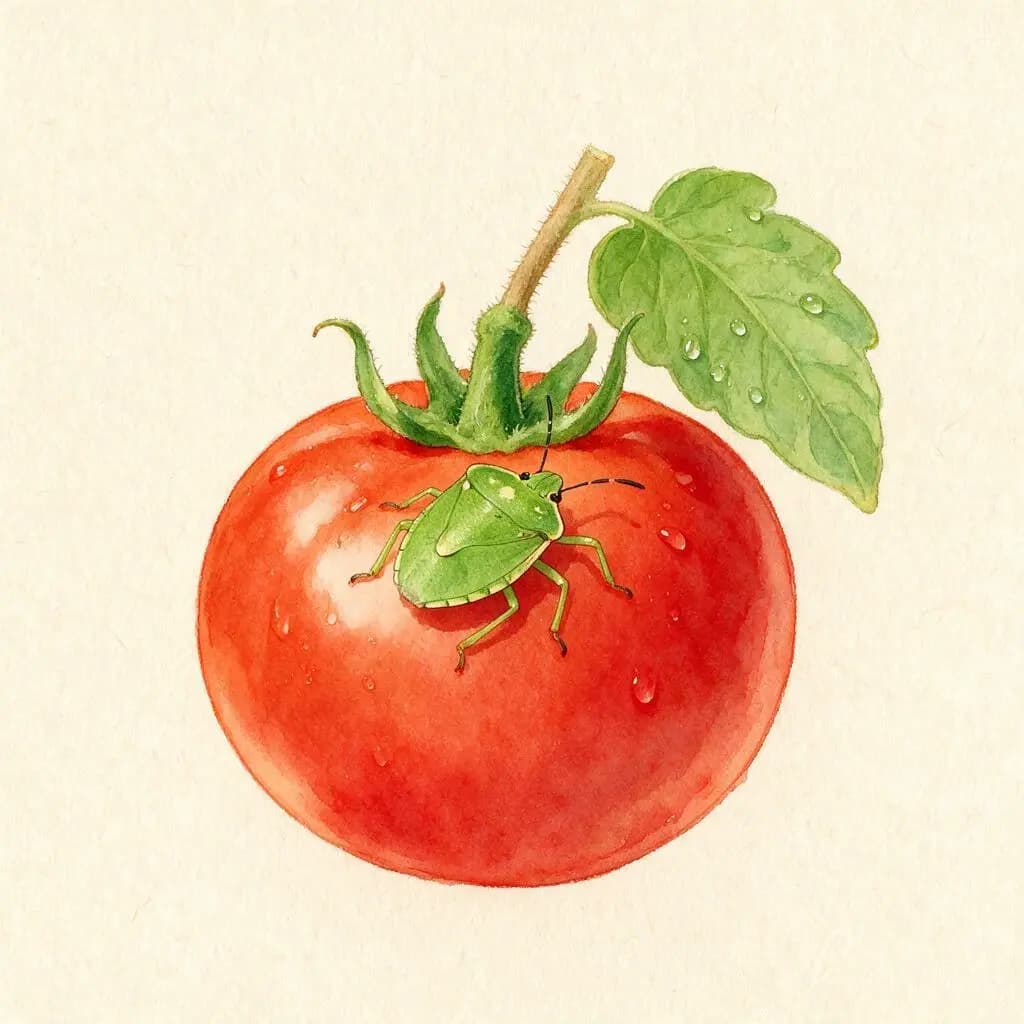
Shield bugs and stink bugs
Also known as: shield bugs, stink bugs, southern green stink bug, green vegetable bug, Nezara viridula, harlequin bug, cabbage bug, Eurydema
Shield-shaped bugs, green or brightly patterned, that pierce fruit and leaves to suck the sap. They cause hard patches, corky areas and misshapen fruit, and give off an unpleasant smell when touched. The first step is to pick them off by hand at dawn and squash the egg clusters.
Its best ally
Parasitic wasp
A natural predator that helps to keep this pest under control. Tap to see how to attract it.

How to recognise it at every stage
Shares your gardenThey like your tomatoes, beans and cabbages: they pierce the fruits and leave marks.
Life cycle: Incomplete metamorphosis: egg (1 week), five nymphal stages (4-5 weeks) and adult. Two to four generations a year; adults overwinter in hiding, and in autumn the green shield bug turns brown.
Tap a stage to see it full size. The photos are AI reference images checked against real photographs; stages without a reliable photo are shown as text only.
Life-stage calendar
| Jan | Feb | Mar | Apr | May | Jun | Jul | Aug | Sep | Oct | Nov | Dec | |
|---|---|---|---|---|---|---|---|---|---|---|---|---|
| Egg clutch | ||||||||||||
| Nymphs | ||||||||||||
| Adult |
Approximate months for mainland Spain; in cold areas they start later and in warm areas they last longer. Garden creatures this month
- 1Protect your plants
Egg clutch
· 1.2 mm per eggA hexagonal raft of 30 to 130 barrel-shaped eggs with lids, cream or yellowish, turning pink.
- Where to find it
- On the undersides of tomato, bean, pepper and aubergine leaves.
- When: May–Sep
- What to do
- This is the easiest stage to remove: take off the leaf with the clutch or peel off the raft.
- 2Protect your plants
Nymphs
· 1-10 mmNewly hatched ones are orange and huddle on the eggshells; then black and round with white and orange spots; the older ones green with rows of white, yellow and pink dots. No wings.
- Where to find it
- Grouped on leaves and green fruits.
- When: Jun–Oct
- What to do
- Shake them off in the morning, while they are still, over a container and take them far away. Mesh keeps them off the fruits.
- Often confused with
- Shield bug nymphs versus ladybirds. Young nymphs are black with spots like a ladybird, but they are flat, have a sucking beak and long antennae. See profile
- 3Keep an eye on it
Adult
· 12-15 mmSmooth green shield with three pale dots along the front edge; reddish-brown in autumn. It smells strongly if disturbed.
- Where to find it
- On fruits and pods; in winter, in cracks, reed screens and houses.
- When: May–Nov
- What to do
- Watch the fruits in summer. Trap plants (mustard, sunflower) along the edge attract many and protect the crop.
- Often confused with
- Ally bugs (Rhynocoris, Nabis, Orius). Slimmer, with a strong curved beak pointing forward; they hunt caterpillars, aphids and thrips. Leave them. See profile
- Green shield bug (Palomena prasina). Green and finely pitted, with dark wing membranes. It lives more on shrubs and hazels.
Often confused with
- Shield bug nymphs versus ladybirds. Young nymphs are black with spots like a ladybird, but they are flat, have a sucking beak and long antennae. See profile
- Ally bugs (Rhynocoris, Nabis, Orius). Slimmer, with a strong curved beak pointing forward; they hunt caterpillars, aphids and thrips. Leave them. See profile
- Green shield bug (Palomena prasina). Green and finely pitted, with dark wing membranes. It lives more on shrubs and hazels.
How to recognise it (symptoms)
- Yellowish or light brown patches on the fruit (tomato, pepper, beans)
- Misshapen fruit with corky areas inside when cut open
- Bean pods with aborted seeds
- Green shield-shaped adults and brightly coloured nymphs in groups
Crops affected
 TomatoMarmande tomato, flattened and ribbed, a good size for salads.
 PepperCalifornia Wonder pepper, a blocky bell type with thick flesh, for stuffing or eating fresh.
 BeansA dwarf green bean that does not need a support and is easy to grow in a bed.
- Green beansA dwarf green bean that does not need a support and is easy to grow in a bed.
 CabbageSavoy cabbage, with blistered, crinkled leaves, which grows sweeter with the cold; it does best in autumn…
 BroccoliCalabrese broccoli, with a compact green head.
 CauliflowerA classic cauliflower with a compact white curd.
 StrawberryA strawberry with large, firm, deep red fruit, very productive and early.
What favours it
- Long, hot summers, which allow several generations in a single season
- Woodland edges, fallow land and nearby wild vegetation, where they shelter
- Lack of rotation for Solanaceae and legumes
Prevention
- Check the undersides of the leaves and squash the eggs: they are small, barrel-shaped and laid in rows
- Encourage earwigs and insect-eating birds (nest boxes)
- Clear weeds from the edges in spring
- Use insect-proof mesh on seed trays and young crops
Organic treatment
Always start here: these remedies are kind to the garden, the soil and pollinators.
- First: collect them at dawn, when they are cold and sluggish, dropping them into soapy water, and squash the egg clusters on the undersides of the leaves
- A registered neem product (at the rate on its label) on young nymphs, at dusk
- Pheromone traps for particular species, such as Nezara, are useful for monitoring
- Natural pyrethrum, as a registered product, only for heavy infestations: it is toxic to bees and predators
Don't confuse it with…
Useful predatory bugs (Podisus, Perillus) look very similar. They can be told apart by their thick beak and pointed shoulders; if in doubt, do not kill them.
In-depth guide — shield bugs in the vegetable garden
Green shield bugs and brightly patterned bugs pierce fruit and leave corky patches. The key is to spot the eggs and nymphs before they become flying adults.
Recognising eggs and nymphs
The eggs are on the undersides of the leaves, in groups: they are small, pale and barrel-shaped. Squash the clusters with a gloved finger.
Hand-picking
Go out into the garden at dawn, when they are slow. Take a jar of soapy water and drop them in carefully, because they give off a very unpleasant smell.
Protecting the crop
- Fine insect-proof mesh on seed trays and young plants.
- Rotation: do not grow tomatoes, peppers and beans one after another on the same plot.
- Clear edges and fallow ground in spring.
Allies and traps
- Nest boxes for insect-eating birds around the edges.
- Podisus and Perillus are useful predators: do not mistake them for pest bugs.
- Pheromone traps to monitor Nezara in large gardens.
If the fruit is already damaged
Eat spotted tomatoes and peppers soon, cutting away the damaged part, and do not keep them for preserving. Step up monitoring of those crops the following year.
Use plant protection products responsibly, even organic ones. Always read and follow the label, the doses and the harvest interval, and never treat plants in flower or while bees are flying, in order to protect pollinators. If in doubt, put prevention and organic methods first.

In the plant catalogue you'll see what to plant, how and when: a well-tended plant resists pests much better.