
Solitary bees: a hotel with tubes of the right diameters
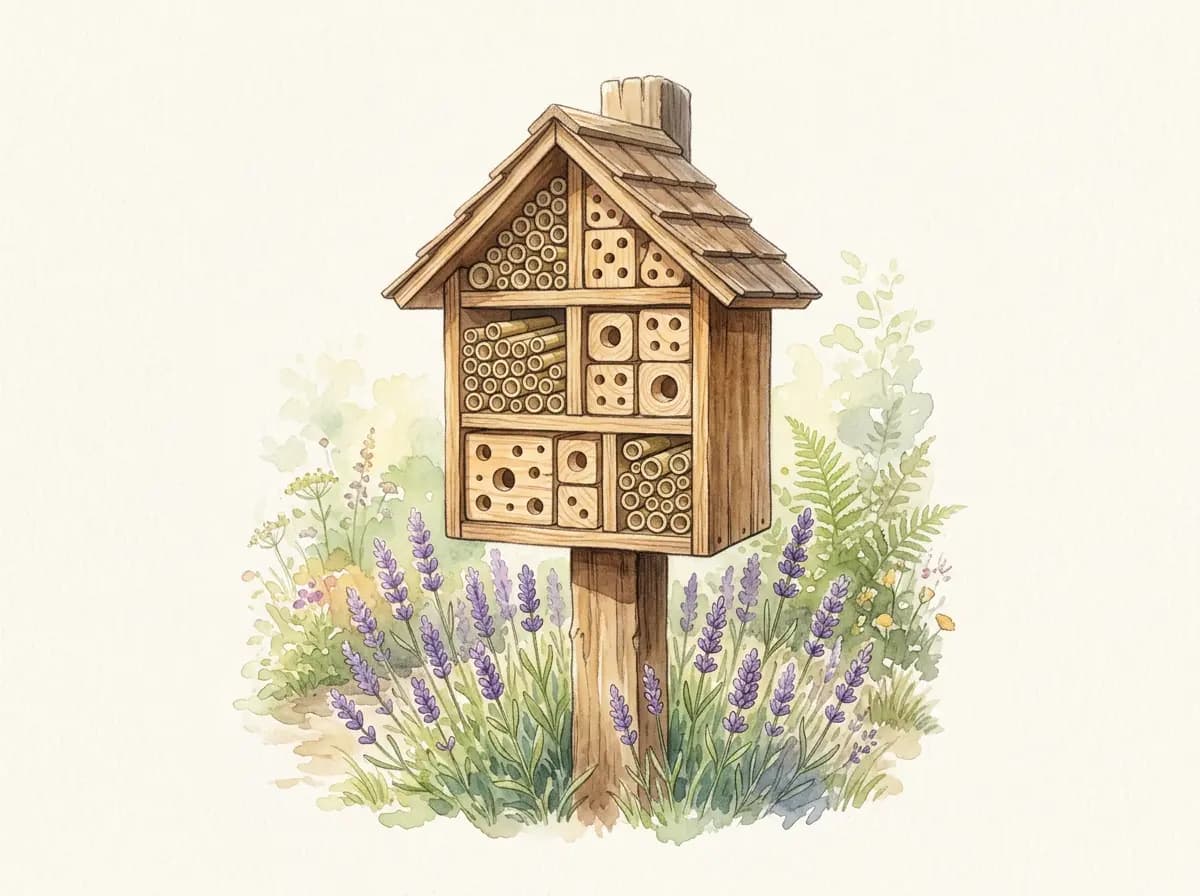
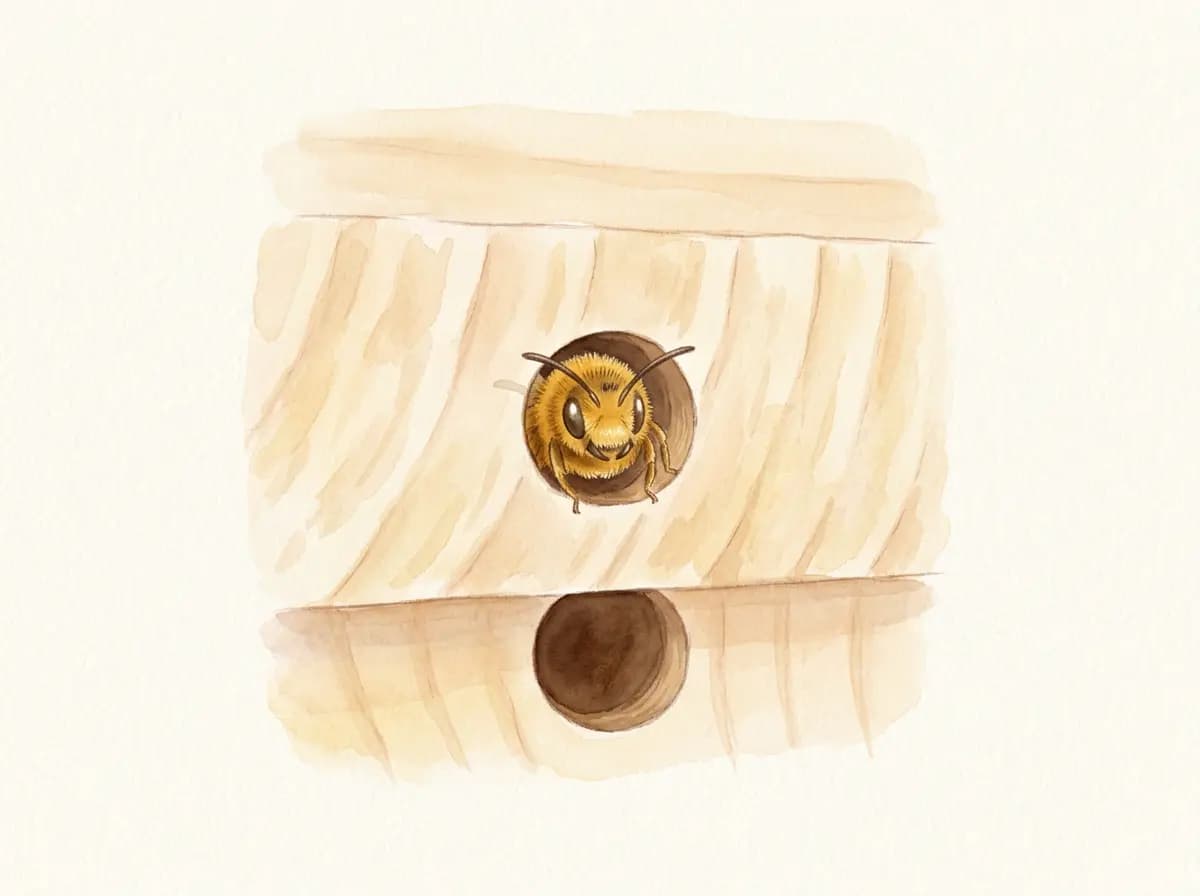
Most bees do not live in a hive: they are solitary, do not swarm and almost never sting. Each female makes her own nest in a tube or cavity, fills it with pollen and seals it with mud or leaves. A good hotel with tubes of the right diameter, well made, helps them a lot; a badly made one is a trap.
- Difficulty: medium
- Diameters: 3, 4, 6, 8 and 10 mm; the most useful are 6 and 8 mm
- Profile: Honey bee
What it helps with
- They pollinate fruit trees, broad beans, courgettes and strawberries, often more effectively than the honey bee.
- They are not aggressive: they do not defend a hive and the females only sting if you squeeze them.
- They turn a small space into a home for species of Osmia, Megachile, Hylaeus and others.
Materials
- Untreated wooden frame with a sloping roof and closed back (see measurements)
- Solid, dry canes or bamboo, cut just behind a node (to have a closed end)
- Blocks of dry hardwood (oak, beech, ash, olive), unvarnished
- Sharp wood drill bits of 3, 4, 6, 8 and 10 mm
- Paper or cardboard tubes to replace each year (optional)
- Fine sandpaper, chicken-wire mesh (to protect from birds) and screws
- A pile of damp clay nearby (or a mud puddle) for the bees that seal with mud
Measurements
- Diameters
- 3, 4, 6, 8 and 10 mm; the most useful are 6 and 8 mm
- Depth
- at least 10 cm; better 15 cm (up to 20 cm for 8–10 mm tubes)
- Back
- always closed: do not drill through the wood; in canes, the natural node at the back
- Spacing
- between holes, 2–3 times their diameter
- Frame
- approx. 30 × 36 cm front and 20 cm deep, with a roof overhanging by 10 cm
- Height
- 1 to 1.5 m, facing south or south-east
Diagram drawn by a program with the same measurements as the table. The figures are indicative: each author proposes slightly different values.
Step by step
1. Make the frame
A wooden box of about 30 × 36 cm at the front and 20 cm deep, with the back closed and a sloping roof overhanging about 10 cm at the front to protect from rain. The back must be properly closed: no draughts can get through.

2. Drill the blocks
In blocks of dry hardwood drill holes of 3, 4, 6, 8 and 10 mm in the side face (not in the end of the log, so it does not crack). 10–15 cm deep and not all the way through. Drill slowly and with a sharp bit so the hole is not left with splinters; run fine sandpaper or a pipe cleaner brush inside.

3. Cut the canes
Cut canes or bamboo just behind a node, 15 cm long, with a fine saw or a sharp cutter, so the mouth does not splinter. Sand the entrance edge. Bundle them tightly, all with the mouth outwards and the node at the back.

4. Fill the frame by diameter
Alternate canes and blocks of various diameters. Pack them so nothing moves. Cover the front with chicken-wire mesh set 3–4 cm from the tubes so birds cannot peck at them.

5. Place it in the morning sun
Fix it to a wall or firm post, at 1–1.5 m, facing south or south-east and with the entrance clear of branches. It must not swing. Next to flowering plants and with a patch of damp mud nearby.

6. Watch without opening
In spring you will see females go in with pollen and seal the tubes with mud (Osmia) or with little pieces of leaf (Megachile). Take photos and enjoy it; do not open or move occupied tubes.

How to recognise it at every stage
PollinatorPollinator: essential for courgettes, melons, fruit trees and strawberries.
Life cycle: Complete metamorphosis, always inside the hive: egg (3 days), larva (6 days) and pupa in a cell capped with wax. A worker takes 21 days from egg to adult, a queen 16 and a drone 24. The colony lives for several years.
Tap a stage to see it full size. The photos are AI reference images checked against real photographs; stages without a reliable photo are shown as text only.
Life-stage calendar
| Jan | Feb | Mar | Apr | May | Jun | Jul | Aug | Sep | Oct | Nov | Dec | |
|---|---|---|---|---|---|---|---|---|---|---|---|---|
| Egg | ||||||||||||
| Larva | ||||||||||||
| Pupa (capped brood) | ||||||||||||
| Adult (worker) | ||||||||||||
| Swarm |
Approximate months for mainland Spain; in cold areas they start later and in warm areas they last longer. Garden creatures this month
- 1Protect it
Egg
· 1.5 mmA white grain, like rice, standing upright at the bottom of each hexagonal wax cell.
- Where to find it
- Inside the hive (in the brood comb).
- When: Feb–Oct
- What to do
- You will only see it if you keep hives: the queen lays up to 1,500 eggs a day in spring.
- 2Protect it
Larva
White, pearly larvae, curled in a C shape at the bottom of the open cells.
- Where to find it
- Inside the hive.
- When: Feb–Oct
- What to do
- The workers feed them with royal jelly, pollen and honey. More flowers nearby = a stronger hive.
- 3Protect it
Pupa (capped brood)
Cells capped with brown wax; inside, a white bee whose eyes gradually darken.
- Where to find it
- Inside the hive.
- When: Feb–Oct
- What to do
- Nothing is needed: in about 12 days a new bee comes out, chewing through the cap.
- 4Protect it
Adult (worker)
· 12-15 mmAbdomen with brownish-golden and dark bands, hairy thorax; often with pellets of pollen on the back legs.
- Where to find it
- On flowers: borage, rosemary, lavender, fruit trees, courgette.
- When: Feb–Nov
- What to do
- Protect it: never spray with the flower open or during flying hours, and leave shallow water with stones.
- Often confused with
- Hoverflies. They are flies: one pair of wings, huge eyes, short antennae, and they hover in mid-air. They do not sting. See profile
- Wasps (Vespula, Polistes). Shiny yellow and black, hairless, with a very marked waist. They are drawn to ripe fruit and meat.
- Solitary bees (Osmia, Andrena…). Smaller or hairier, they do not make a hive: they nest in canes, holes or the ground. They are pollinators too.
Nests, egg clutches and shelters
- Protect it
Swarm
A brown cluster of thousands of bees hanging from a branch or a wall, the size of a ball. They are calm.
- Where to find it
- On branches, hedges, lampposts or wall cavities, normally in spring.
- When: Apr–Jun
- What to do
- Do not spray it or disturb it: call a beekeepers' association, the town hall or the fire brigade to collect it.
Often confused with
- Hoverflies. They are flies: one pair of wings, huge eyes, short antennae, and they hover in mid-air. They do not sting. See profile
- Wasps (Vespula, Polistes). Shiny yellow and black, hairless, with a very marked waist. They are drawn to ripe fruit and meat.
- Solitary bees (Osmia, Andrena…). Smaller or hairier, they do not make a hive: they nest in canes, holes or the ground. They are pollinators too.
Where and when to put it
- Put it up in winter or early spring (February–March), before the first bees wake.
- Morning sun, sheltered from rain and wind.
- A few metres from flowers and plants with nectar and pollen: lavender, rosemary, borage, phacelia.
- Away from places with too much mould or waterlogging.
Maintenance
- Do not clean tubes sealed with mud. In autumn or winter, remove occupied cardboard or paper tubes and keep them in a cool, dry shed, in a ventilated container protected from mice and birds, until spring.
- Every 1–2 years, replace old or mouldy tubes with new ones. New ones go next to the old ones.
- Remove the old tubes after two springs, when all the bees have emerged.
- Watch for mould or moth grubs; if there are any, replace the affected filling.
- Always keep flowers and a little damp mud available in spring.
Common mistakes
What comes up most often, so you can avoid it from the start.
Using tubes with no back, open at both ends.
The female needs a tube closed at the back to build her cells one after another. With a draught the nest dries out and the young die, so they almost never occupy them.
Using canes or bamboo that are splintered inside or at the mouth.
Splinters tear the bees’ wings as they come and go, and so they avoid those tubes. Sand the mouth and use cleanly cut canes, just behind a node.
Making holes that are too short, under 10 cm.
The bee lays the females at the back of the tube and the males near the entrance. In a short tube only the back part fits, and mostly males are born.
Making all the holes the same diameter, or very wide (more than 10 mm).
Each species looks for a hole of its own size, from 3 to 10 mm. With a single size you only attract one species, and the widest holes are hardly used by any.
Using treated, varnished or painted wood.
Wood treatments are toxic to the larvae, which spend months shut inside the tube. Use untreated wood.
Drilling into the cut end of a log or leaving splinters inside the hole.
The cut end (end grain) cracks as it dries, water gets in and the nests open up. Drill into the side of the wood and clean each hole well.
Placing the hotel in shade, facing north, with no roof, on the ground or hanging so that it swings.
Bees need the morning sun to warm up and start flying; without a roof the nests get wet; on the ground there is damp and creatures that eat them; and if it swings, they do not occupy it.
Filling the hotel with pine cones, loose straw or thick cardboard.
That filling suits ladybirds or lacewings, but not solitary bees, which only breed inside a tube or hole closed at the back.
Putting the tubes inside a closed plastic bottle.
Plastic does not let moisture out: drops form inside, mould appears and the larvae die.
Buying cocoons or bees in a kit to release them.
They may be another species or bring parasites that pass to the local bees. The ones in your area arrive on their own if the hotel is well made and has flowers nearby.
Plants that help
 LavenderA Mediterranean aromatic shrub with blue-violet spikes much loved by bees, indispensable in dry gardens and…
It flowers in summer for weeks and is one of the plants with the most bee visits in the whole garden.
 RosemaryA Mediterranean shrub that is very tough once established.
It flowers from winter to spring, just when the first solitary bees of the year come out and there are hardly any flowers.
 BorageA leaf and flower vegetable, very hardy and typical of Aragon and Navarre in northern Spain, where the stems…
Its blue flowers fill with nectar very quickly and flower in spring; it also self-seeds every year.
 PhaceliaA green manure with violet-blue flowers that grows fast and attracts bees like few other plants.
It flowers 6–8 weeks after sowing and gives a lot of pollen, the food the bee stores in each cell for her young.
 ThymePerennial thyme for poor, dry soil, ideal for sunny borders.
Its small flowers, in spring, are made to measure for the smallest solitary bees.
 SageCommon sage is a woody subshrub with velvety, very aromatic grey-green leaves and spikes of violet flowers…
It flowers at the end of spring; its tube-shaped flowers are much visited by long-tongued bees.
More information on the site
Sources
The measurements are a synthesis of these conservation guides; where each author gives different figures, they appear as a range.