
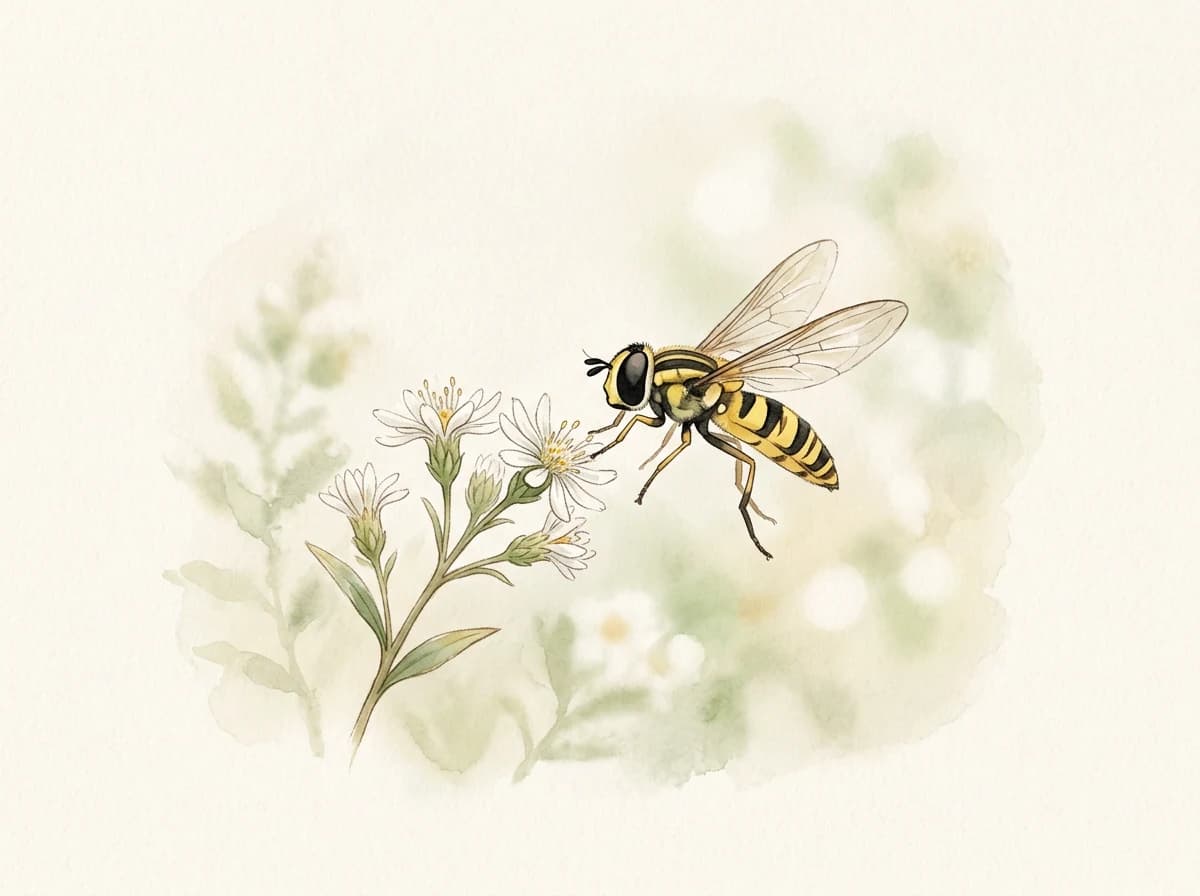
Hoverfly
Syrphus ribesii and others
Also called: flower fly, syrphid fly, hover fly, harmless wasp mimic, Syrphidae
They look like wasps but are harmless flies that hang motionless in the air. The adult pollinates (it is one of the most important pollinators after bees) and the larva eats hundreds of aphids.

How to recognise it at every stage
Garden allyGarden ally and pollinator: the larvae eat aphids and the adults visit flowers.
Life cycle: Complete metamorphosis: egg (2-3 days), larva (1-2 weeks), pupa (1-2 weeks) and adult. In warm weather, from egg to adult in under a month, with several generations a year.
Tap a stage to see it full size. The photos are AI reference images checked against real photographs; stages without a reliable photo are shown as text only.
Life-stage calendar
| Jan | Feb | Mar | Apr | May | Jun | Jul | Aug | Sep | Oct | Nov | Dec | |
|---|---|---|---|---|---|---|---|---|---|---|---|---|
| Egg | ||||||||||||
| Larva | ||||||||||||
| Pupa | ||||||||||||
| Adult |
Approximate months for mainland Spain; in cold areas they start later and in warm areas they last longer. Garden creatures this month
- 1Protect it
Egg
· 1 mmA white, elongated, loose egg with a finely sculpted surface (under a hand lens).
- Where to find it
- Lying on the leaf, in the middle of or at the edge of an aphid colony.
- When: Mar–Oct
- What to do
- Leave it be: the female lays it right where its larva will have food.
- 2Protect it
Larva
· 8-12 mmA little "slug" with no legs and no visible head, translucent (greenish, whitish or brown), narrower at the front. It lifts the front end to catch aphids and suck them dry.
- Where to find it
- Inside aphid colonies, on shoots and leaf undersides.
- When: Mar–Oct
- What to do
- Protect it: each larva eats about 400 aphids. Do not mistake it for a slug or a caterpillar, and do not wash those leaves with soap.
- Often confused with
- Hoverfly larva versus slug or caterpillar. The slug has tentacles and leaves slime; the caterpillar has a hard head and legs. The hoverfly larva has neither head nor legs, and sits in the middle of the aphids.
- 3Protect it
Pupa
· 6-8 mmA smooth drop or teardrop, greenish or brown, with no legs, stuck on by the wide end.
- Where to find it
- On leaves, stems and on the ground under the plant.
- When: Apr–Oct
- What to do
- Leave it: an adult hoverfly will come out in a week or two.
- 4Protect it
Adult
· 8-12 mmA fly with yellow or orange and black bands, like a wasp, but with a single pair of wings, huge eyes, short antennae and no waist. It stays still in the air ("hovering").
- Where to find it
- On open, flat flowers: umbellifers, marigold, sweet alyssum, daisy-family plants.
- When: Feb–Nov
- What to do
- Protect it: it does not sting. Sow small flowers in succession so it has nectar and pollen all year.
- Often confused with
- Adult hoverfly versus wasp or bee. The hoverfly is a fly: one pair of wings, eyes taking up almost the whole head, very short antennae, no waist and no sting. It hovers in mid-air and darts about suddenly.
Often confused with
- Adult hoverfly versus wasp or bee. The hoverfly is a fly: one pair of wings, eyes taking up almost the whole head, very short antennae, no waist and no sting. It hovers in mid-air and darts about suddenly.
- Hoverfly larva versus slug or caterpillar. The slug has tentacles and leaves slime; the caterpillar has a hard head and legs. The hoverfly larva has neither head nor legs, and sits in the middle of the aphids.
What it eats
- Larva: aphids (hundreds per larva), thrips, young scale insects.
- Adult: nectar and pollen. An excellent pollinator.
How it helps in the garden
How to attract this ally to your garden
- Simple, open yellow and white flowers: marigold, daisy, tagetes, cosmos and coriander in flower.
- Always keep something in flower from March to October: without nectar, the adult hoverflies and lacewings leave the garden.
- A saucer or very shallow pond with stones: on hot days the adults drink there without risk of drowning.
Plants in the catalogue that attract it
 Pot marigold (calendula)An annual with almost continuous orange or yellow edible flowers that self-sows year after year with hardly…
 Shasta daisyA perennial with large white daisies with yellow centres all summer long, very easy to grow.
 French marigoldA compact marigold, widely used in the vegetable garden alongside tomatoes.
 CosmosA free-flowering annual with feathery foliage, bearing flowers in shades of pink, white or crimson all…
 CorianderAn annual coriander, grown for its leaves and for its seed.
What to avoid so you do not harm it by accident
- Mistaking them for wasps and killing them: they neither sting nor bite. If one lands on your arm, it will leave on its own.
- Systemic insecticides: they build up in the flowers and kill the adult.
How to recognise it
Body with yellow and black bands (wasp mimicry), a single pair of wings (wasps have two pairs), large eyes and the ability to stay motionless in mid-air.
Risk to people: None. They do not sting or bite, even though they look like wasps.
Many allies are protected by Spanish law: do not capture or keep in captivity toads, hedgehogs, bats or native reptiles. Attract them, watch them and thank them from a distance. Rules in other countries differ: check your local regulations.

Allies do better if the garden is varied. Learn to identify each visitor and to prevent problems with good habits.