
Hoverflies: flowers and the “hoverfly lagoon”
Hoverflies look like little wasps but do not sting. The larvae of many species eat aphids and the adults pollinate. They are attracted with simple flowers and, for the species with aquatic larvae, with a “hoverfly lagoon”.
- Difficulty: easy
- Hoverfly lagoon: 10–20 L, with 1/3 plant matter and 2/3 rainwater, 20–30 cm deep
- Profile: Hoverfly
What it helps with
- The larvae of many species (such as Episyrphus or Sphaerophoria) feed on aphids.
- The adults are very active pollinators.
- The “hoverfly lagoon” lets you rear the species whose larvae live in water with decomposing plant matter.
Materials
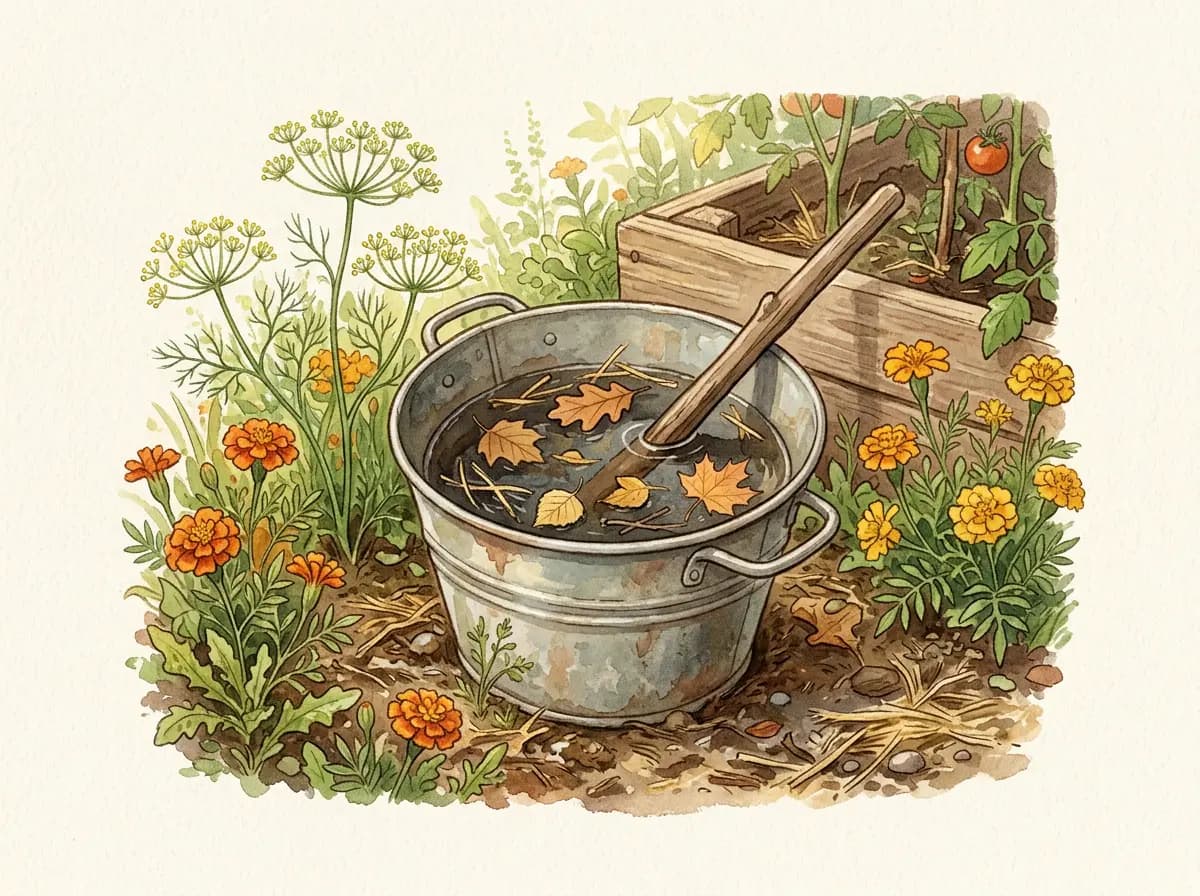
- A leak-free bucket, pail or planter of 10–20 L
- Leaves, cut grass, straw or tender prunings
- Rainwater
- A stick or sloping branch as an exit ramp
- Stones so it does not tip over and a mesh to stop other animals drowning
- Border flowers: dill, coriander, calendula, sweet alyssum, phacelia, chamomile
Measurements
- Hoverfly lagoon
- 10–20 L, with 1/3 plant matter and 2/3 rainwater, 20–30 cm deep
- Ramp
- a stick sloping from the bottom to the rim
- Distance from the house
- at least 3–5 m (it smells when it matures)
- Flowering border
- 50 cm wide at least, with open, flat flowers
Step by step
1. Choose the container
A 10–20 L bucket, plastic or clay, with no holes. Put it in a partly shaded corner, at a distance from the house because, as it matures, it smells of decomposing matter.

2. Fill it with leaves and water
Put in a third of leaves, cut grass or straw, and top up with rainwater until it covers the material. Leave a sloping branch as a ramp so insects can get out.

3. Wait and maintain
After a few weeks the water turns dark and the females of some species lay eggs on the surface; the larvae (“rat-tailed maggots”) live at the bottom, among the leaves, and breathe through a long, thin tube that they push up to the surface. Add rainwater if the level drops.

4. Plant flowers for the adults
Adults go to open, shallow flowers: dill, coriander, calendula, chamomile, sweet alyssum, phacelia, yarrow. Sow in batches to have flowers from spring to autumn.

5. Leave some aphids
The females lay their eggs next to aphid colonies. If you clear them all, they will have nowhere to lay.

Hoverfly or mosquito larvae? How to tell them apart
A bucket with water and leaves can rear both. Look inside calmly, without stirring, and notice where they are and how they move.

Hoverfly (“rat-tailed” larva)
- Grey or brown, plump, like a worm of 1 to 2 cm.
- It has a long, thin tube at the back, the “tail”, which it stretches to the surface to breathe.
- It lives at the bottom, tucked among the rotting leaves, and moves slowly.
- It is the one you are looking for: leave it in peace.
Mosquito
- Thin and small, under 1 cm.
- It hangs head-down just under the surface, where it breathes.
- If you come close or block the light, it dives to the bottom in jerks and comes back up.
- Next to them you will see comma-shaped pupae that also move: the mosquitoes come out of those.
How to stop it breeding mosquitoes
Mosquitoes lay their eggs in still, open water. Hoverfly larvae, on the other hand, live in the mud of wet leaves. With these measures the bucket still serves hoverflies and hardly serves mosquitoes.

- 1Fill the bucket to the top with leaves and grass and add just enough water to soak everything, without a layer of clean water on top.
- 2Check the surface once a week, especially from May to October.
- 3If you see mosquito larvae, stir the water well and add more leaves, or throw the top layer onto dry soil or into the compost: out of the water they die.
- 4If they appear again, cover the bucket with a well-secured insect screen. Bear in mind that the mesh also keeps out most hoverflies, so while it is on it will breed few.
- 5Another option is a biological product against mosquito larvae based on Bti (Bacillus thuringiensis israelensis), sold in garden centres, which acts on mosquito larvae, not on hoverfly larvae. Use the dose on the label.
When it is not advisable: on a balcony or city yard, next to windows or in areas with tiger mosquito if you cannot check it every week. The tiger mosquito breeds in very little water and bites by day. In those cases help hoverflies only with simple flowers and by leaving a few aphids, which is what counts most.
How to recognise it at every stage
Garden allyGarden ally and pollinator: the larvae eat aphids and the adults visit flowers.
Life cycle: Complete metamorphosis: egg (2-3 days), larva (1-2 weeks), pupa (1-2 weeks) and adult. In warm weather, from egg to adult in under a month, with several generations a year.
Tap a stage to see it full size. The photos are AI reference images checked against real photographs; stages without a reliable photo are shown as text only.
Life-stage calendar
| Jan | Feb | Mar | Apr | May | Jun | Jul | Aug | Sep | Oct | Nov | Dec | |
|---|---|---|---|---|---|---|---|---|---|---|---|---|
| Egg | ||||||||||||
| Larva | ||||||||||||
| Pupa | ||||||||||||
| Adult |
Approximate months for mainland Spain; in cold areas they start later and in warm areas they last longer. Garden creatures this month
- 1Protect it
Egg
· 1 mmA white, elongated, loose egg with a finely sculpted surface (under a hand lens).
- Where to find it
- Lying on the leaf, in the middle of or at the edge of an aphid colony.
- When: Mar–Oct
- What to do
- Leave it be: the female lays it right where its larva will have food.
- 2Protect it
Larva
· 8-12 mmA little "slug" with no legs and no visible head, translucent (greenish, whitish or brown), narrower at the front. It lifts the front end to catch aphids and suck them dry.
- Where to find it
- Inside aphid colonies, on shoots and leaf undersides.
- When: Mar–Oct
- What to do
- Protect it: each larva eats about 400 aphids. Do not mistake it for a slug or a caterpillar, and do not wash those leaves with soap.
- Often confused with
- Hoverfly larva versus slug or caterpillar. The slug has tentacles and leaves slime; the caterpillar has a hard head and legs. The hoverfly larva has neither head nor legs, and sits in the middle of the aphids.
- 3Protect it
Pupa
· 6-8 mmA smooth drop or teardrop, greenish or brown, with no legs, stuck on by the wide end.
- Where to find it
- On leaves, stems and on the ground under the plant.
- When: Apr–Oct
- What to do
- Leave it: an adult hoverfly will come out in a week or two.
- 4Protect it
Adult
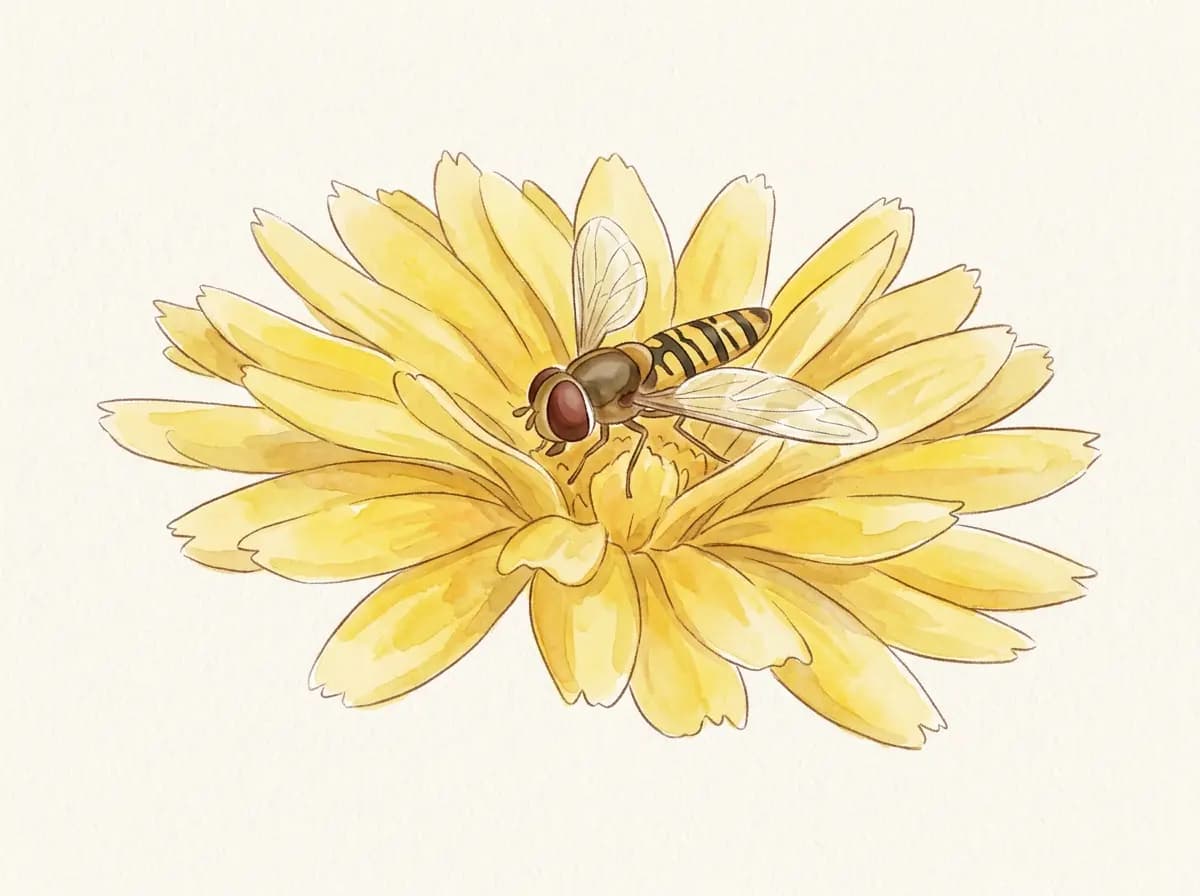
· 8-12 mmA fly with yellow or orange and black bands, like a wasp, but with a single pair of wings, huge eyes, short antennae and no waist. It stays still in the air ("hovering").
- Where to find it
- On open, flat flowers: umbellifers, marigold, sweet alyssum, daisy-family plants.
- When: Feb–Nov
- What to do
- Protect it: it does not sting. Sow small flowers in succession so it has nectar and pollen all year.
- Often confused with
- Adult hoverfly versus wasp or bee. The hoverfly is a fly: one pair of wings, eyes taking up almost the whole head, very short antennae, no waist and no sting. It hovers in mid-air and darts about suddenly.
Often confused with
- Adult hoverfly versus wasp or bee. The hoverfly is a fly: one pair of wings, eyes taking up almost the whole head, very short antennae, no waist and no sting. It hovers in mid-air and darts about suddenly.
- Hoverfly larva versus slug or caterpillar. The slug has tentacles and leaves slime; the caterpillar has a hard head and legs. The hoverfly larva has neither head nor legs, and sits in the middle of the aphids.
Where and when to put it
- Lagoon: from March to May, so that it is mature by summer.
- Flowers: sown in autumn and spring, staggered.
- Position: partial shade, away from the house and from places people walk.
Maintenance
- Top up rainwater in summer and add leaves at the end of spring.
- In autumn, let it cool down and, in winter, do not empty it if there are larvae.
- In spring remove the excess material and renew half.
- Look at the surface once a week: if mosquito larvae appear, follow the steps in the section “How to stop it breeding mosquitoes”.
Common mistakes
What comes up most often, so you can avoid it from the start.
Filling the bucket with tap water instead of rainwater.
The chlorine in tap water slows the decomposition of the leaves, which is what feeds the larvae. If you have no rainwater, let tap water stand for a couple of days before using it.
Leaving a layer of clean water on top of the leaves.
Still, clear water is exactly where mosquitoes lay. Keep the bucket full of soaked leaves, with very little free water.
Putting it right next to the terrace or the window.
When the leaves rot, the water smells bad. Put it 3–5 m from the house, in a corner you do not pass often.
Adding chemicals or cooked food scraps.
Chemicals poison the larvae, and cooked food rots differently, smells much worse and attracts rats and flies. All you need is leaves, grass and water.
Sowing only double garden flowers.
“Double” flowers have so many petals that they hide the centre of the flower, where the pollen and nectar are. Adult hoverflies cannot feed and leave.
Plants that help
 DillAn aromatic annual dill, grown for both its leaves and its seed.
Its umbrella flowers are open and shallow, perfect for the short tongues of hoverflies. It flowers in summer.
 CorianderAn annual coriander, grown for its leaves and for its seed.
If you let it bolt, it fills with little white flowers within a few weeks and hoverflies come straight away.
 CalendulaAn annual with almost continuous orange or yellow edible flowers that self-sows year after year with hardly…
It flowers almost all year; its simple, open-centred flowers give pollen when few flowers are left.
 Sweet alyssumA ground-covering plant with tiny, highly scented flowers in dense clusters, perfect for the edges of beds…
A low plant that flowers almost non-stop, with honey-scented little flowers; it works for borders and between vegetables.
 PhaceliaA green manure with violet-blue flowers that grows fast and attracts bees like few other plants.
It flowers 6–8 weeks after sowing and gives a huge amount of pollen, which hoverflies love.
 ChamomileCommon chamomile, grown for its flowers to make herbal tea.
Its open flowers, like little daisies, leave the pollen exposed in spring and summer.
More information on the site
Sources
The measurements are a synthesis of these conservation guides; where each author gives different figures, they appear as a range.