
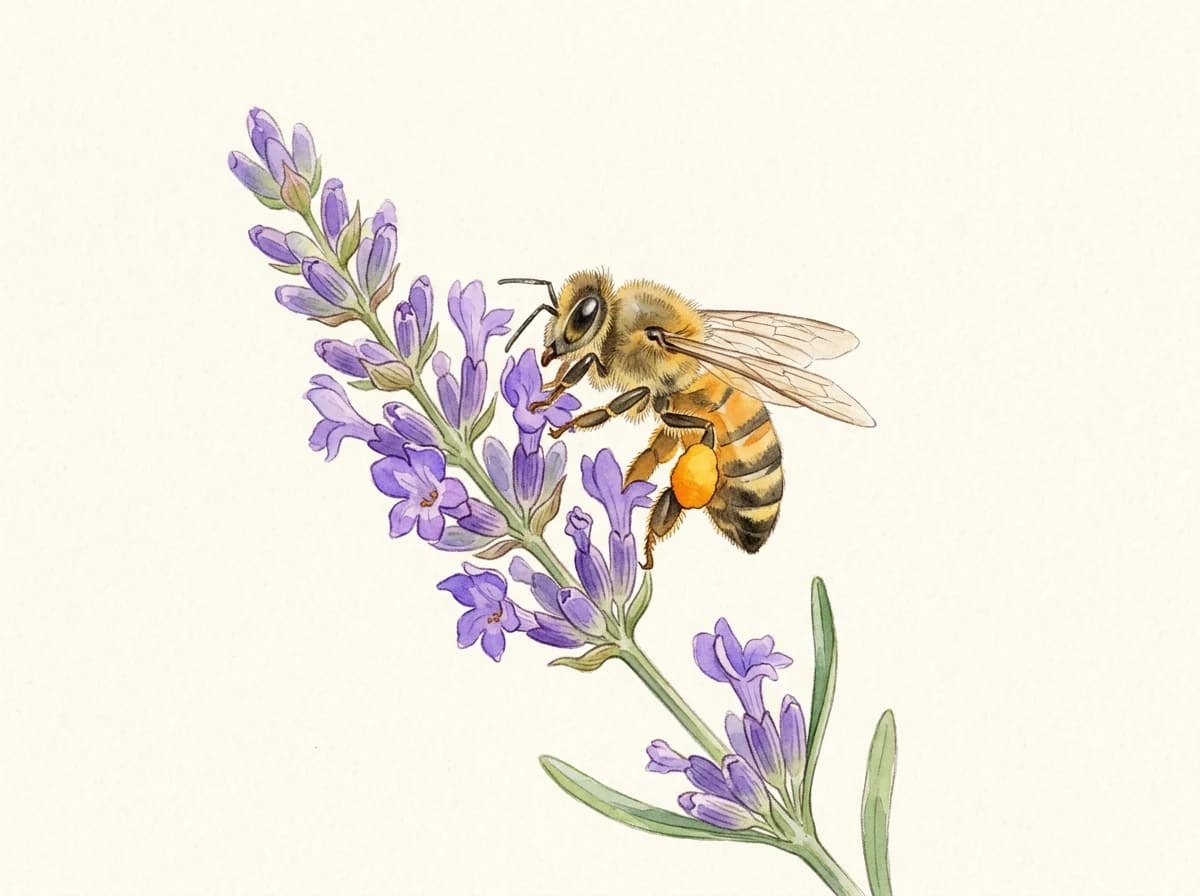
Honey bee
Apis mellifera
Also called: European honey bee, honeybee, bee, Apis mellifera
It is the best-known pollinator. Pollinating insects, with bees at the head, play a part in about a third of the food we eat. Without them we would get far fewer courgettes, pumpkins, strawberries, apples or cherries.

How to recognise it at every stage
PollinatorPollinator: essential for courgettes, melons, fruit trees and strawberries.
Life cycle: Complete metamorphosis, always inside the hive: egg (3 days), larva (6 days) and pupa in a cell capped with wax. A worker takes 21 days from egg to adult, a queen 16 and a drone 24. The colony lives for several years.
Tap a stage to see it full size. The photos are AI reference images checked against real photographs; stages without a reliable photo are shown as text only.
Life-stage calendar
| Jan | Feb | Mar | Apr | May | Jun | Jul | Aug | Sep | Oct | Nov | Dec | |
|---|---|---|---|---|---|---|---|---|---|---|---|---|
| Egg | ||||||||||||
| Larva | ||||||||||||
| Pupa (capped brood) | ||||||||||||
| Adult (worker) | ||||||||||||
| Swarm |
Approximate months for mainland Spain; in cold areas they start later and in warm areas they last longer. Garden creatures this month
- 1Protect it
Egg
· 1.5 mmA white grain, like rice, standing upright at the bottom of each hexagonal wax cell.
- Where to find it
- Inside the hive (in the brood comb).
- When: Feb–Oct
- What to do
- You will only see it if you keep hives: the queen lays up to 1,500 eggs a day in spring.
- 2Protect it
Larva
White, pearly larvae, curled in a C shape at the bottom of the open cells.
- Where to find it
- Inside the hive.
- When: Feb–Oct
- What to do
- The workers feed them with royal jelly, pollen and honey. More flowers nearby = a stronger hive.
- 3Protect it
Pupa (capped brood)
Cells capped with brown wax; inside, a white bee whose eyes gradually darken.
- Where to find it
- Inside the hive.
- When: Feb–Oct
- What to do
- Nothing is needed: in about 12 days a new bee comes out, chewing through the cap.
- 4Protect it
Adult (worker)
· 12-15 mmAbdomen with brownish-golden and dark bands, hairy thorax; often with pellets of pollen on the back legs.
- Where to find it
- On flowers: borage, rosemary, lavender, fruit trees, courgette.
- When: Feb–Nov
- What to do
- Protect it: never spray with the flower open or during flying hours, and leave shallow water with stones.
- Often confused with
- Hoverflies. They are flies: one pair of wings, huge eyes, short antennae, and they hover in mid-air. They do not sting. See profile
- Wasps (Vespula, Polistes). Shiny yellow and black, hairless, with a very marked waist. They are drawn to ripe fruit and meat.
- Solitary bees (Osmia, Andrena…). Smaller or hairier, they do not make a hive: they nest in canes, holes or the ground. They are pollinators too.
Nests, egg clutches and shelters
- Protect it
Swarm
A brown cluster of thousands of bees hanging from a branch or a wall, the size of a ball. They are calm.
- Where to find it
- On branches, hedges, lampposts or wall cavities, normally in spring.
- When: Apr–Jun
- What to do
- Do not spray it or disturb it: call a beekeepers' association, the town hall or the fire brigade to collect it.
Often confused with
- Hoverflies. They are flies: one pair of wings, huge eyes, short antennae, and they hover in mid-air. They do not sting. See profile
- Wasps (Vespula, Polistes). Shiny yellow and black, hairless, with a very marked waist. They are drawn to ripe fruit and meat.
- Solitary bees (Osmia, Andrena…). Smaller or hairier, they do not make a hive: they nest in canes, holes or the ground. They are pollinators too.
What it eats
- Nectar (energy)
- Pollen (protein for the larvae)
How to attract this ally to your garden
- Blue, purple and yellow flowers (they see them best): lavender, sage, borage, hyssop, rosemary, thyme, alyssum and phacelia.
- Stagger flowering throughout the year: there are lean periods, especially in midsummer and in winter.
- Set up a safe drinking spot with a saucer, stones and damp moss so they can drink without drowning.
- Let the "weeds" flower: dandelion, thistle, white dead-nettle.
Plants in the catalogue that attract it
 English lavenderA Mediterranean aromatic shrub with blue-violet spikes much loved by bees, indispensable in dry gardens and…
 Pineapple sageA perennial Salvia whose leaves have a fruity pineapple scent.
 BorageA leaf and flower vegetable, very hardy and typical of Aragon and Navarre in northern Spain, where the stems…
 HyssopHyssop is a compact, woody sub-shrub with narrow, aromatic leaves and spikes of blue, pink or white flowers…
 RosemaryA Mediterranean shrub that is very tough once established.
 ThymePerennial thyme for poor, dry soil, ideal for sunny borders.
 PhaceliaA green manure with violet-blue flowers that grows fast and attracts bees like few other plants.
 DandelionA wild plant of meadows, roadsides and vegetable gardens.
 CardoonThe same species as the globe artichoke, it is grown for its blanched leaf stalks, a Christmas dish in the…
What to avoid so you do not harm it by accident
- Neonicotinoids and any systemic insecticide: they build up in nectar and pollen.
- Do not treat plants with the flower open, not even with organic products: you can kill bees and hoverflies that are feeding.
- Do not prune all the hedges at once in winter: you leave the beneficial insects that hibernate in them without shelter.
How to recognise it
10-15 mm, body covered in fine hairs, 4 wings, yellow-brown bands more muted than a wasp's. They carry yellow or orange pellets on their back legs (pollen).
Risk to people: They only sting if they feel threatened. The honey bee dies after stinging. If you do not bother them, they will do nothing to you. Anyone allergic to stings should be extra careful and keep their treatment to hand.
Many allies are protected by Spanish law: do not capture or keep in captivity toads, hedgehogs, bats or native reptiles. Attract them, watch them and thank them from a distance. Rules in other countries differ: check your local regulations.

Allies do better if the garden is varied. Learn to identify each visitor and to prevent problems with good habits.