
Ground beetles and spiders: piles of stones and wood
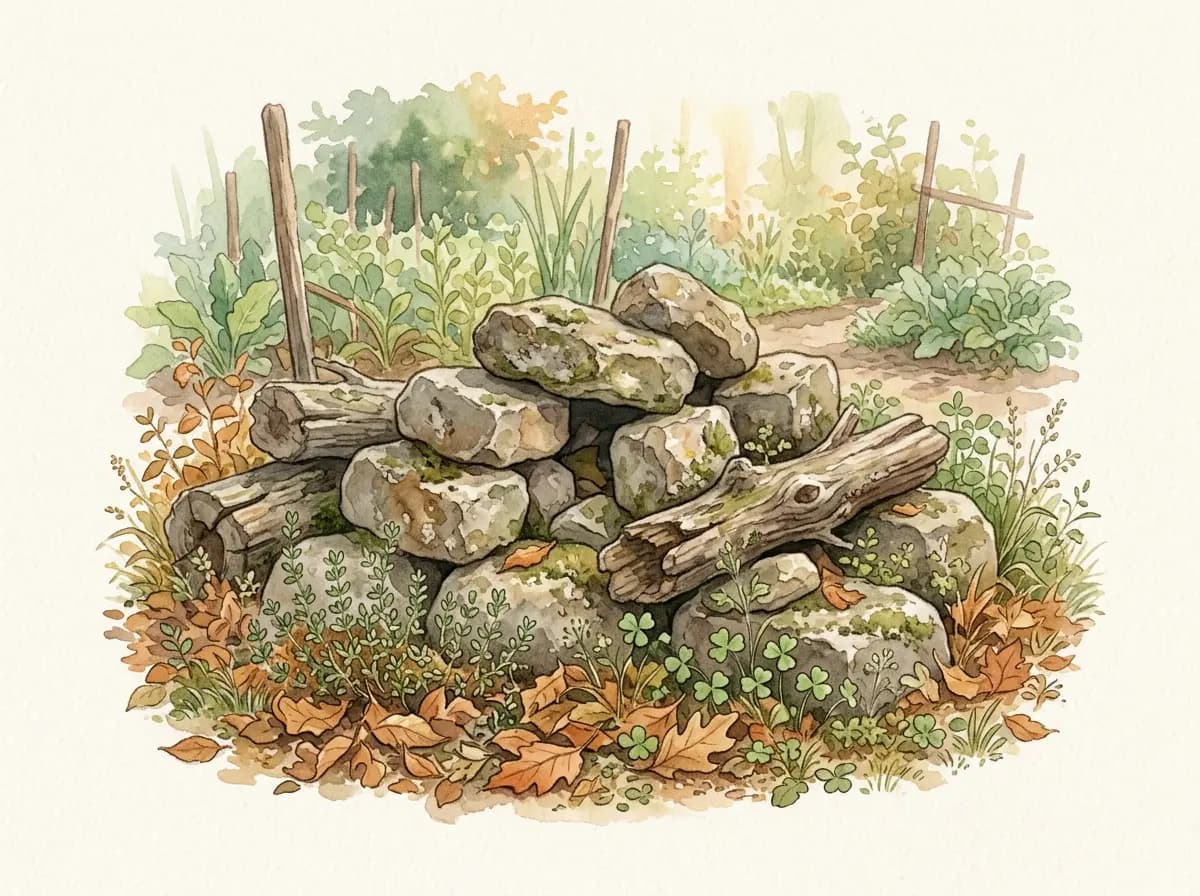
Ground beetles (carabids) and spiders hunt at night on the ground: insect eggs and larvae, small slugs, young caterpillars. A corner of stones, wood and leaf litter is enough for them to hide by day and spend the winter.
- Difficulty: easy
- Pile of stones and wood: approx. 1 m long × 50 cm wide × 40–50 cm high
- Profile: Ground beetle (hunter beetle)
What it helps with
- Ground beetles eat larvae, eggs, slugs and small snails.
- Spiders keep down flies, winged aphids, small caterpillars and mosquitoes.
- An untouched corner improves the soil and biodiversity.
Materials
- Stones of different sizes (10–30 cm)
- Logs and thick branches of untreated wood
- Leaf litter, bark and straw
- Low plants such as thyme or clover to cover the edge
Measurements
- Pile of stones and wood
- approx. 1 m long × 50 cm wide × 40–50 cm high
- Gaps
- 2 to 10 cm between stones and logs
- Grassy bank (optional)
- 1.5–2 m wide and 40 cm high, with clumps of grasses
Step by step
1. Choose a quiet corner
A little-visited spot, in partial shade or with morning sun, near the beds.

2. Make the base
Lay thick logs and large stones on the ground, leaving gaps between them. There is no need to dig.

3. Add layers
Put branches, bark, smaller stones and leaf litter on top. Leave gaps of 2–10 cm where they can get in.

4. Cover the edges with plants
Low plants (thyme, clover, stinging nettle) around it. If you like, a grassy bank at the edge of the bed.

5. Leave it alone
Do not disturb it. Over the months, insects and spiders will settle on their own.

How to recognise it at every stage
Garden allyGarden ally: at night it hunts slugs, caterpillars and soil larvae.
Life cycle: Complete metamorphosis: egg in the soil, hunting larva (several months), pupa in a cell of earth and adult, which can live two or three years. One generation a year.
Tap a stage to see it full size. The photos are AI reference images checked against real photographs; stages without a reliable photo are shown as text only.
Life-stage calendar
| Jan | Feb | Mar | Apr | May | Jun | Jul | Aug | Sep | Oct | Nov | Dec | |
|---|---|---|---|---|---|---|---|---|---|---|---|---|
| Eggs | ||||||||||||
| Larva | ||||||||||||
| Pupa | ||||||||||||
| Adult |
Approximate months for mainland Spain; in cold areas they start later and in warm areas they last longer. Garden creatures this month
- 1Protect it
Eggs
· 2-3 mmWhite and oval, loose in a small cell.
- Where to find it
- In damp soil.
- When: Apr–Jun
- What to do
- Mulch and little tillage: that way they are not destroyed.
- 2Protect it
Larva
· 1-3 cmElongated, black or brown and shiny, with six legs, strong jaws and two little "horns" at the end.
- Where to find it
- Under stones, boards and mulch, hunting on the ground.
- When: May–Oct
- What to do
- Leave it: it eats snail eggs, larvae and small slugs.
- Often confused with
- Centipede. The centipede has a great many legs; the ground beetle larva has only six. See profile
- 3Protect it
Pupa
White, in a cell of earth.
- Where to find it
- In the soil.
- When: Jul–Sep
- What to do
- It cannot be seen.
- 4Protect it
Adult
· 1-4 cmA black beetle, sometimes with metallic green, blue or coppery sheens, long-legged and very fast.
- Where to find it
- By day under stones, boards and leaf litter; at night running about the garden.
- When: Mar–Oct
- What to do
- Leave stones, logs or an untilled strip as shelter. A beer slug trap also drowns them: boards are better.
- Often confused with
- Colorado potato beetle or other beetles that share the garden. Ground beetles are black or dark metallic, run a lot and are on the ground, not eating leaves.
Often confused with
- Centipede. The centipede has a great many legs; the ground beetle larva has only six. See profile
- Colorado potato beetle or other beetles that share the garden. Ground beetles are black or dark metallic, run a lot and are on the ground, not eating leaves.
Where and when to put it
- It can be built at any time of year, best at the end of summer or autumn.
- Near the beds, between two crops or at the edge.
- In partial shade or with morning sun.
Maintenance
- Do not turn it over or break it up in winter: there are insects at rest.
- Top up the wood every 2–3 years as it decomposes.
- Do not use slug bait with metaldehyde: it is fatal to ground beetles.
- Avoid deep digging of the garden soil: it destroys their galleries.
Common mistakes
What comes up most often, so you can avoid it from the start.
Making the pile too compact, with no gaps.
Ground beetles and spiders hide by day in the crevices between stones and logs. If everything is packed tight, they have nowhere to go and leave.
Using treated wood, pallets with chemicals or plastic.
Treated wood releases toxic substances as it rots, and plastic neither decomposes nor holds the moisture they need. Use only stone and natural wood.
Turning the pile over “to see what is there”.
Each time you break it up, the animals lose their shelter and, in winter, wake up in the middle of the cold, which can be fatal. Look at it without touching it.
Using slug bait or insecticides nearby.
Ground beetles eat slugs and insects; if their prey is poisoned, they are poisoned too. Metaldehyde baits are especially bad for them.
Removing the cobwebs from corners of the garden.
Each web traps flies, mosquitoes and winged aphids. If you remove it, the spider has to spend energy weaving another and hunts less in the meantime.
Plants that help
 ThymePerennial thyme for poor, dry soil, ideal for sunny borders.
It forms low, dense mats around the pile that shade the soil; beetles and spiders hide beneath them.
 White cloverA low-growing legume that covers the ground all year round and fixes nitrogen, so it works in paths between…
It covers the ground like a carpet and keeps it cool and damp, which is where ground beetles hunt at night.
 Stinging nettleOne of the most useful wild plants.
A clump in a corner fills with aphids and small insects, which are food for spiders, and its stems serve them for weaving.
More information on the site
Sources
The measurements are a synthesis of these conservation guides; where each author gives different figures, they appear as a range.