
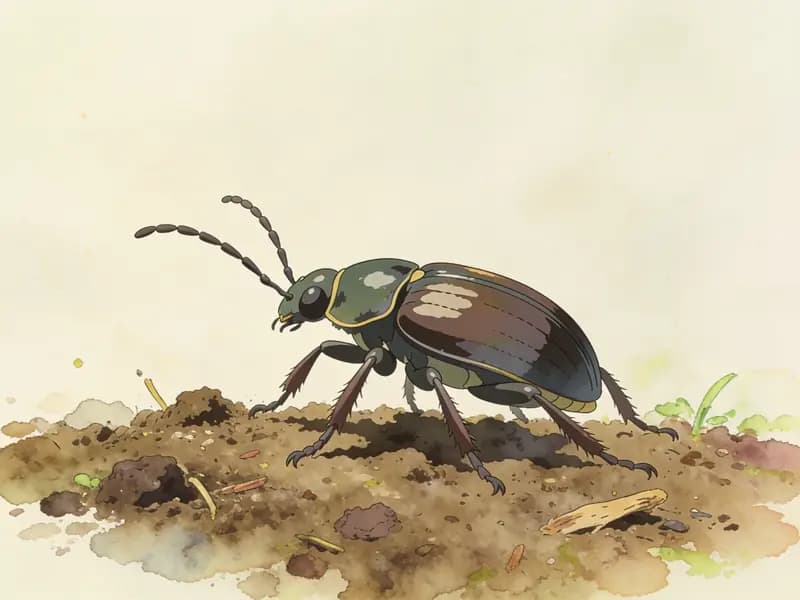
Ground beetle (hunter beetle)
Carabus, Poecilus, Pterostichus
Also called: carabid, ground beetle, carabus, carabid beetle
Black or metallic-shiny beetles that scurry over the garden floor at dusk. They eat young slugs, soil caterpillars and fly larvae. They are discreet hunters and very useful.

How to recognise it at every stage
Garden allyGarden ally: at night it hunts slugs, caterpillars and soil larvae.
Life cycle: Complete metamorphosis: egg in the soil, hunting larva (several months), pupa in a cell of earth and adult, which can live two or three years. One generation a year.
Tap a stage to see it full size. The photos are AI reference images checked against real photographs; stages without a reliable photo are shown as text only.
Life-stage calendar
| Jan | Feb | Mar | Apr | May | Jun | Jul | Aug | Sep | Oct | Nov | Dec | |
|---|---|---|---|---|---|---|---|---|---|---|---|---|
| Eggs | ||||||||||||
| Larva | ||||||||||||
| Pupa | ||||||||||||
| Adult |
Approximate months for mainland Spain; in cold areas they start later and in warm areas they last longer. Garden creatures this month
- 1Protect it
Eggs
· 2-3 mmWhite and oval, loose in a small cell.
- Where to find it
- In damp soil.
- When: Apr–Jun
- What to do
- Mulch and little tillage: that way they are not destroyed.
- 2Protect it
Larva
· 1-3 cmElongated, black or brown and shiny, with six legs, strong jaws and two little "horns" at the end.
- Where to find it
- Under stones, boards and mulch, hunting on the ground.
- When: May–Oct
- What to do
- Leave it: it eats snail eggs, larvae and small slugs.
- Often confused with
- Centipede. The centipede has a great many legs; the ground beetle larva has only six. See profile
- 3Protect it
Pupa
White, in a cell of earth.
- Where to find it
- In the soil.
- When: Jul–Sep
- What to do
- It cannot be seen.
- 4Protect it
Adult
· 1-4 cmA black beetle, sometimes with metallic green, blue or coppery sheens, long-legged and very fast.
- Where to find it
- By day under stones, boards and leaf litter; at night running about the garden.
- When: Mar–Oct
- What to do
- Leave stones, logs or an untilled strip as shelter. A beer slug trap also drowns them: boards are better.
- Often confused with
- Colorado potato beetle or other beetles that share the garden. Ground beetles are black or dark metallic, run a lot and are on the ground, not eating leaves.
Often confused with
- Centipede. The centipede has a great many legs; the ground beetle larva has only six. See profile
- Colorado potato beetle or other beetles that share the garden. Ground beetles are black or dark metallic, run a lot and are on the ground, not eating leaves.
What it eats
- Young slugs and snails
- Soil caterpillars (cutworms, armyworms)
- Fly larvae and pupae in the soil, including those of the fruit fly
- Ants and ground spiders
How it helps in the garden
How to attract this ally to your garden
- Permanent mulch of straw or leaves: ground beetles hunt at night and spend the day hidden underneath, in the shade and the damp.
- Flat stones resting on the ground: cool chambers where they hide.
- Hedges and flower strips between beds: they give shelter and food to these and other predators of garden pests.
What to avoid so you do not harm it by accident
- Rotavators and deep tillage: they damage the larvae and the adults that live in the soil.
- Slug baits with metaldehyde: they kill them too.
How to recognise it
1-3 cm, black or with metallic green/golden sheens, long legs, visible jaws. They run very fast when you lift a stone.
Risk to people: None.
Many allies are protected by Spanish law: do not capture or keep in captivity toads, hedgehogs, bats or native reptiles. Attract them, watch them and thank them from a distance. Rules in other countries differ: check your local regulations.

Allies do better if the garden is varied. Learn to identify each visitor and to prevent problems with good habits.