
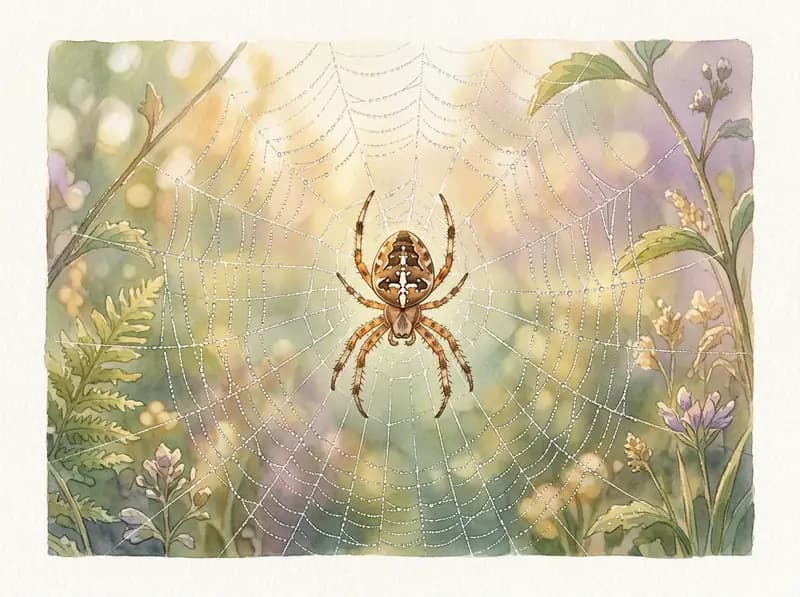
Garden spider
Araneus diadematus and others
Also called: orb weaver, cross spider, European garden spider, common spider, orb-web spider
The webs in your garden catch flies, mosquitoes and moths at all hours. Each spider gets through a great number of insects over the year. Treat them as allies and do not kill them or tear down their webs without reason.

How to recognise it at every stage
Garden allyGarden ally: its web catches flies, moths and winged aphids.
Life cycle: No metamorphosis: little spiderlings come out of the egg sac and grow by moulting their skin. The female lays in autumn, the eggs spend the winter and the young hatch in spring. One generation a year.
Tap a stage to see it full size. The photos are AI reference images checked against real photographs; stages without a reliable photo are shown as text only.
Life-stage calendar
| Jan | Feb | Mar | Apr | May | Jun | Jul | Aug | Sep | Oct | Nov | Dec | |
|---|---|---|---|---|---|---|---|---|---|---|---|---|
| Egg sac | ||||||||||||
| Spiderlings | ||||||||||||
| Adult |
Approximate months for mainland Spain; in cold areas they start later and in warm areas they last longer. Garden creatures this month
- 1Protect it
Egg sac
· 1-2 cmA small ball of yellowish or brown silk, cottony, with hundreds of eggs.
- Where to find it
- In wall cracks, canes, under eaves and on dry stems.
- When: Sep–Apr
- What to do
- Leave it where it is; do not clean reed screens and corners thoroughly in autumn.
- 2Protect it
Spiderlings
· 1-2 mmA ball of tiny yellow spiders with a black mark, huddled on a small web; if you touch it, they scatter and then gather again.
- Where to find it
- In hedges, rose bushes and stakes, in spring.
- When: Apr–Jun
- What to do
- It is not a pest: they are garden spider young. In a few days they spread out around the garden.
- Often confused with
- Ball of spiderlings versus a pest. Spiderlings are yellow with a black mark and sit on a small web; aphids make no web and do not scatter when you blow on them. See profile
- 3Protect it
Adult
· 1-2 cm (female)Rounded brown, orange or greyish abdomen with a cross of white dots; it spins a round web with spokes.
- Where to find it
- In the centre of its web, among plants, stakes and hedges.
- When: Jun–Oct
- What to do
- Protect it: it is not dangerous. If a web is in your way, move the spider with a stick to another plant.
- Often confused with
- Wasp spider (Argiope bruennichi). Another orb-weaving spider with yellow and black stripes and a web with a white zigzag. It is also an ally and harmless.
Often confused with
- Ball of spiderlings versus a pest. Spiderlings are yellow with a black mark and sit on a small web; aphids make no web and do not scatter when you blow on them. See profile
- Wasp spider (Argiope bruennichi). Another orb-weaving spider with yellow and black stripes and a web with a white zigzag. It is also an ally and harmless.
What it eats
- Mosquitoes, flies, moths, bugs
- Whitefly and thrips (the small ones)
- Occasionally winged aphids
How it helps in the garden
How to attract this ally to your garden
- Vertical structures between plants for weaving: tomato stakes, trellises, branches.
- Leave piles of logs or stones and some leaf litter: they shelter spiders, lizards and hedgehogs.
- Cut down on night lighting: lights attract insects from the whole surroundings and disturb nocturnal wildlife.
What to avoid so you do not harm it by accident
- Removing webs without reason: the spider weaves again and wastes energy for nothing.
- Contact insecticides: they kill the spider when it lands or walks on a freshly treated leaf.
How to recognise it
Body 5-15 mm, round abdomen with pale cross-shaped markings. Classic circular bicycle-wheel web.
Risk to people: Practically none. The garden cross spider and the common orb weavers are not dangerous to people and only bite if you crush them. In the south and on the coast there are spiders with a more troublesome bite, such as the Mediterranean black widow, very shy and uncommon: if a spider bites you and you feel intense pain or general malaise, see a doctor.
Many allies are protected by Spanish law: do not capture or keep in captivity toads, hedgehogs, bats or native reptiles. Attract them, watch them and thank them from a distance. Rules in other countries differ: check your local regulations.

Allies do better if the garden is varied. Learn to identify each visitor and to prevent problems with good habits.