
Credits and licences
- #1 — vueltaalhuerto illustration
- #2 — vueltaalhuerto illustration
- #3 — vueltaalhuerto illustration
- #4 — vueltaalhuerto illustration
- #5 — vueltaalhuerto illustration
- #6 — vueltaalhuerto illustration
- #7 — vueltaalhuerto illustration
- #8 — vueltaalhuerto illustration
- #9 — vueltaalhuerto illustration
- #10 — vueltaalhuerto illustration
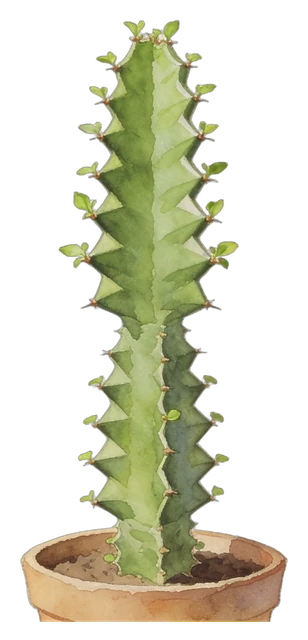
Euphorbia anoplia (zipper plant)
and 2 more names
euphorbia, spurgeEuphorbia anoplia (zipper plant) is sown in seed trays from March to May, and planted out from April to June. Grow it in full sun, 15 cm apart, with little watering. Dates are for a mild temperate climate in the northern hemisphere; the calendar below adjusts them to your zone.
A cactus-like succulent without spines, with several upright dark green stems with 4 or 5 ribs, which in a pot usually reach 15 to 30 cm. Its most striking feature is the wavy, brownish-purple edges of the ribs, which resemble a zip and give it its common name. From spring to autumn small reddish-purple flowers (cyathia) appear at the stem tips. It is an easy plant if kept in bright light and almost dry in winter. It is now considered a variety of Euphorbia polygona (E. polygona var. anoplia), and some floras simply treat it as a synonym of that species. LEGAL AND SAFETY NOTICE: Euphorbia anoplia (E. polygona var. anoplia) is listed in Appendix II of the CITES convention, which has protected all succulent euphorbias since 1 July 1975, and in Annex B of EU Regulation (EC) No 338/97. Buying and owning a legally sourced nursery plant in the EU is lawful, but keep the invoice or proof of origin: importing or exporting specimens to or from outside the EU requires a CITES permit (in Spain, through the CITES authority of the Secretaría de Estado de Comercio, the Secretariat of State for Trade, and its inspection points), and you must not collect it in the wild or buy plants of doubtful origin. The few exemptions in the CITES annotation (certain artificially propagated cultivars of Euphorbia trigona, E. lactea and E. ‘Milii’) do not include this species. Its white latex is irritant and toxic: on the skin it can cause redness, blisters and ulcers, and in the eye anything from conjunctivitis to serious damage to the cornea, with cases of blindness reported after accidental contact. Prune, repot and take cuttings wearing gloves, long sleeves and goggles, wash stained skin with plenty of water and, if latex splashes into an eye, rinse it with water and go to an eye emergency department without delay. It is neither edible nor medicinal, and it is toxic to children, dogs and cats: keep it out of their reach.
Family and origin: Spurge family (Euphorbiaceae) · native to South Africa (Western and Eastern Cape), on dry rocky slopes; the plant is sold under the name ‘Tanzanian zipper’ out of trade habit, not because of its origin · More plants from Africa
01In your area
How will it do in your home?
Year calendar
| Task | J | F | M | A | M | J | J | A | S | O | N | D |
|---|---|---|---|---|---|---|---|---|---|---|---|---|
| Seed trayMar–May | no | no | yes | yes | yes | no | no | no | no | no | no | no |
| Plant / transplantApr–Jun | no | no | no | yes | yes | yes | no | no | no | no | no | no |
| FloweringApr–Sep | no | no | no | yes | yes | yes | yes | yes | yes | no | no | no |
| CuttingsMay–Jul | no | no | no | no | yes | yes | yes | no | no | no | no | no |
Its life cycle at a glance
Swipe and tap a stage to see its details.
02Planting
Planting and transplanting
- TipAlways buy a nursery-grown plant with an invoice.
03Care
Care through the year
Sun and aspectFull sun · 8 h of sun · South or south-west, with nothing casting shade at midday
- Too little sun
- Ideal range
- Plenty of sun
South or south-west, with nothing casting shade at midday
Strong sun: Loves full midday sun and high temperatures.
Direct sun from spring to autumn; in high summer, behind south-facing glass, it is best shaded in the middle of the day if the stems scorch. It withstands a light, dry frost (around -1 °C) but not frost combined with damp: overwinter it bright, cool and dry, at 5 to 10 °C.
- Common mistakeLack of light makes them stretch and go soft (etiolation).
WateringLet it dry out between waterings · summer: every 5-7 days
- Summerevery 5-7 days0.2 L per plant/week
- Spring / Autumnevery 10-14 days0.1 L per plant/week
- Winteronly in extreme drought (once a month)0 L per plant/week
Let it dry out between waterings: A Mediterranean favourite: better thirsty than overwatered.
Water thoroughly only when the potting mix is completely dry, from spring to autumn (every 10 to 20 days in hot weather); in winter, almost nothing. It is very sensitive to excess water: use a pot with drainage holes and a very mineral potting mix.
When to water? Push your finger 5 cm into the soil next to the base of the plant:
- Damp: soil sticks to your finger. Do not water yet. It has more than enough; wait for it to dry out more.
- Cool but clean, no mud. Wait another 1-2 days before watering.
- Dry and dusty. Water now, but moderately. Do not overdo it: it prefers thirst to excess.
- TipWater thoroughly and leave long gaps: better thirsty than overwatered.
- Common mistakeWatering often rots the crown and the roots.
Potting mix and feedingpH 6–7 · Very gritty, free-draining mix
Very gritty, free-draining mix.
30 % multi-purpose compost · 40 % coarse sand · 30 % perlite or pumice.
Very high: standing moisture rots them.
This plant prefers a pH between 6.0 and 7.0 (slightly acidic to neutral).
- Multi-purpose compost on its own with no drainage: rot sets in quickly.
- Watering the rosette or the leaves marks them and causes rot.
- TipPlant it in a terracotta pot with a very mineral potting mix (for example, three quarters coarse sand, pumice or perlite and one quarter cactus compost), in the brightest spot in the house or on a terrace sheltered from rain.
- TipVery free-draining mix (with sand/perlite) and pots with a drainage hole.
Common mistakes and tips
- TipRepot it every two or three years in spring, wearing gloves.
- TipWatch for mealybugs.
- TipGrowth, cold and flowering figures are a rough guide.
04Propagation
Make new plants
It is mainly propagated by stem cuttings: cut a healthy stem in spring or summer, wearing gloves, let it dry for ten days to two weeks until the cut has callused, and plant it in coarse sand or a barely moist mineral potting mix; it roots in a few weeks. It can also be propagated by seed, which germinates in three or four weeks with warmth, and by the offsets that form at the base.
Seeds: how to germinate them~25 days
05Uses and health
What it is used for, and with what care
The white latex of euphorbias, rich in irritant diterpenes, is highly irritating to the skin and eyes and toxic if swallowed: it can cause blisters, skin ulcers, serious damage to the cornea, and vomiting or irritation of the mouth if swallowed. Euphorbia polygona, of which this plant is a variety, has been described as mildly poisonous to people. Handle it with gloves and goggles, wash stained skin with water and, if latex reaches the eye, rinse it and go to A&E. Keep it out of reach of children, dogs and cats; if a pet nibbles it, rinse its mouth with water and call the vet. Like other succulent euphorbias, it is listed in CITES Appendix II: always buy nursery-grown specimens.
- Properties
- An ornamental succulent with no home medicinal uses.
- Uses
- Not edible. It has no culinary or medicinal uses; do not use it in herbal teas or consume it.
For guidance only; this is not medical treatment and does not replace advice from a doctor or vet.
06Companions and related plants
What to plant it with
Compare with similar varieties
| Variety | Sowing | Harvest | Days | Spacing | Difficulty |
|---|---|---|---|---|---|
| Euphorbia aeruginosa (miniature saguaro) | Mar–May | — | — | 20 cm | Easy |
| Euphorbia aggregata (pincushion euphorbia) | Mar–May | — | — | 30 cm | Moderate |
| Euphorbia alluaudii (Madagascar euphorbia) | Mar–May | — | — | 60 cm | Moderate |
| Euphorbia anoplia (zipper plant) | Mar–May | Apr–Sep | — | 15 cm | Easy |
| Euphorbia bisellenbeckii (octopus arms) | Mar–May | Jun–Aug | — | 25 cm | Easy |
| Euphorbia caput-medusae (Medusa’s head) | Mar–May | Jul–Sep | — | 40 cm | Moderate |
| Euphorbia echinus (hedgehog euphorbia) | Mar–May | — | — | 50 cm | Easy |
| Euphorbia enopla (pincushion euphorbia) | Mar–May | — | — | 25 cm | Easy |
| Euphorbia ferox | Mar–May | — | — | 40 cm | Moderate |
| Euphorbia frankii | Mar–May | — | — | 25 cm | Moderate |
| Euphorbia fruticosa | Mar–May | — | — | 50 cm | Easy |
| Euphorbia handiensis (Jandía spurge) | Mar–May | Apr–Sep | — | 30 cm | Easy |
| Euphorbia horrida (African milk barrel) | Mar–May | Apr–Sep | — | 25 cm | Easy |
| Euphorbia knuthii | Mar–May | Apr–Sep | — | 20 cm | Moderate |
| Euphorbia mammillaris (corn cob euphorbia) | Mar–May | Apr–Sep | — | 15 cm | Easy |
| Euphorbia meloformis (melon spurge) | Mar–May | Apr–Sep | — | 15 cm | Moderate |