
Credits and licences
- #1 — vueltaalhuerto illustration
- #2 — vueltaalhuerto illustration
- #3 — vueltaalhuerto illustration
- #4 — vueltaalhuerto illustration
- #5 — vueltaalhuerto illustration
- #6 — vueltaalhuerto illustration
- #7 — vueltaalhuerto illustration
- #8 — vueltaalhuerto illustration
- #9 — vueltaalhuerto illustration
- #10 — vueltaalhuerto illustration
Euphorbia mammillaris (corn cob euphorbia)
and 2 more names
Euphorbia mammillaris 'Variegata', spurgeEuphorbia mammillaris (corn cob euphorbia) is sown in seed trays from March to May, and planted out from April to June. Grow it in full sun, 15 cm apart, with little watering. Dates are for a mild temperate climate in the northern hemisphere; the calendar below adjusts them to your zone.
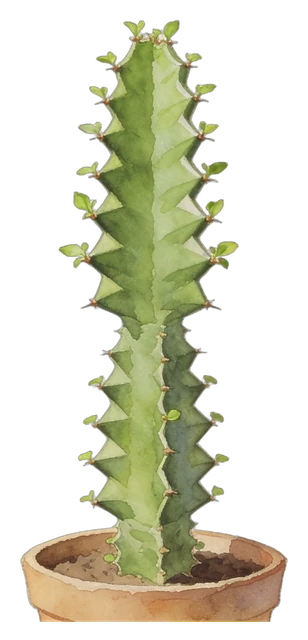
A small, leafless succulent that forms a clump of thick, upright, club-shaped stems 20 to 35 cm tall and 1.5 to 6 cm thick, dark green and covered in tightly packed hexagonal tubercles arranged in vertical rows, like a corn cob; hence its common name. It has 7 to 17 rows and, here and there, blunt whitish flower stalks up to 1 cm long that look like spines but do not prick. It sprouts readily from the base and over the years forms a compact group. Yellow cyathia appear at the stem tips from late winter to early summer. The cultivar ‘Variegata’, very common in the trade, has cream or greenish-white stems with emerald-green patches, and cold weather gives it pinkish tones. It is a tender plant: only for frost-free areas or a bright room indoors. LEGAL AND SAFETY NOTICE: Euphorbia mammillaris, like other succulent euphorbias, is listed in Appendix II of the CITES convention and covered in the EU by Regulation (EC) No 338/97. Buying and owning a legally sourced nursery plant in the EU is lawful, but keep the invoice or proof of origin: importing or exporting specimens to or from outside the EU requires a CITES permit (in Spain, through the CITES authority of the Secretaría de Estado de Comercio, the Secretariat of State for Trade, and its inspection points), and you must not collect it in the wild or buy plants of doubtful origin. The few exemptions in the CITES annotation (certain artificially propagated cultivars of Euphorbia trigona, E. lactea and E. ‘Milii’) do not include this species or its cultivar ‘Variegata’. Its white latex is irritant and toxic: on the skin it can cause redness, blisters and ulcers, and in the eye anything from conjunctivitis to serious damage to the cornea, with cases of blindness reported after accidental contact. Prune, repot and take cuttings wearing gloves, long sleeves and goggles, wash stained skin with plenty of water and, if latex splashes into an eye, rinse it with water and go to an eye emergency department without delay. It is neither edible nor medicinal, and it is toxic to children, dogs and cats: keep it out of their reach.
Family and origin: Spurge family (Euphorbiaceae) · native to South Africa (the Little Karoo and the southern Cape), on arid rocky slopes · More plants from Africa
01In your area
How will it do in your home?
Year calendar
| Task | J | F | M | A | M | J | J | A | S | O | N | D |
|---|---|---|---|---|---|---|---|---|---|---|---|---|
| Seed trayMar–May | no | no | yes | yes | yes | no | no | no | no | no | no | no |
| Plant / transplantApr–Jun | no | no | no | yes | yes | yes | no | no | no | no | no | no |
| FloweringApr–Sep | no | no | no | yes | yes | yes | yes | yes | yes | no | no | no |
| CuttingsMay–Jul | no | no | no | no | yes | yes | yes | no | no | no | no | no |
Its life cycle at a glance
Swipe and tap a stage to see its details.
02Planting
Planting and transplanting
- TipAlways buy a nursery-grown plant with an invoice.
03Care
Care through the year
Sun and aspectFull sun · 8 h of sun · South or south-west, with nothing casting shade at midday
- Too little sun
- Ideal range
- Plenty of sun
South or south-west, with nothing casting shade at midday
Strong sun: Loves full midday sun and high temperatures.
Direct sun, which keeps its colour and compact habit; it tolerates some shade, but a plant raised in shade scorches if moved suddenly into the sun. The variegated form has less chlorophyll and scorches sooner: give it gentle morning sun. It does not tolerate frost: overwinter it bright, dry and above about 5 to 8 °C.
- Common mistakeLack of light makes them stretch and go soft (etiolation).
WateringLet it dry out between waterings · summer: every 5-7 days
- Summerevery 5-7 days0.2 L per plant/week
- Spring / Autumnevery 10-14 days0.1 L per plant/week
- Winteronly in extreme drought (once a month)0 L per plant/week
Let it dry out between waterings: A Mediterranean favourite: better thirsty than overwatered.
Water regularly from March to September, but only when the potting mix is completely dry (every 10 to 15 days in hot weather), and almost not at all in winter. Do not leave standing water in the saucer. Use a pot with drainage holes and a very mineral potting mix.
When to water? Push your finger 5 cm into the soil next to the base of the plant:
- Damp: soil sticks to your finger. Do not water yet. It has more than enough; wait for it to dry out more.
- Cool but clean, no mud. Wait another 1-2 days before watering.
- Dry and dusty. Water now, but moderately. Do not overdo it: it prefers thirst to excess.
- TipWater thoroughly and leave long gaps: better thirsty than overwatered.
- Common mistakeWatering often rots the crown and the roots.
Potting mix and feedingpH 6–7.2 · Very gritty, free-draining mix
Very gritty, free-draining mix.
30 % multi-purpose compost · 40 % coarse sand · 30 % perlite or pumice.
Very high: standing moisture rots them.
This plant prefers a pH between 6.0 and 7.2 (slightly acidic to neutral).
- Multi-purpose compost on its own with no drainage: rot sets in quickly.
- Watering the rosette or the leaves marks them and causes rot.
- TipPlant it in a terracotta pot with a very mineral potting mix (three quarters coarse sand, pumice or perlite and one quarter cactus compost), in the brightest spot.
- TipVery free-draining mix (with sand/perlite) and pots with a drainage hole.
Common mistakes and tips
- TipRepot it every two or three years in spring, wearing gloves, because over time it forms a tight cluster.
- TipWatch for mealybugs.
- TipGrowth, cold and flowering figures are a rough guide.
04Propagation
Make new plants
It is mainly propagated by stem cuttings or basal offsets, which are cut wearing gloves in late spring or summer, rinsed to remove the latex, left to dry for one or two weeks until the cut has callused, and planted in a dry, loose, very free-draining potting mix. It can also be propagated by seed, which germinates with warmth. The cultivar ‘Variegata’ only keeps its markings when grown from cuttings.
Seeds: how to germinate them~25 days
05Uses and health
What it is used for, and with what care
Its white latex, rich in irritant diterpenes, is highly irritating to the skin and eyes and toxic if swallowed: it can cause blisters, skin ulcers, serious damage to the cornea, and vomiting or irritation of the mouth if swallowed. Handle it with gloves, long sleeves and goggles; wash any splash off with plenty of water and, if latex reaches the eye, rinse it and go to an eye emergency department. Keep it out of reach of children, dogs and cats; if a pet bites it, rinse its mouth with water and call the vet. There are no specific toxicity data for this species; the general precautions for the genus apply.
- Properties
- An ornamental succulent with no home medicinal uses.
- Uses
- Not edible. It has no culinary or medicinal uses; do not use it in herbal teas or consume it.
For guidance only; this is not medical treatment and does not replace advice from a doctor or vet.
06Companions and related plants
What to plant it with
Compare with similar varieties
| Variety | Sowing | Harvest | Days | Spacing | Difficulty |
|---|---|---|---|---|---|
| Euphorbia aeruginosa (miniature saguaro) | Mar–May | — | — | 20 cm | Easy |
| Euphorbia aggregata (pincushion euphorbia) | Mar–May | — | — | 30 cm | Moderate |
| Euphorbia alluaudii (Madagascar euphorbia) | Mar–May | — | — | 60 cm | Moderate |
| Euphorbia anoplia (zipper plant) | Mar–May | Apr–Sep | — | 15 cm | Easy |
| Euphorbia bisellenbeckii (octopus arms) | Mar–May | Jun–Aug | — | 25 cm | Easy |
| Euphorbia caput-medusae (Medusa’s head) | Mar–May | Jul–Sep | — | 40 cm | Moderate |
| Euphorbia echinus (hedgehog euphorbia) | Mar–May | — | — | 50 cm | Easy |
| Euphorbia enopla (pincushion euphorbia) | Mar–May | — | — | 25 cm | Easy |
| Euphorbia ferox | Mar–May | — | — | 40 cm | Moderate |
| Euphorbia frankii | Mar–May | — | — | 25 cm | Moderate |
| Euphorbia fruticosa | Mar–May | — | — | 50 cm | Easy |
| Euphorbia handiensis (Jandía spurge) | Mar–May | Apr–Sep | — | 30 cm | Easy |
| Euphorbia horrida (African milk barrel) | Mar–May | Apr–Sep | — | 25 cm | Easy |
| Euphorbia knuthii | Mar–May | Apr–Sep | — | 20 cm | Moderate |
| Euphorbia mammillaris (corn cob euphorbia) | Mar–May | Apr–Sep | — | 15 cm | Easy |
| Euphorbia meloformis (melon spurge) | Mar–May | Apr–Sep | — | 15 cm | Moderate |