Credits and licences
- #1 — vueltaalhuerto illustration
- #2 — vueltaalhuerto illustration
- #3 — vueltaalhuerto illustration
Wild madder
Wild madder is sown directly outdoors from October to November. It flowers from May to July. Grow it in sun or partial shade, 100 cm apart, with little watering. Dates are for a mild temperate climate in the northern hemisphere; the calendar below adjusts them to your zone.
What else to sow in October and November
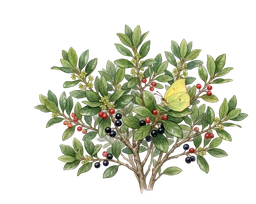
An evergreen perennial climber with hard, glossy leaves and square, rough stems that hook onto the shrubs of hedges and Mediterranean scrub edges. Its greenish summer flowers give way to black berries eaten by birds. It is a host plant for hummingbird hawk-moth caterpillars, together with cleavers, and it lives well under hedges of other native plants, which give it support. It is not the dye madder (Rubia tinctorum), which is another species. Its berries and roots are not edible.
Family and origin: Coffee family (Rubiaceae) · native to Mediterranean region and Atlantic Europe · More plants from Mediterranean basin
01In your area
How will it do in your garden?
Year calendar
| Task | J | F | M | A | M | J | J | A | S | O | N | D |
|---|---|---|---|---|---|---|---|---|---|---|---|---|
| Direct sowingOct–Nov | no | no | no | no | no | no | no | no | no | yes | yes | no |
| FloweringMay–Jul | no | no | no | no | yes | yes | yes | no | no | no | no | no |
| Divide the clumpMar, Oct | no | no | yes | no | no | no | no | no | no | yes | no | no |
Its life cycle at a glance
Swipe and tap a stage to see its details.
02Planting
Where and how to plant it
Sow the seed 1 cm deep; leave 1 m between plants; give it a stake from the start.
1 m between plants
Seed at a depth of 1 cm.
- Direct sowing
- Oct–Nov
- Germination
- ~60 days
- Support
- Needs a stake
- TipPlant it next to a hedge of scrub shrubs, such as Mediterranean buckthorn, mastic or laurustinus, so it can lean on them, and do not put it right against small plants, which it covers.
- Common mistakePlanting it hard up against a wall with no gap reduces air flow.
03Care
Care through the year
Sun and aspectSun and shade · 4 h of sun · shade in summer
- Too little sun
- Ideal range
- Plenty of sun
East or north, at the foot of a hedge
Moderate sun: Copes with full sun, but give it some shade during heatwaves.
Partial shade, or gentle morning sun, at the foot of a hedge or shrub that supports it.
WateringLet it dry out between waterings · summer: every 2 weeks in the first summer; none afterwards
- Summerevery 2 weeks in the first summer; none afterwards4 L per plant/week
- Spring / Autumnnone once established1.6 L per plant/week
- Winternone0.6 L per plant/week
Let it dry out between waterings: A Mediterranean favourite: better thirsty than overwatered. Mulch: straw or dry plant material cuts watering by 30-50 %.
Water regularly only in the first year. Once established it withstands the Mediterranean summer drought.
When to water? Push your finger 5 cm into the soil next to the base of the plant:
- Damp: soil sticks to your finger. Do not water yet. It has more than enough; wait for it to dry out more.
- Cool but clean, no mud. Wait another 1-2 days before watering.
- Dry and dusty. Water now, but moderately. Do not overdo it: it prefers thirst to excess.
Soil and feedingpH 6–8.5 · Deep soil with good drainage
Deep soil with good drainage.
Medium/high.
This plant prefers a pH between 6.0 and 8.5 (slightly acidic to alkaline).
- Guide the first stems onto the support; after that it climbs on its own.
- A mulch at the base keeps the roots moist.
- Planting it hard against a wall reduces air flow and encourages powdery mildew.
- Pruning at the wrong time removes its flower buds.
Pruning
- TipPrune after flowering to keep its vigour in check.
Common mistakes and tips
- TipThe rough stems cling to clothes, so wear gloves to remove what is too much.
- TipThe dye madder (Rubia tinctorum) is another species and should not be confused with it or used for home dyes without knowing the risks.
- TipGuide the first stems onto the support; after that it climbs on its own.
- Common mistakeLeaving it untrained turns it into a tangle that is hard to manage.
04Propagation
Make new plants
It is propagated from seed (collected from the ripe black berries and sown in autumn; it sometimes takes more than one spring to come up) or, more easily, by dividing clumps that sprout from its rhizome, in spring or autumn. Pieces of stem with roots that touch the soil also root.
Seeds: how to germinate them~60 days
05Uses and health
What it is used for, and with what care
There is no reliable toxicity data for this species. As a precaution, do not eat its berries or roots or use them in preparations; the dye madder (Rubia tinctorum) contains compounds that should not be swallowed. The rough stems can irritate skin. If anything is swallowed, consult your poison information service or a vet.
- Properties
- A native climber with berries for birds and shelter for hummingbird hawk-moth caterpillars. No home uses.
- Uses
- Not edible.
For guidance only; this is not medical treatment and does not replace advice from a doctor or vet.
06Companions and related plants