Credits and licences
- #1 — vueltaalhuerto illustration
- #2 — vueltaalhuerto illustration
- #3 — vueltaalhuerto illustration
- #4 — vueltaalhuerto illustration
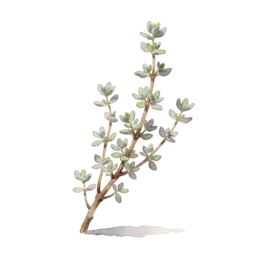
Mediterranean buckthorn
Mediterranean buckthorn is sown directly outdoors from October to November. It flowers from February to April. Grow it in full sun, 200 cm apart, with little watering. Dates are for a mild temperate climate in the northern hemisphere; the calendar below adjusts them to your zone.
What else to sow in October and November
An evergreen shrub with glossy, leathery leaves, typical of Mediterranean scrub and coastal hedges. It flowers very early, between February and April, with small greenish flowers that are among the first nectar sources of the year for bees and flies, and it bears fruits that turn from red to black and are eaten by birds. It is a host plant for the caterpillars of the brimstone and Cleopatra butterflies, which lay their eggs on its young leaves: a Mediterranean buckthorn in the hedge is a gift to them. It tolerates drought, wind and pruning and makes a good green screen all year. Plants are male or female; only females bear fruit, so it is worth planting several.
Family and origin: Buckthorn family (Rhamnaceae) · native to Mediterranean basin · More plants from Mediterranean basin
01In your area
How will it do in your garden?
Year calendar
| Task | J | F | M | A | M | J | J | A | S | O | N | D |
|---|---|---|---|---|---|---|---|---|---|---|---|---|
| Direct sowingOct–Nov | no | no | no | no | no | no | no | no | no | yes | yes | no |
| Plant / transplantFeb–Mar, Oct–Nov | no | yes | yes | no | no | no | no | no | no | yes | yes | no |
| FloweringFeb–Apr | no | yes | yes | yes | no | no | no | no | no | no | no | no |
| PruningMay–Jun | no | no | no | no | yes | yes | no | no | no | no | no | no |
Its life cycle at a glance
Swipe and tap a stage to see its details.
02Planting
Where and how to plant it
Sow the seed 1 cm deep; leave 2 m between plants.
2 m between plants
Seed at a depth of 1 cm; seedlings go in with the root ball level with the soil.
- Transplanting
- Feb–Mar, Oct–Nov
- Direct sowing
- Oct–Nov
- Germination
- ~45 days
03Care
Care through the year
Sun and aspectFull sun · 6 h of sun · South or south-west, sheltered from cold wind
- Too little sun
- Ideal range
- Plenty of sun
South or south-west, sheltered from cold wind
Strong sun: Loves full midday sun and high temperatures.
Full sun or partial shade. It copes well with summer heat; where frosts are hard, put it in a spot sheltered from cold wind.
WateringLet it dry out between waterings · summer: every 2-3 weeks in the first summer; none afterwards
- Summerevery 2-3 weeks in the first summer; none afterwards3 L per plant/week
- Spring / Autumnnone once established1.2 L per plant/week
- Winternone0.5 L per plant/week
Let it dry out between waterings: A Mediterranean favourite: better thirsty than overwatered. Mulch: straw or dry plant material cuts watering by 30-50 %.
Water regularly only in the first year, so it roots well. After that it gets by on rainfall; what it likes least is waterlogging. A bark or stone mulch helps to keep moisture in.
When to water? Push your finger 5 cm into the soil next to the base of the plant:
- Damp: soil sticks to your finger. Do not water yet. It has more than enough; wait for it to dry out more.
- Cool but clean, no mud. Wait another 1-2 days before watering.
- Dry and dusty. Water now, but moderately. Do not overdo it: it prefers thirst to excess.
- TipWater generously in the first year until it is established; after that it looks after itself.
Soil and feedingpH 6–8.5 · Deep soil with good drainage
Deep soil with good drainage.
Medium/high.
This plant prefers a pH between 6.0 and 8.5 (slightly acidic to alkaline).
- Water generously in the first year until it is established.
- A thick mulch all year round, not touching the trunk.
PruningWhen: May–Jun
Pruning time for this plant: May–Jun.
- TipPlant it in a hedge or a sunny corner and do not prune it in mid-spring, when the butterflies lay eggs on the tender leaves: it is better to trim it right after flowering, and only lightly.
- TipFormative pruning after flowering keeps the shape compact.
- Common mistakePruning at the wrong time removes the year's flower buds.
Common mistakes and tips
- TipThe fruits are for the birds; they are not edible and can upset children and pets.
04Propagation
Make new plants
It is propagated from seed, collected from the ripe fruit and cleaned of pulp; sowing outdoors in autumn lets the winter cold wake it naturally, and it sprouts in spring. It can also be grown from semi-ripe cuttings in summer, with rooting hormone and very free-draining mix, although this is somewhat slow. Because plants are male or female, a seedling's sex is not known until it flowers.
Seeds: how to germinate them~45 days
05Uses and health
What it is used for, and with what care
The fruits and bark of buckthorns contain laxative anthraquinones and can cause vomiting and diarrhoea if eaten in quantity, especially in children and pets. Do not use them in infusions or home remedies. If fruits are eaten, call your poison information service or a vet.
- Properties
- A native shrub that is very useful to wildlife: its early flowers feed bees and its fruits feed birds. No home uses are recommended.
- Uses
- Not edible. The fruits are for the birds.
For guidance only; this is not medical treatment and does not replace advice from a doctor or vet.
06Companions and related plants