Credits and licences
- #1 — vueltaalhuerto illustration
- #2 — vueltaalhuerto illustration
- #3 — vueltaalhuerto illustration
- #4 — vueltaalhuerto illustration
- #5 — vueltaalhuerto illustration
- #6 — vueltaalhuerto illustration
- #7 — vueltaalhuerto illustration
- #8 — vueltaalhuerto illustration
- #9 — vueltaalhuerto illustration
Vitex trifolia (simple-leaf chaste tree)
and 3 more names
Vitex trifolia 'Purpurea', three-leaf chaste tree, vitexVitex trifolia (simple-leaf chaste tree) is planted from March to May and from September to October. It flowers from June to September. Grow it in full sun, 150 cm apart, with little watering. Dates are for a mild temperate climate in the northern hemisphere; the calendar below adjusts them to your zone.
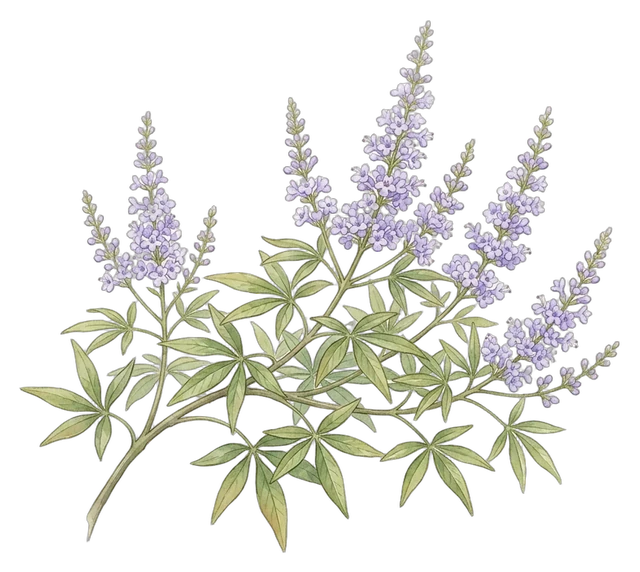
An evergreen or semi-evergreen shrub or small tree, 1 to 3 m tall, with square stems and aromatic leaves made up of a single leaflet or three, greyish green on top and silvery or violet underneath; in the cultivar ‘Purpurea’ the underside is a deep violet, giving the shrub a silvery, purplish look. From summer to autumn it bears upright spikes of two-lipped, bluish lilac flowers, much visited by bees and butterflies, followed by small, round, violet-black fruits. It is a plant for sun, heat and well-drained soil, grown in pots or in the ground in mild coastal climates. It is more sensitive to cold than the common chaste tree (Vitex agnus-castus) and does not withstand hard frosts. Its leaves and flowers give off a resinous scent; in some people they can irritate the skin. It is not grown to eat. In other warm regions of the world, such as Hawaii and Florida, it has naturalised, although it is not on the Spanish catalogue of invasive alien species or on the EU list.
Family and origin: Mint family (Lamiaceae) · native to Coasts and shores of southern Asia, Australia and the Pacific islands · More plants from Southeast Asia
01In your area
How will it do in your garden?
Year calendar
| Task | J | F | M | A | M | J | J | A | S | O | N | D |
|---|---|---|---|---|---|---|---|---|---|---|---|---|
| Plant / transplantMar–May, Sep–Oct | no | no | yes | yes | yes | no | no | no | yes | yes | no | no |
| FloweringJun–Sep | no | no | no | no | no | yes | yes | yes | yes | no | no | no |
| PruningFeb–Mar | no | yes | yes | no | no | no | no | no | no | no | no | no |
| CuttingsJun–Sep | no | no | no | no | no | yes | yes | yes | yes | no | no | no |
Its life cycle at a glance
Swipe and tap a stage to see its details.
02Planting
Where and how to plant it
Leave 1.5 m between plants and 1.5 m between rows.
1.5 m between plants · 1.5 m between rows
Seedlings are planted with the root ball level with the soil.
- Transplanting
- Mar–May, Sep–Oct
- Common mistakePlanting too deep smothers the crown of the plant.
03Care
Care through the year
Sun and aspectFull sun · 8 h of sun · South or south-west, with nothing casting shade at midday
- Too little sun
- Ideal range
- Plenty of sun
South or south-west, with nothing casting shade at midday
Strong sun: Loves full midday sun and high temperatures.
Full sun and heat; in shade it becomes leggy and flowers poorly, and the violet undersides of the leaves show less. In cool areas, plant it against a south- or west-facing wall. It tolerates wind and sea air well.
WateringLet it dry out between waterings · summer: once a week in the first year; after that, only in long droughts
- Summeronce a week in the first year; after that, only in long droughts3 L per plant/week
- Spring / Autumnevery 10-14 days1.2 L per plant/week
- Winterhardly ever0.5 L per plant/week
Let it dry out between waterings: A Mediterranean favourite: better thirsty than overwatered. Mulch: straw or dry plant material cuts watering by 30-50 %.
Water regularly in the first year until it is established; after that it copes well with drought, although with occasional summer watering it flowers more and better. It does not tolerate waterlogging, especially in winter. In a pot, water when the potting mix is dry about 5 cm down and do not leave water in the saucer.
When to water? Push your finger 5 cm into the soil next to the base of the plant:
- Damp: soil sticks to your finger. Do not water yet. It has more than enough; wait for it to dry out more.
- Cool but clean, no mud. Wait another 1-2 days before watering.
- Dry and dusty. Water now, but moderately. Do not overdo it: it prefers thirst to excess.
- TipIn winter, protect it in cold areas with a thick mulch, or move it somewhere frost-free if it is in a pot.
- TipThe figures for height, spacing, watering and temperature are a guide only.
- TipWater generously in the first year until it is established; after that it looks after itself.
Soil and feedingpH 6–8 · Deep soil with good drainage
Deep soil with good drainage.
Medium/high.
This plant prefers a pH between 6.0 and 8.0 (slightly acidic to alkaline).
- Water generously in the first year until it is established.
- A thick mulch all year round, not touching the trunk.
- TipPlant it in well-drained soil, or in a large pot with a mineral, free-draining potting mix.
PruningWhen: Feb–Mar
Pruning time for this plant: Feb–Mar.
- TipPrune in late winter, leaving two or three buds on each main branch, and it will flower on the new growth; in areas with frost it may be cut back to the ground and regrow from the base.
- TipFormative pruning after flowering keeps the shape compact.
- Common mistakePruning at the wrong time removes the year's flower buds.
Common mistakes and tips
- TipCut off faded spikes to prolong flowering and remove the fruits if you do not want it to self-seed, especially near natural areas.
04Propagation
Make new plants
It is usually propagated from semi-ripe cuttings in summer, 10 to 15 cm long, with two pairs of leaves, in a moist, sandy potting mix with gentle warmth; they root in four to eight weeks and give a plant identical to the parent. The cultivar ‘Purpurea’ is propagated this way, because it does not come true from seed.
05Uses and health
What it is used for, and with what care
WARNING: it can irritate the skin of some people when handled; wear gloves when pruning and wash your hands afterwards. There is no reliable data on its toxicity to dogs and cats, so do not let them chew the leaves or fruits. Do not use it in home remedies or infusions, and do not confuse it with the common chaste tree (Vitex agnus-castus), whose fruits are used in herbal medicine on medical advice.
- Properties
- An ornamental shrub that is good for bees. In its native region its leaves and fruits are used in traditional medicine, and its oils have been studied as mosquito repellents, but these are not uses for the home.
- Uses
- It is not grown for food or for infusions, and there is no culinary or home medicinal use to recommend.
For guidance only; this is not medical treatment and does not replace advice from a doctor or vet.
06Companions and related plants