Credits and licences
- #1 — vueltaalhuerto illustration
- #2 — vueltaalhuerto illustration
- #3 — vueltaalhuerto illustration
- #4 — vueltaalhuerto illustration
- #5 — vueltaalhuerto illustration
- #6 — vueltaalhuerto illustration
- #7 — vueltaalhuerto illustration
- #8 — vueltaalhuerto illustration
- #9 — vueltaalhuerto illustration
- #10 — vueltaalhuerto illustration
Triangle palm (Dypsis decaryi)
and 1 more names
neodypsisTriangle palm (Dypsis decaryi) is sown in seed trays from March to June, and planted out from April to June. Grow it in full sun, 300 cm apart, with moderate watering. Dates are for a mild temperate climate in the northern hemisphere; the calendar below adjusts them to your zone.
What else to sow in March, April, May and June
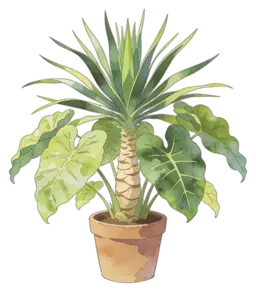
A palm with a single, thick, greyish-green trunk that in cultivation usually reaches 4 to 6 metres over the years, although in its native habitat it can grow taller. The leaves, 2 to 3 m long, are stiff, arching and bluish green with a waxy bloom, and they grow in three rows from the crown, so that seen from above the canopy forms a very distinctive triangle. The whitish leaf bases form a kind of column on top of the trunk. It produces branched inflorescences of small cream flowers, followed by oval fruits. It is slow-growing in Spain and needs sun, warmth and very free-draining soil. It tolerates light frosts, but cold damp and severe cold damage it; on the Spanish Mediterranean coast and in the Canary Islands it grows outdoors in the garden, while elsewhere it is grown in a large pot and protected in winter. It does not take kindly to transplanting because its roots are sensitive. It is a threatened species in its native habitat.
Family and origin: Palm family (Arecaceae) · native to South-eastern Madagascar · More plants from Africa
01In your area
How will it do in your garden?
Year calendar
| Task | J | F | M | A | M | J | J | A | S | O | N | D |
|---|---|---|---|---|---|---|---|---|---|---|---|---|
| Seed trayMar–Jun | no | no | yes | yes | yes | yes | no | no | no | no | no | no |
| Plant / transplantApr–Jun | no | no | no | yes | yes | yes | no | no | no | no | no | no |
| PruningApr–May | no | no | no | yes | yes | no | no | no | no | no | no | no |
Its life cycle at a glance
Swipe and tap a stage to see its details.
02Planting
Where and how to plant it
Sow the seed 2 cm deep; leave 3 m between plants and 3 m between rows.
3 m between plants · 3 m between rows
Seed at a depth of 2 cm; seedlings go in with the root ball level with the soil.
- Transplanting
- Apr–Jun
- Seed tray
- Mar–Jun
- Germination
- ~35 days
- TipThe species is listed in CITES Appendix II, so if you buy plants or seeds from outside the European Union, ask for the paperwork.
03Care
Care through the year
Sun and aspectFull sun · 8 h of sun · South or south-west, with nothing casting shade at midday
- Too little sun
- Ideal range
- Plenty of sun
South or south-west, with nothing casting shade at midday
Strong sun: Loves full midday sun and high temperatures.
It needs full sun, and in very hot climates a little shade during the strongest hours suits it while it is young. It tolerates short, light frosts, down to about -2 °C, with damaged leaves, and as soon as there are hard frosts or cold damp in winter it is at risk; sources do not agree on the exact figure, so treat it as a warm-climate palm. Elsewhere, grow it in a large pot and keep it under cover.
WateringMoist but never waterlogged · summer: every 2-3 days
- Summerevery 2-3 days10 L per plant/week
- Spring / Autumnevery 4-5 days5 L per plant/week
- Winterevery 2-3 weeks1.5 L per plant/week
Moist but never waterlogged: Water before the surface is completely dry. Never puddles. Mulch: straw or dry plant material cuts watering by 30-50 %.
Water thoroughly and let the top of the potting mix dry out before watering again; in summer, once or twice a week in a pot, and very little in winter. It tolerates some drought once established, but if it lacks water the leaf tips dry out. It needs sandy, very free-draining soil: if the roots are waterlogged it rots.
When to water? Push your finger 4 cm into the soil next to the base of the plant:
- Damp: soil sticks to your finger. Do not water today. The moisture is fine.
- Cool but clean, no mud. Water early tomorrow if it stays like this, or this evening.
- Dry and dusty. Water now, and deeply. This is not where it likes to be.
Soil and feedingpH 5.5–7.5 · Free-draining, somewhat gritty mix
Free-draining, somewhat gritty mix.
50 % multi-purpose compost · 30 % coarse sand · 20 % perlite or pumice.
High.
This plant prefers a pH between 5.5 and 7.5 (slightly acidic to slightly alkaline).
- Give a balanced granular fertiliser in spring and summer.
- Water generously but let the surface dry between waterings.
- Burying the trunk causes rot.
- Cutting off all the green fronds weakens the palm.
- TipPlant it in full sun, in sandy or gravelly soil, about three metres from other plants and from walls, because the crown spreads out.
- TipIf you grow it in a pot, choose a large, heavy one with good drainage, and repot it carefully in spring, without disturbing the root ball.
- TipFeed in spring and summer with a palm fertiliser, and watch out for scale insects and red spider mite.
- TipFree-draining soil and regular watering in hot weather; it does not like constant waterlogging.
PruningWhen: Apr–May
Pruning time for this plant: Apr–May.
- TipRemove only leaves that have already died, without pruning the crown.
- Common mistakeOver-pruning weakens the palm and opens the door to pests.
04Propagation
Make new plants
It is propagated only from seed, because it has a single trunk, produces no offsets and cannot be grown from cuttings. The seeds, found inside the ripe fruits, germinate best when fresh: clean off the pulp, soak them for a day and sow them about 2 cm deep in sand or a light, sandy mix, at 25-30 °C and with constant moisture but no waterlogging. They germinate in one or two months, unevenly, and above 35 °C results get worse. The seedling first produces a narrow, strap-like leaf and takes years to look like an adult palm. As it is a protected species in its native habitat, buy nursery-grown seeds and plants rather than wild-collected ones.
Seeds: how to germinate them~35 days
05Uses and health
What it is used for, and with what care
There is no reliable data on its toxicity to people, so its fruits and seeds should not be eaten. Closely related palms, such as the areca palm, are considered of low toxicity to dogs and cats, but there is no specific data for this species: if an animal chews the fruits or leaves it may have digestive upset, and the stiff leaves can prick. Consult the vet if it eats a significant amount. Wear gloves when removing dead leaves. It is a threatened species in its native habitat and is listed in CITES Appendix II: buy nursery-grown plants and seeds.
- Properties
- It is an ornamental palm of great decorative value. No medicinal properties are attributed to it.
- Uses
- It is not edible and is not used in cooking. The fruits and seeds should not be eaten.
For guidance only; this is not medical treatment and does not replace advice from a doctor or vet.
06Companions and related plants