Credits and licences
- #1 — vueltaalhuerto illustration
- #2 — vueltaalhuerto illustration
- #3 — vueltaalhuerto illustration
- #4 — vueltaalhuerto illustration
- #5 — vueltaalhuerto illustration
- #6 — vueltaalhuerto illustration
- #7 — vueltaalhuerto illustration
- #8 — vueltaalhuerto illustration
- #9 — vueltaalhuerto illustration
Silky eremophila (Eremophila nivea)
and 1 more names
silver emu bushSilky eremophila (Eremophila nivea) is planted from April to May and in September. It flowers from March to May. Grow it in full sun, 120 cm apart, with little watering. Dates are for a mild temperate climate in the northern hemisphere; the calendar below adjusts them to your zone.
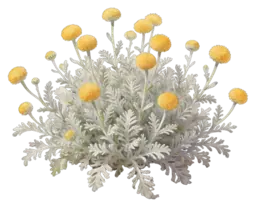
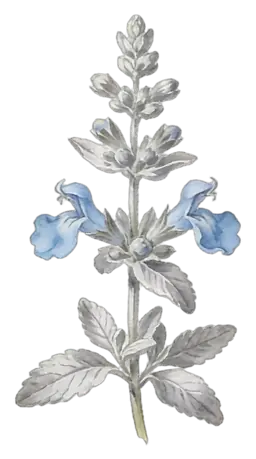
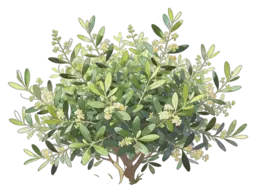
Eremophila nivea is an Australian shrub 1 to 1.5 m tall, much prized for its foliage: the leaves are narrow and covered in white, silky, woolly hairs, giving the whole plant a silvery look. The flowers are tubular, bluish lilac, and appear singly or in pairs among the leaves. It comes from arid areas with sandy and sandy-clay soils, and in the garden it likes full sun, dry heat and perfect drainage. What it handles worst is humidity: the hairy foliage gets fungal diseases if it gets wet or the air is heavy, so in humid climates, or where there is summer rain, it does better in a pot than in the ground. It is a collector's plant, and grafted eremophilas are more tolerant of excess water around the roots.
Family and origin: Figwort family (Scrophulariaceae) · native to Western Australia (the Three Springs and Yalgoo areas) · More plants from Oceania
01In your area
How will it do in your garden?
Year calendar
| Task | J | F | M | A | M | J | J | A | S | O | N | D |
|---|---|---|---|---|---|---|---|---|---|---|---|---|
| Plant / transplantApr–May, Sep | no | no | no | yes | yes | no | no | no | yes | no | no | no |
| FloweringMar–May | no | no | yes | yes | yes | no | no | no | no | no | no | no |
| PruningAug–Sep | no | no | no | no | no | no | no | yes | yes | no | no | no |
| CuttingsJun–Aug | no | no | no | no | no | yes | yes | yes | no | no | no | no |
Its life cycle at a glance
Swipe and tap a stage to see its details.
02Planting
Where and how to plant it
Leave 1.2 m between plants.
03Care
Care through the year
Sun and aspectFull sun · 8 h of sun · South or south-west, with nothing casting shade at midday
- Too little sun
- Ideal range
- Plenty of sun
South or south-west, with nothing casting shade at midday
Strong sun: Loves full midday sun and high temperatures.
Full sun and open air. It withstands light frosts, down to about -4 or -5 °C according to some sources, although others describe it as cold-sensitive; protect young plants and those in pots when the temperature drops below 0 °C.
WateringLet it dry out between waterings · summer: every 5-7 days
- Summerevery 5-7 days3 L per plant/week
- Spring / Autumnevery 10-14 days1.2 L per plant/week
- Winteronly in extreme drought (once a month)0.5 L per plant/week
Let it dry out between waterings: A Mediterranean favourite: better thirsty than overwatered.
Water sparingly: wait until the potting mix is completely dry between waterings and wet the soil, not the foliage. It needs a very free-draining mix, with plenty of sand or fine gravel, and a pot with drainage holes. In winter, hardly any water.
When to water? Push your finger 5 cm into the soil next to the base of the plant:
- Damp: soil sticks to your finger. Do not water yet. It has more than enough; wait for it to dry out more.
- Cool but clean, no mud. Wait another 1-2 days before watering.
- Dry and dusty. Water now, but moderately. Do not overdo it: it prefers thirst to excess.
- TipWater generously in the first year until it is established; after that it looks after itself.
Soil and feedingpH 6.5–8 · Deep soil with good drainage
Deep soil with good drainage.
Medium/high.
This plant prefers a pH between 6.5 and 8.0 (neutral to alkaline).
- Water generously in the first year until it is established.
- A thick mulch all year round, not touching the trunk.
- TipPlant it in a very sunny, open spot, in sandy, very well-drained soil, or in a large terracotta pot with cactus compost mixed with coarse sand.
- TipIn humid climates or where there is summer rain, keep it in a pot under cover or in a porch, and water only the potting mix.
PruningWhen: Aug–Sep
Pruning time for this plant: Aug–Sep.
- TipAfter flowering, a light prune keeps it compact, without cutting into old wood.
- TipThe figures for cold, watering, pruning time and flowering are approximate, because there is hardly any growing data for Spain.
- TipFormative pruning after flowering keeps the shape compact.
- Common mistakePruning at the wrong time removes the year's flower buds.
04Propagation
Make new plants
It is propagated from semi-ripe cuttings, although it is tricky: the woolly foliage rots easily if it gets wet or the air is very humid. Nurseries prefer grafting onto a Myoporum rootstock (a related Australian shrub that tolerates wet soil better), which is why many plants are sold grafted. Seed is rarely used.
05Uses and health
What it is used for, and with what care
There is no reliable data on the toxicity of this species to people, dogs or cats. In Australia some eremophilas are known to be toxic to livestock, so as a precaution do not eat it and do not let animals chew the plant.
- Properties
- A very decorative shrub for its silvery foliage, with low water needs; the flowers attract bees and other insects.
For guidance only; this is not medical treatment and does not replace advice from a doctor or vet.
06Companions and related plants