
Credits and licences
- #1 — vueltaalhuerto illustration
- #2 — vueltaalhuerto illustration
- #3 — vueltaalhuerto illustration
- #4 — vueltaalhuerto illustration
- #5 — vueltaalhuerto illustration
- #6 — vueltaalhuerto illustration
- #7 — vueltaalhuerto illustration
- #8 — vueltaalhuerto illustration
- #9 — vueltaalhuerto illustration
- #10 — vueltaalhuerto illustration
Sea urchin cactus (Astrophytum asterias)
and 2 more names
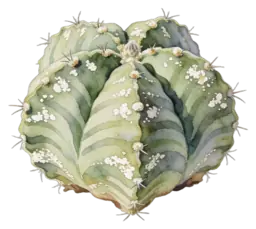
Astrophytum 'Superkabuto', kabuto cactusSea urchin cactus (Astrophytum asterias) is sown in seed trays from April to June, and planted out from April to June. It flowers from May to July. Grow it in full sun, 12 cm apart, with little watering. Dates are for a mild temperate climate in the northern hemisphere; the calendar below adjusts them to your zone.
A small, disc-flattened, spineless cactus about 6 to 15 cm across and barely 2 to 8 cm tall. It has eight broad, shallow ribs with rows of areoles covered in white wool, and an olive-green body speckled with tiny white dots. In summer it opens yellow flowers with an orange or reddish throat, about 6 to 7 cm across, and produces small, woolly fruits. It grows very slowly and is one of the most delicate species in the genus: it cannot tolerate too much water. The cultivars called 'Superkabuto' or 'kabuto' are collectors' selections with very dense, almost merged white dots. It is a species protected under the CITES convention (Appendix I) and is threatened in the wild: buy only nursery-grown plants with their documentation and never specimens taken from the wild.
Family and origin: Cactus family (Cactaceae) · native to Southern Texas and north-eastern Mexico · More plants from Mesoamerica
01In your area
How will it do in your home?
Year calendar
| Task | J | F | M | A | M | J | J | A | S | O | N | D |
|---|---|---|---|---|---|---|---|---|---|---|---|---|
| Seed trayApr–Jun | no | no | no | yes | yes | yes | no | no | no | no | no | no |
| Plant / transplantApr–Jun | no | no | no | yes | yes | yes | no | no | no | no | no | no |
| FloweringMay–Jul | no | no | no | no | yes | yes | yes | no | no | no | no | no |
Its life cycle at a glance
Swipe and tap a stage to see its details.
02Planting
Planting and transplanting
- TipIt is sometimes confused with peyote because of its shape, but it is not the same plant.
03Care
Care through the year
Sun and aspectFull sun · 8 h of sun · South or south-west, with nothing casting shade at midday
- Too little sun
- Ideal range
- Plenty of sun
South or south-west, with nothing casting shade at midday
Strong sun: Loves full midday sun and high temperatures.
Very intense light and, if possible, direct morning sun; behind glass or outdoors at midday in summer it scorches. If you buy it from a greenhouse, accustom it to the sun gradually.
WateringLet it dry out between waterings · summer: every 5-7 days
- Summerevery 5-7 days0.2 L per plant/week
- Spring / Autumnevery 10-14 days0.1 L per plant/week
- Winteronly in extreme drought (once a month)0 L per plant/week
Let it dry out between waterings: A Mediterranean favourite: better thirsty than overwatered.
Water sparingly and only when the potting mix is completely dry, from spring to autumn, wetting the soil and not the body of the plant. From November to March, no water. It is very prone to rot: a very mineral potting mix, a terracotta pot and plenty of ventilation.
When to water? Push your finger 5 cm into the soil next to the base of the plant:
- Damp: soil sticks to your finger. Do not water yet. It has more than enough; wait for it to dry out more.
- Cool but clean, no mud. Wait another 1-2 days before watering.
- Dry and dusty. Water now, but moderately. Do not overdo it: it prefers thirst to excess.
- TipA dry winter rest: with hardly any water they flower better in spring.
- Common mistakeWatering in cold winter weather is the fast track to rot.
Potting mix and feedingpH 6–7 · Mineral mix with almost no organic matter
Mineral mix with almost no organic matter.
20 % multi-purpose compost · 40 % silica sand · 40 % pumice or lava rock.
Extreme.
This plant prefers a pH between 6.0 and 7.0 (slightly acidic to neutral).
- Rich, compact mix: certain rot within a few months.
- Watering in cold winter weather: the first step towards rot.
- TipPlant it in a terracotta pot with an almost entirely mineral potting mix (for example, 70 to 80 % coarse sand, pumice or fine gravel and a little cactus compost), with good drainage.
- TipStart watering in mid-spring, always when the potting mix is already dry, and stop watering in autumn.
- TipPlenty of light and a free-draining mineral mix.
- Common mistakeA mix that holds water drowns the roots.
Common mistakes and tips
- TipPut it in a very bright, airy spot; on the Spanish Mediterranean coast and inland it can live outdoors from May to October protected from rain, and in winter it must be brought in and kept dry, not dropping below about 5 °C.
- TipRepot every two or three years in spring.
- TipMealybugs hide in the wool of the areoles: check frequently.
- TipLEGAL NOTICE: Astrophytum asterias is listed in Appendix I of CITES and in Annex A of the European regulation on trade in wild fauna and flora; do not take specimens from the wild, and insist on an invoice and documentation when buying.
- TipThe growth figures are approximate.
04Propagation
Make new plants
It is propagated mainly by seed, sown on the surface, without burying, on a very fine, moist mineral potting mix, with gentle warmth (about 20 to 28 °C) and plenty of light, in a covered tray. It comes up in one to three weeks, and the seedlings take years to reach maturity: they flower at about three or four years old. The plant usually needs pollen from another specimen to produce fertile seed, so it is worth hand-pollinating with a second plant. Unusual specimens, such as the Superkabuto, are usually bought grafted or already rooted because they are expensive and slow.
Seeds: how to germinate them~10 days
05Uses and health
What it is used for, and with what care
- Properties
- An ornamental collector's cactus, with no medicinal or edible uses.
For guidance only; this is not medical treatment and does not replace advice from a doctor or vet.
06Companions and related plants
What to plant it with
Compare with similar varieties
| Variety | Sowing | Harvest | Days | Spacing | Difficulty |
|---|---|---|---|---|---|
| Sea urchin cactus (Astrophytum asterias) | Apr–Jun | — | — | 12 cm | Difficult |
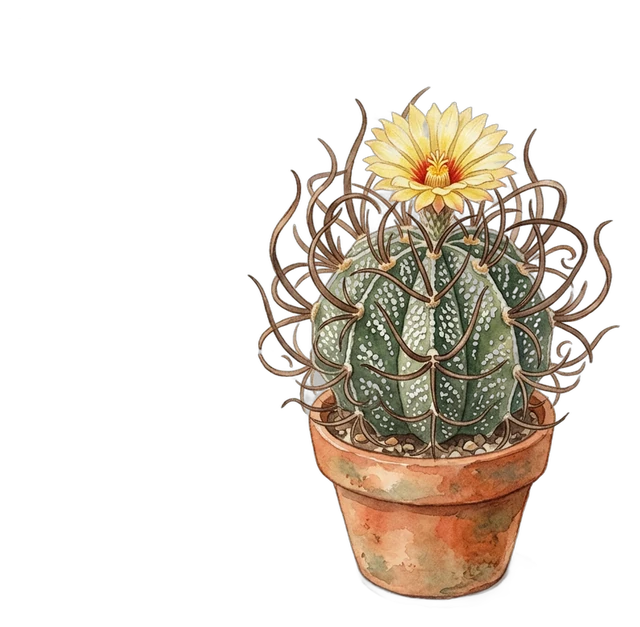
| Goat's horn cactus (Astrophytum capricorne) | Apr–Jun | — | — | 15 cm | Moderate |
| Astrophytum ornatum (bishop's hood) | — | — | — | 15 cm | Moderate |
No known toxicity to people or pets
No known toxicity to people or pets. It is a protected species (CITES, Appendix I): buy only nursery-grown specimens with documentation. It is sometimes confused with peyote (Lophophora) because of its rounded, spineless shape, but it is a different plant and has no edible or recreational use.