
Credits and licences
- #1 — vueltaalhuerto illustration
- #2 — vueltaalhuerto illustration
- #3 — vueltaalhuerto illustration
- #4 — vueltaalhuerto illustration
- #5 — vueltaalhuerto illustration
- #6 — vueltaalhuerto illustration
- #7 — vueltaalhuerto illustration
- #8 — vueltaalhuerto illustration
- #9 — vueltaalhuerto illustration
Rhaphidophora tenuis
and 1 more names
tenuisRhaphidophora tenuis is planted from April to June. Grow it in sun or partial shade, 50 cm apart, with moderate watering. Dates are for a mild temperate climate in the northern hemisphere; the calendar below adjusts them to your zone.
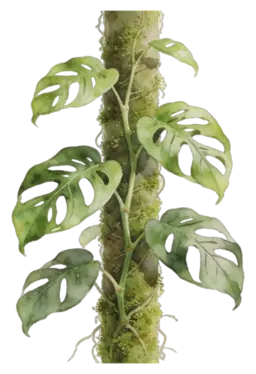
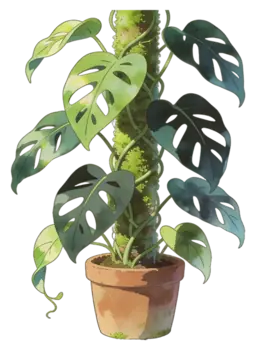
Rhaphidophora tenuis is a slender climbing aroid that changes its appearance with age. When young it has small, entire, lance-shaped leaves, slightly curved and pointing upwards, about 5 to 8 cm long; as it climbs and gets more light, the leaves grow larger and become deeply split into lobes, up to 30 cm or more. It is sold in pots with a moss pole and is one of the most rewarding and striking rhaphidophoras. For a long time it was considered a synonym of Rhaphidophora korthalsii, and in 2006 it was recognised as a species in its own right, endemic to north-western Borneo. At home it needs plenty of light out of direct sun, a support pole and some humidity; it rarely flowers. LEGAL AND SAFETY NOTICE: aroids contain calcium oxalate crystals in their leaves, stems and sap: chewing or swallowing them causes pain and swelling of the mouth and throat, drooling and vomiting, and the sap can irritate the skin and eyes. Aroids of the genus Monstera are listed as toxic to dogs and cats; there is no specific information for this species, so treat it the same way. What to do: keep it out of reach of children and pets, wear gloves when pruning it or taking cuttings, wash your hands afterwards and, if any is swallowed, consult a doctor or a vet. Do not use it in food, infusions or remedies. We have not found this species listed in the CITES Convention or in the Spanish Catalogue of Invasive Alien Species, and it can be freely bought and sold.
Family and origin: Arum family (Araceae) · native to North-western Borneo (Sarawak and Brunei), in lowland and hill rainforests up to about 1,000 m, climbing trees and rocks · More plants from Southeast Asia
01In your area
How will it do in your home?
Year calendar
| Task | J | F | M | A | M | J | J | A | S | O | N | D |
|---|---|---|---|---|---|---|---|---|---|---|---|---|
| Plant / transplantApr–Jun | no | no | no | yes | yes | yes | no | no | no | no | no | no |
| PruningMar–Apr | no | no | yes | yes | no | no | no | no | no | no | no | no |
| CuttingsApr–Aug | no | no | no | yes | yes | yes | yes | yes | no | no | no | no |
Its life cycle at a glance
Swipe and tap a stage to see its details.
02Planting
Planting and transplanting
- TipGive it a damp moss or cork pole: with a tall support the plant moves from entire juvenile leaves to split adult ones.
- TipTurn the pot from time to time and wipe off dust with a damp cloth.
03Care
Care through the year
Sun and aspectSun and shade · 4 h of sun · shade in summer
- Too little sun
- Ideal range
- Plenty of sun
East, or south with light shade during the middle of the day
Gentle sun: Morning or afternoon sun. Midday summer sun stresses and scorches it.
Bright light out of direct sun; young plants tolerate direct sun worse than mature ones. Temperature 18 to 28 °C, not below about 12 °C.
- TipTurn the pot every week so it grows evenly towards the light.
WateringMoist but never waterlogged · summer: every 7 to 10 days, when the top third has dried
- Summerevery 7 to 10 days, when the top third has dried0.6 L per plant/week
- Spring / Autumnevery 4-5 days0.3 L per plant/week
- Winterevery 12 to 15 days, almost dry between waterings0.1 L per plant/week
Moist but never waterlogged: Water before the surface is completely dry. Never puddles.
An airy, free-draining potting mix with bark, perlite and coir. Let part of the potting mix dry out between waterings to avoid root rot. It prefers high humidity.
When to water? Push your finger 3 cm into the soil next to the base of the plant:
- Damp: soil sticks to your finger. Do not water today. The moisture is fine.
- Cool but clean, no mud. Water early tomorrow if it stays like this, or this evening.
- Dry and dusty. Water now, and deeply. This is not where it likes to be.
- TipAdjust watering to the light and the season: in winter almost all of them need much less water.
- Common mistakeOverwatering is the number one killer: let it dry out as the species requires.
Potting mix and feedingpH 5.5–7 · Multi-purpose compost lightened with perlite
Multi-purpose compost lightened with perlite.
70 % multi-purpose compost · 20 % perlite · 10 % coir.
High: always a pot with a drainage hole and a shallow saucer.
This plant prefers a pH between 5.5 and 7.0 (slightly acidic to neutral).
- Repot every 2-3 years into a pot a finger's width wider, not much more.
- A handful of worm castings a year keeps the potting mix alive.
- Reusing old potting mix without refreshing it compacts and rots the roots.
- No drainage in the pot = waterlogged roots = dead plant.
PruningWhen: Mar–Apr
Pruning time for this plant: Mar–Apr.
Common mistakes and tips
- TipWatch out for mealybug and red spider mite.
- TipWash your hands after handling it.
- TipThe frequencies and timings are approximate.
04Propagation
Make new plants
It is propagated by stem cuttings with at least one node, one leaf and, ideally, an aerial root. Cut with a clean blade below the node, from April to August, and root it in a glass of water or in moist, airy potting mix with warmth and light; roots appear in a few weeks. Seed is hardly ever used because the plant rarely fruits in cultivation.
Seeds: how to germinate them~30 days
05Uses and health
What it is used for, and with what care
SAFETY NOTICE: like other aroids, it contains calcium oxalate crystals: chewing or swallowing it causes pain and swelling of the mouth and throat, drooling and vomiting, and the sap can irritate the skin and eyes. There is no specific data for this species, so we apply the precaution for the group. Keep it out of reach of children and pets, wear gloves when pruning and consult a doctor or a vet if any is swallowed.
- Properties
- An ornamental houseplant; it has no safe medicinal or culinary uses.
- Uses
- It is not edible. Do not use it in food, infusions or remedies.
For guidance only; this is not medical treatment and does not replace advice from a doctor or vet.
06Companions and related plants
What to plant it with
Compare with similar varieties
| Variety | Sowing | Harvest | Days | Spacing | Difficulty |
|---|---|---|---|---|---|
| Mini monstera (Rhaphidophora tetrasperma) | — | — | — | 50 cm | Easy |
| Rhaphidophora puberula | Apr–Jun | — | — | 40 cm | Moderate |
| Rhaphidophora tenuis | Apr–Jun | — | — | 50 cm | Moderate |