Credits and licences
- #1 — vueltaalhuerto illustration
- #2 — vueltaalhuerto illustration
- #3 — vueltaalhuerto illustration
- #4 — vueltaalhuerto illustration
- #5 — vueltaalhuerto illustration
- #6 — vueltaalhuerto illustration
- #7 — vueltaalhuerto illustration
Resurrection plant (false rose of Jericho)
and 3 more names
Selaginella lepidophylla, selaginella, stone flowerResurrection plant (false rose of Jericho) is planted from April to May. Grow it in sun or partial shade, 15 cm apart, with little watering. Dates are for a mild temperate climate in the northern hemisphere; the calendar below adjusts them to your zone.
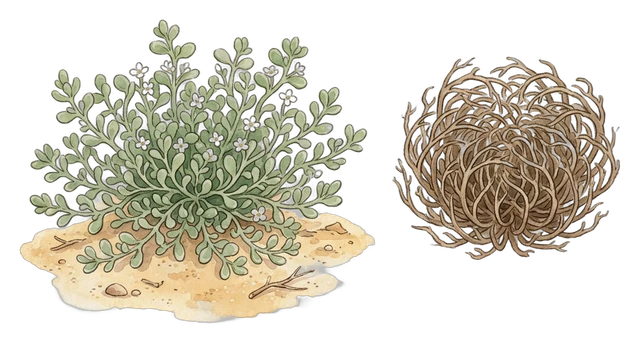
A very curious desert plant, a lycophyte (a distant relative of ferns and mosses, with no flowers or seeds) that forms a rosette of flattened branches covered in tiny scale-like leaves, green when it is hydrated. When water runs short, the branches curl inwards into a dry brown ball that looks dead, and it can stay like that for a long time; given water, it opens up again and turns green within a few hours. This is the plant sold in shops as ‘rose of Jericho’ or ‘resurrection plant’, a name that invites confusion: the true rose of Jericho is a different plant, Anastatica hierochuntica (see its profile), which is a flowering plant and, once dry, is genuinely dead. At home it is enjoyed as a curiosity, opening it for a few days and letting it dry out again; if it is kept soaking for too long it rots or goes mouldy. As it is sold dry and many plants are collected from the wild, it is best to buy from trusted suppliers.
Family and origin: Spikemoss family (Selaginellaceae) · native to Chihuahuan Desert (northern Mexico and the south-western United States) · More plants from Mesoamerica
01In your area
How will it do in your home?
Year calendar
| Task | J | F | M | A | M | J | J | A | S | O | N | D |
|---|---|---|---|---|---|---|---|---|---|---|---|---|
| Plant / transplantApr–May | no | no | no | yes | yes | no | no | no | no | no | no | no |
| Divide the clumpApr–Jun | no | no | no | yes | yes | yes | no | no | no | no | no | no |
Its life cycle at a glance
Swipe and tap a stage to see its details.
02Care
Care through the year
Sun and aspectSun and shade · 3 h of sun · shade in summer
- Too little sun
- Ideal range
- Plenty of sun
East, or south with light shade during the middle of the day
Gentle sun: Morning or afternoon sun. Midday summer sun stresses and scorches it.
Bright light without strong midday sun; next to a bright window or on a covered terrace. Keep it away from radiators and draughts.
- TipTurn the pot every week so it grows evenly towards the light.
WateringLet it dry out between waterings · summer: only to open it: a few days in water and then a long dry rest
- Summeronly to open it: a few days in water and then a long dry rest0.3 L per plant/week
- Spring / Autumnevery 10-14 days0.1 L per plant/week
- Winterthe same, with long dry rests0 L per plant/week
Let it dry out between waterings: A Mediterranean favourite: better thirsty than overwatered.
To hydrate it, stand its base in a deep dish with a couple of centimetres of water, ideally rainwater or distilled water (or tap water left to stand); it opens within a few hours. Leave it open for three to seven days and then take it out of the water so it dries out completely again before repeating, with a dry rest of at least two weeks. Do not leave it soaking for more than a week, because it rots or goes mouldy. Sources differ somewhat on the timings: those given here are approximate.
When to water? Push your finger 3 cm into the soil next to the base of the plant:
- Damp: soil sticks to your finger. Do not water yet. It has more than enough; wait for it to dry out more.
- Cool but clean, no mud. Wait another 1-2 days before watering.
- Dry and dusty. Water now, but moderately. Do not overdo it: it prefers thirst to excess.
- TipIf you see white mould or an unpleasant smell, take it out of the water, let it dry thoroughly in the air and do not rehydrate it for a few weeks.
- TipAdjust watering to the light and the season: in winter almost all of them need much less water.
- Common mistakeOverwatering is the number one killer: let it dry out as the species requires.
Potting mix and feedingpH 6–7.5 · Multi-purpose compost lightened with perlite
Multi-purpose compost lightened with perlite.
70 % multi-purpose compost · 20 % perlite · 10 % coir.
High: always a pot with a drainage hole and a shallow saucer.
This plant prefers a pH between 6.0 and 7.5 (slightly acidic to slightly alkaline).
- Repot every 2-3 years into a pot a finger's width wider, not much more.
- A handful of worm castings a year keeps the potting mix alive.
- Reusing old potting mix without refreshing it compacts and rots the roots.
- No drainage in the pot = waterlogged roots = dead plant.
- TipUse it as a curiosity in a shallow dish or bowl, with gravel or a very free-draining mineral mix, and alternate hydration phases of a week at most with dry rests of at least two weeks.
- Common mistakePots without drainage waterlog the roots and rot the plant.
Common mistakes and tips
- TipOver time, repeated cycles weaken it: it normally lives through a good number of cycles, sometimes for years, but it is not eternal.
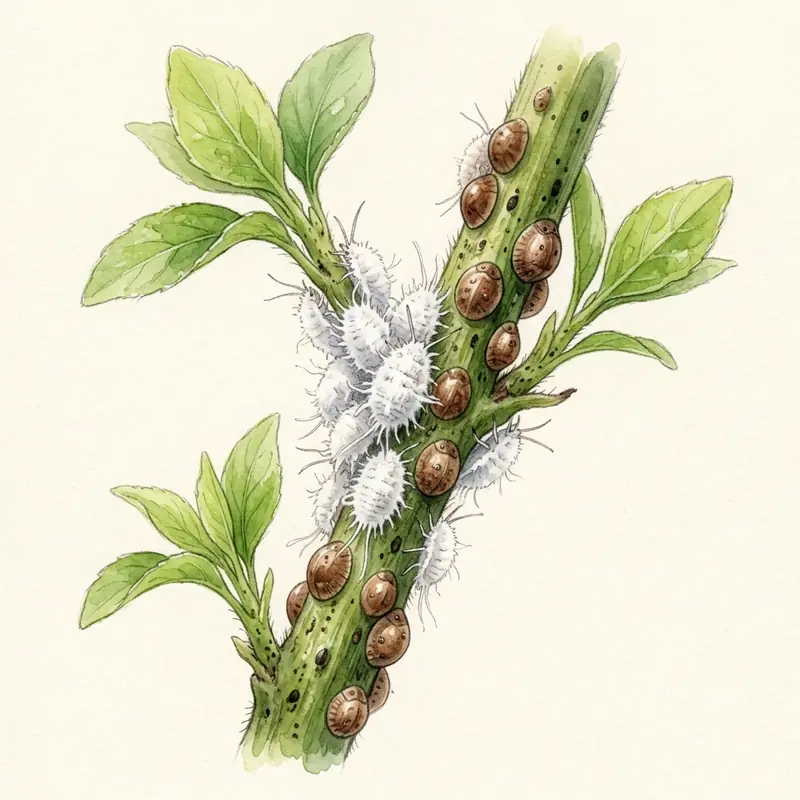
- TipWatch out for mealybugs and red spider mite, which can hide among the branches.
- TipTemperatures, timings and rest periods are approximate.
03Propagation
Make new plants
At home it is hardly ever propagated: the plants you buy are dry rosettes of wild or commercial origin, and lycophytes like this one reproduce by spores in nature, a method that is impractical for the amateur. If you have a living, vigorous clump, the most sensible approach is to divide it in spring into small pieces, each with its own base and roots, and keep them in a slightly moist mineral mix in diffuse light; it is a slow procedure with few documented successes.
04Uses and health
What it is used for, and with what care
There are no reliable data on the toxicity of this species to people, dogs and cats: do not eat it, do not use it in infusions and stop animals from chewing the plant. CONFUSION: what is sold as ‘rose of Jericho’ is usually this plant, but the true rose of Jericho is Anastatica hierochuntica, a different species; do not mix up information between the two profiles. Many dry plants are collected from the wild: buy from trusted suppliers.
- Properties
- An ornamental curiosity plant that is not grown for health purposes. Although it has been used as an infusion in Mexican folk tradition, there is no solid evidence of any effect, so it is not presented as a remedy.
- Uses
- It is not edible and must not be used in infusions or home preparations.
For guidance only; this is not medical treatment and does not replace advice from a doctor or vet.
05Companions and related plants
What to plant it with
06Pests and diseases
Critters and ailments to keep an eye on
The most common ones on this plant. Tap one to see how to recognise it and what to do.