
Credits and licences
- #1 — vueltaalhuerto illustration
- #2 — vueltaalhuerto illustration
- #3 — vueltaalhuerto illustration
- #4 — vueltaalhuerto illustration
- #5 — vueltaalhuerto illustration
- #6 — vueltaalhuerto illustration
- #7 — vueltaalhuerto illustration
- #8 — vueltaalhuerto illustration
- #9 — vueltaalhuerto illustration
- #10 — vueltaalhuerto illustration
Aloe mitriformis (mitre aloe)
and 3 more names
Aloe mitriformis, Aloe perfoliata, aloeAloe mitriformis (mitre aloe) is sown in seed trays from March to May, and planted out from April to June and in September. Grow it in full sun, 60 cm apart, with little watering. Dates are for a mild temperate climate in the northern hemisphere; the calendar below adjusts them to your zone.
What else to sow in March, April and May
Aloe mitriformis is a creeping or trailing aloe: from a short, thick stem, which leans over and branches with age, come rosettes of broad, fleshy, bluish or grey-green leaves with whitish teeth along the edges, and over time the plant forms a low, spreading clump about 30 to 50 cm tall. The flower spike carries a dense cluster of scarlet tubular flowers (sometimes yellow or orange) that attract birds and insects. It is drought-resistant and is grown in pots, rock gardens and sunny borders in climates without hard frosts. The accepted name today is Aloe perfoliata: Kew (POWO) and South Africa's SANBI treat A. mitriformis as a synonym, although nurseries still sell it as Aloe mitriformis or mitre aloe. It is not Aloe vera and is not used in cosmetics: do not use it as such. LEGAL AND SAFETY NOTICE: all species of the genus Aloe, except Aloe vera (A. barbadensis), are covered by the CITES Convention: about twenty species in Appendix I and the rest in Appendix II, and in the European Union by Regulation (EC) No 338/97. The official Species+ database lists A. mitriformis in Appendix II (Annex B in the EU), so it is a CITES plant. It is prohibited to collect specimens from the wild or to trade them between countries without CITES permits, and breaches can lead to administrative and even criminal penalties. What to do: buy only nursery-grown plants, with an invoice or label showing their origin, keep the receipt if you are going to sell or give away the plant, and check with the CITES Customs Service (Spain) before travelling with it or sending it outside the EU; check its current status in the Species+ database (speciesplus.net). As for safety, aloe leaves release a bitter yellow latex that irritates the skin and is laxative and toxic if swallowed; the plant is harmful to dogs and cats. Wear gloves when pruning and keep it out of reach of children and pets. We have not found it listed in the Spanish Catalogue of Invasive Alien Species.
Family and origin: Asphodel family (Asphodelaceae) · native to South Africa, in the west and south of the Cape Province, on rocky slopes and fynbos scrub · More plants from Africa
01In your area
How will it do in your garden?
Year calendar
| Task | J | F | M | A | M | J | J | A | S | O | N | D |
|---|---|---|---|---|---|---|---|---|---|---|---|---|
| Seed trayMar–May | no | no | yes | yes | yes | no | no | no | no | no | no | no |
| Plant / transplantApr–Jun, Sep | no | no | no | yes | yes | yes | no | no | yes | no | no | no |
| CuttingsApr–Jul | no | no | no | yes | yes | yes | yes | no | no | no | no | no |
| Divide the clumpApr–Jun | no | no | no | yes | yes | yes | no | no | no | no | no | no |
Its life cycle at a glance
Swipe and tap a stage to see its details.
02Care
Care through the year
Sun and aspectFull sun · 6 h of sun · South or south-west, with nothing casting shade at midday
- Too little sun
- Ideal range
- Plenty of sun
South or south-west, with nothing casting shade at midday
Strong sun: Loves full midday sun and high temperatures.
Full sun or very bright light; in the extreme heat of inland areas it appreciates some midday shade. It withstands very light frosts in dry soil; to be safe, do not leave it outdoors below about -2 °C or with damp potting mix. We have not found a reliable figure for its cold hardiness.
- Common mistakeLack of light makes them stretch and go soft (etiolation).
WateringLet it dry out between waterings · summer: every 10 to 15 days
- Summerevery 10 to 15 days0.2 L per plant/week
- Spring / Autumnevery 10-14 days0.1 L per plant/week
- Winternone, or once a month0 L per plant/week
Let it dry out between waterings: A Mediterranean favourite: better thirsty than overwatered.
Water thoroughly and let the potting mix dry out completely between waterings; in winter, hardly at all. Always empty the saucer.
When to water? Push your finger 5 cm into the soil next to the base of the plant:
- Damp: soil sticks to your finger. Do not water yet. It has more than enough; wait for it to dry out more.
- Cool but clean, no mud. Wait another 1-2 days before watering.
- Dry and dusty. Water now, but moderately. Do not overdo it: it prefers thirst to excess.
- TipWrinkled leaves indicate a lack of water; soft, translucent ones, too much.
- TipWater thoroughly and leave long gaps: better thirsty than overwatered.
- Common mistakeWatering often rots the crown and the roots.
Soil and feedingpH 6–7.5 · Very gritty, free-draining mix
Very gritty, free-draining mix.
30 % multi-purpose compost · 40 % coarse sand · 30 % perlite or pumice.
Very high: standing moisture rots them.
This plant prefers a pH between 6.0 and 7.5 (slightly acidic to slightly alkaline).
- Multi-purpose compost on its own with no drainage: rot sets in quickly.
- Watering the rosette or the leaves marks them and causes rot.
- TipPlant it in a deep pot or a pocket in a rock garden, with a very free-draining mix of half cactus compost and half gravel.
- TipFeed it once or twice between spring and summer with cactus fertiliser at half strength.
- TipVery free-draining mix (with sand/perlite) and pots with a drainage hole.
Common mistakes and tips
- TipGive it room to spread or trail.
- TipWatch out for mealybugs.
- TipDimensions, temperatures and timings are approximate.
03Propagation
Make new plants
It is propagated by offsets and by cuttings of the creeping stem: in spring or early summer, separate the rosettes that form along the stem, with a piece of stem and, if possible, roots; leave the wound to dry for several days and plant them in a mineral potting mix. It can also be sown: the seeds, which are fine, brown and have a membranous wing, are sown in spring in a sandy mix at about 18 to 25 °C. Buy only nursery-grown plants.
Seeds: how to germinate them~21 days
04Uses and health
What it is used for, and with what care
SAFETY WARNING: aloe leaves contain a yellow latex with anthraquinones, bitter and laxative, which irritates the skin and causes vomiting and diarrhoea if swallowed; it is harmful to dogs and cats. Wear gloves when pruning, keep it out of reach of children and pets and consult a doctor or vet if any is swallowed. LEGAL NOTICE: the genus Aloe (except Aloe vera) is covered by CITES, almost entirely in Appendix II: buy only nursery-grown plants with an invoice and do not collect wild specimens.
- Properties
- An ornamental plant. It is not Aloe vera and must not be used as such: it has no home medicinal uses.
- Uses
- It is not edible. Do not use it in food, juices, herbal teas or cosmetics: the latex in the leaves is bitter, laxative and irritant.
For guidance only; this is not medical treatment and does not replace advice from a doctor or vet.
05Companions and related plants
What to plant it with
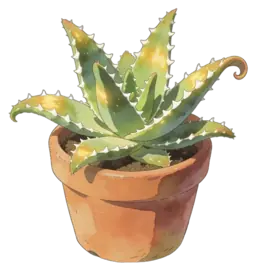
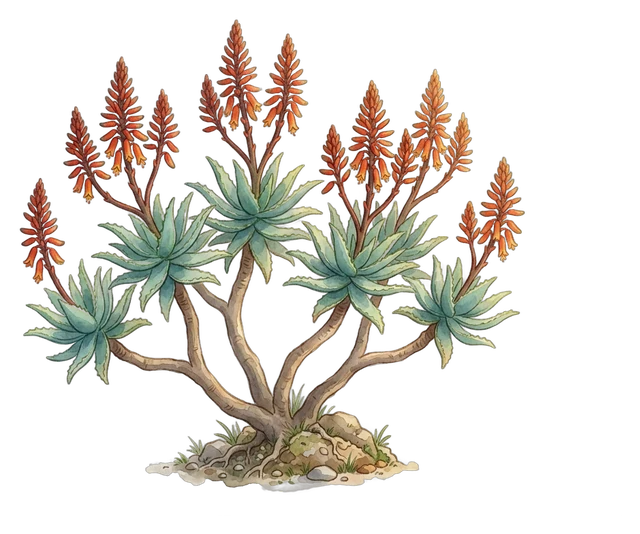
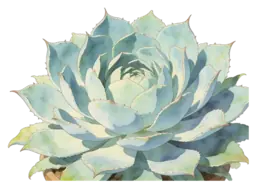
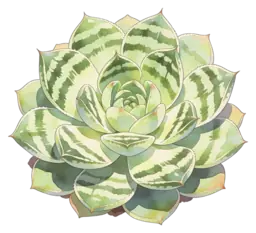
Compare with similar varieties
| Variety | Sowing | Harvest | Days | Spacing | Difficulty |
|---|---|---|---|---|---|
| Spider aloe (Aloe × spinosissima) | Apr–Jun, Sep | — | — | 40 cm | Easy |
| Aloe arborescens (candelabra aloe) | Mar–Apr | — | — | 100 cm | Easy |
| Lace aloe (Aloe aristata) | — | — | — | 20 cm | Easy |
| Aloe mitriformis (mitre aloe) | Mar–May | — | — | 60 cm | Easy |
| Soap aloe (Aloe maculata, syn. Aloe saponaria) | Mar–May | Feb–May | — | 50 cm | Easy |
| Tiger aloe (Gonialoe variegata, Aloe variegata) | Mar–May | — | — | 25 cm | Easy |
| Aloe vera | — | — | — | 30 cm | Easy |