Credits and licences
- #1 — vueltaalhuerto illustration
- #2 — vueltaalhuerto illustration
- #3 — vueltaalhuerto illustration
- #4 — vueltaalhuerto illustration
- #5 — vueltaalhuerto illustration
- #6 — vueltaalhuerto illustration
- #7 — vueltaalhuerto illustration
- #8 — vueltaalhuerto illustration
- #9 — vueltaalhuerto illustration
Earth star (Cryptanthus)
and 3 more names
cryptanthus, Cryptanthus bivittatus, Cryptanthus zonatusEarth star (Cryptanthus) is planted from April to June. Grow it in sun or partial shade, 25 cm apart, with moderate watering. Dates are for a mild temperate climate in the northern hemisphere; the calendar below adjusts them to your zone.
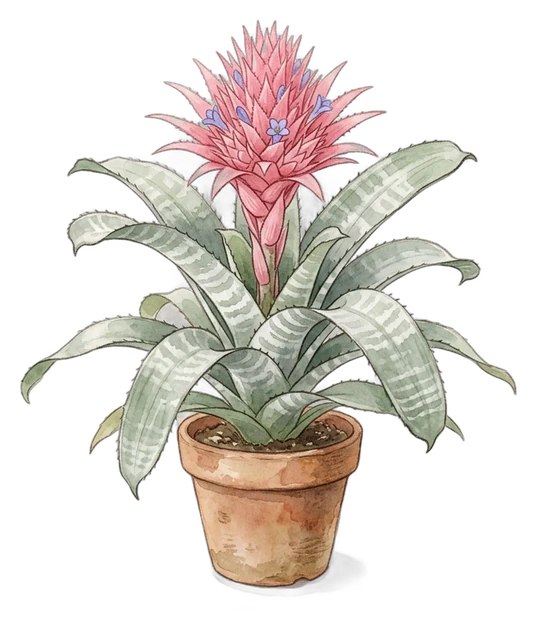
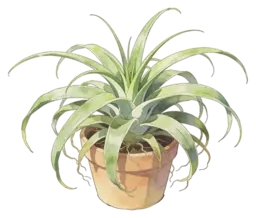
A small, terrestrial bromeliad, meaning it lives on the ground rather than in trees, 10 to 25 cm across, made up of a flat, star-shaped rosette of long leaves with wavy edges and small soft teeth, striped lengthways in light or dark tones, green, pink, reddish or brown depending on the variety. Unlike other bromeliads, it has no central cup for water: you water the potting mix. It flowers only once, with small white flowers in the centre of the rosette, and then produces offsets at the base. It is a plant for indoors or for a terrarium, and it does not tolerate cold below about 10 °C. In shops it is sold as Cryptanthus bivittatus or as striped earth star, and also as Cryptanthus zonatus (zebra plant), whose leaves have crossways bands. It is not edible. Do not confuse it with the urn plant Aechmea fasciata or with the pineapple.
Family and origin: Bromeliad family (Bromeliaceae) · native to Brazil (Atlantic Forest and areas in the east of the country, on the forest floor) · More plants from South America
01In your area
How will it do in your home?
Year calendar
| Task | J | F | M | A | M | J | J | A | S | O | N | D |
|---|---|---|---|---|---|---|---|---|---|---|---|---|
| Plant / transplantApr–Jun | no | no | no | yes | yes | yes | no | no | no | no | no | no |
| Divide the clumpApr–Jul | no | no | no | yes | yes | yes | yes | no | no | no | no | no |
Its life cycle at a glance
Swipe and tap a stage to see its details.
02Care
Care through the year
Sun and aspectSun and shade · 5 h of sun · shade in summer
- Too little sun
- Ideal range
- Plenty of sun
East, or south with light shade during the middle of the day
Moderate sun: Copes with full sun, but give it some shade during heatwaves.
Bright, filtered light, without direct midday sun, which scorches the leaves and fades the markings. In poor light, the leaves turn green and lose their colour. It appreciates warmth, at 18 to 26 °C; do not leave it below about 10 to 15 °C.
- TipTurn the pot every week so it grows evenly towards the light.
WateringMoist but never waterlogged · summer: every 2-3 days
- Summerevery 2-3 days0.6 L per plant/week
- Spring / Autumnevery 4-5 days0.3 L per plant/week
- Winterevery 2-3 weeks0.1 L per plant/week
Moist but never waterlogged: Water before the surface is completely dry. Never puddles. Mulch: straw or dry plant material cuts watering by 30-50 %.
Water the potting mix, not the centre of the rosette, when the top has dried out, using rainwater or chlorine-free water if you can. The potting mix must be very airy and drain well, because the roots are small and rot with too much water. It appreciates humid air, for example grouped with other plants or on a tray of pebbles.
When to water? Push your finger 2 cm into the soil next to the base of the plant:
- Damp: soil sticks to your finger. Do not water today. The moisture is fine.
- Cool but clean, no mud. Water early tomorrow if it stays like this, or this evening.
- Dry and dusty. Water now, and deeply. This is not where it likes to be.
- TipThe leaf tips dry out in dry air or with very hard water: cut off only the dry tip, following the shape of the leaf.
- TipAdjust watering to the light and the season: in winter almost all of them need much less water.
- Common mistakeOverwatering is the number one killer: let it dry out as the species requires.
Potting mix and feedingpH 5.5–6.5 · Multi-purpose compost lightened with perlite
Multi-purpose compost lightened with perlite.
70 % multi-purpose compost · 20 % perlite · 10 % coir.
High: always a pot with a drainage hole and a shallow saucer.
This plant prefers a pH between 5.5 and 6.5 (slightly acidic to neutral).
- Repot every 2-3 years into a pot a finger's width wider, not much more.
- A handful of worm castings a year keeps the potting mix alive.
- Reusing old potting mix without refreshing it compacts and rots the roots.
- No drainage in the pot = waterlogged roots = dead plant.
- TipPlant it in a small, shallow pot, because it has few roots, with a very open potting mix.
- TipFeed sparingly: a liquid fertiliser diluted to a quarter strength once a month in spring and summer is enough.
- Common mistakePots without drainage waterlog the roots and rot the plant.
03Propagation
Make new plants
It is propagated by offsets, which appear at the base or between the leaves of the mother plant, especially after flowering, while the mother rosette gradually fades. When the offset is a third to half the size of the mother, or about 5 to 8 cm, cut it off with a clean knife, with as much root as possible, and plant it in a small pot with an airy bromeliad mix of fine bark, perlite and peat, at 22 to 26 °C and in humid air. It takes in a few weeks. It can also be raised from seed, but this is very slow and is done almost only by collectors.
04Uses and health
What it is used for, and with what care
WARNING: no toxicity to dogs or cats is known according to the plant lists consulted, and it is generally considered safe in homes with pets, but there are no reliable data for people, so as a precaution do not eat it and stop children and pets from chewing the leaves. The leaf edges have small teeth that can scratch the skin. If a significant amount has been eaten, consult a doctor or a vet.
- Properties
- It is a small, very decorative houseplant with showy colours and markings and slow growth, ideal for terrariums, tables and bright corners with little space.
- Uses
- It is not grown for food and is not used in cooking or home remedies. It is not a pineapple and does not produce edible fruit.
For guidance only; this is not medical treatment and does not replace advice from a doctor or vet.
05Companions and related plants