
Credits and licences
- #1 — vueltaalhuerto illustration
- #2 — vueltaalhuerto illustration
- #3 — vueltaalhuerto illustration
- #4 — vueltaalhuerto illustration
- #5 — vueltaalhuerto illustration
- #6 — vueltaalhuerto illustration
- #7 — vueltaalhuerto illustration
- #8 — vueltaalhuerto illustration
- #9 — vueltaalhuerto illustration
- #10 — vueltaalhuerto illustration
Drosera × snyderi (hybrid sundew)
and 2 more names
Drosera nidiformis x natalensis, sundewDrosera × snyderi (hybrid sundew) is sown in seed trays from March to May, and planted out from March to May. Grow it in full sun, 10 cm apart, with plenty of watering. Dates are for a mild temperate climate in the northern hemisphere; the calendar below adjusts them to your zone.
A hybrid carnivorous plant with a semi-upright rosette about 5 to 8 cm across, with fine, elongated, hairy, yellowish-green leaves bearing red tentacles and sticky droplets that trap midges and other tiny insects. In strong light the leaves flush red. It sends up very long, slender flower stalks with small, widely spaced pink flowers that usually set seed unaided. It is one of the easiest and most rewarding South African sundews for beginners, although it goes through spells with few or smaller leaves, which do not mean it is ill. Like any hybrid, it is not a ‘pure’ botanical species: the name is used among hobbyists, and seedlings may resemble the parents without being identical. It is neither edible nor medicinal.
Family and origin: Sundew family (Droseraceae) · native to A hybrid of South African origin between Drosera nidiformis and Drosera natalensis; sellers disagree on whether it arose in the wild or in cultivation · More plants from Africa
01In your area
How will it do in your home?
Year calendar
| Task | J | F | M | A | M | J | J | A | S | O | N | D |
|---|---|---|---|---|---|---|---|---|---|---|---|---|
| Seed trayMar–May | no | no | yes | yes | yes | no | no | no | no | no | no | no |
| Plant / transplantMar–May | no | no | yes | yes | yes | no | no | no | no | no | no | no |
| Divide the clumpMar–May | no | no | yes | yes | yes | no | no | no | no | no | no | no |
Its life cycle at a glance
Swipe and tap a stage to see its details.
02Care
Care through the year
Sun and aspectFull sun · 6 h of sun · shade in summer
- Too little sun
- Ideal range
- Plenty of sun
South or south-west, with nothing casting shade at midday
Moderate sun: Copes with full sun, but give it some shade during heatwaves.
It needs plenty of light: direct morning and afternoon sun, or a powerful grow light. In strong light it turns red and traps better; if it lacks light, it stretches and turns pale green. Behind glass during the middle of the day in summer, give it some shade, and keep the air fairly humid.
- TipAlways buy it from a nursery: do not collect wild sundews, because several European species are protected.
- TipTurn the pot every week so it grows evenly towards the light.
WateringVery moist, tolerates waterlogging · summer: saucer with 1 to 2 cm of mineral-free water, at all times
- Summersaucer with 1 to 2 cm of mineral-free water, at all times1.1 L per plant/week
- Spring / Autumnevery 3-4 days0.5 L per plant/week
- Winterpotting mix just moist, no saucer0.1 L per plant/week
Very moist, tolerates waterlogging: Saturated or nearly saturated soil. Still watch out for fungal disease.
Always water with very low-mineral water: rainwater, distilled water or reverse-osmosis water. Tap water, especially if it is hard, gradually leaves salts in the potting mix and eventually kills the plant. The easiest method is to stand the pot in a saucer with a couple of centimetres of water during the growing season and, in winter, keep the mix just moist, without a saucer. Never feed it: it lives on the insects it catches and fertiliser burns the roots.
This is a plant for waterlogged soil or pond margins: the finger test does not help, because the soil must stay wet all the time. Make sure the mud never dries out and, if it grows in a pond, that the water covers the base as the profile says; in summer, top up what evaporates.
- TipIf at some point it loses leaves and is left with just a few small ones, do not overwater it or move it: it usually resprouts after a few weeks.
- TipAdjust watering to the light and the season: in winter almost all of them need much less water.
Potting mix and feedingpH 4–6 · Multi-purpose compost lightened with perlite
Multi-purpose compost lightened with perlite.
70 % multi-purpose compost · 20 % perlite · 10 % coir.
High: always a pot with a drainage hole and a shallow saucer.
This plant prefers a pH between 4.0 and 6.0 (acidic to slightly acidic).
- Repot every 2-3 years into a pot a finger's width wider, not much more.
- A handful of worm castings a year keeps the potting mix alive.
- Reusing old potting mix without refreshing it compacts and rots the roots.
- No drainage in the pot = waterlogged roots = dead plant.
- TipGrow it in a mix of equal parts unfertilised sphagnum peat and perlite or silica sand, in a plastic or glazed clay pot with drainage holes, and water with rainwater, distilled water or reverse-osmosis water.
- TipDo not feed it dead insects or meat.
- Common mistakePots without drainage waterlog the roots and rot the plant.
Common mistakes and tips
- TipKeep the temperature at 15 to 30 °C; in winter, a bright, cool, frost-free spot (roughly above about 3 to 5 °C) keeps it healthy, although it grows little.
- TipThe figures for cold, temperature and timings are approximate.
03Propagation
Make new plants
The most reliable method is to separate the daughter rosettes at the base and divide the clump in spring, because this way the new plants are identical to the parent. It can also be grown from seed, which sets readily because the flowers self-pollinate, but as it is a hybrid the resulting plants are not identical to the parent. Sow the seed fresh on the surface of moist peat, without covering, in light and warmth.
Seeds: how to germinate them~21 days
04Uses and health
What it is used for, and with what care
WARNING: there is no reliable data on the toxicity of this species. Sundews contain naphthoquinones, substances that can irritate the skin and mucous membranes in sensitive people, so do not eat it, do not use it in home remedies, and wash your hands after handling it. The sticky mucilage on the leaves is harmless to touch, but keep children and pets from biting the plant; if this happens, consult the doctor or the vet.
- Properties
- An ornamental curiosity that catches some midges and tiny flies, but it is no substitute for an insecticide and does not control a pest. It is a good way to learn how carnivorous plants feed.
- Uses
- It is not edible and is not used in infusions. Some European sundews are used in herbal medicine under professional supervision, but this indoor hybrid is not for home use.
For guidance only; this is not medical treatment and does not replace advice from a doctor or vet.
05Companions and related plants
What to plant it with
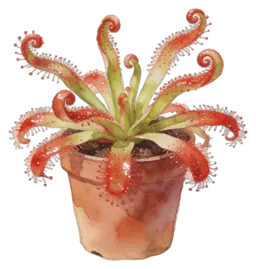
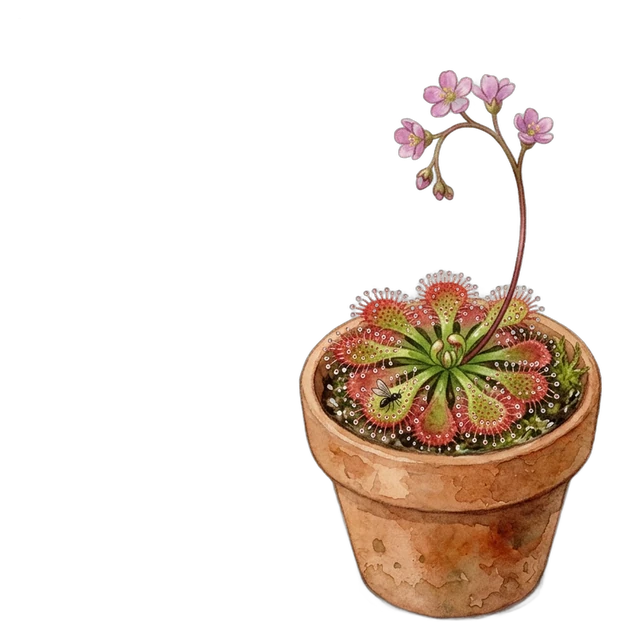
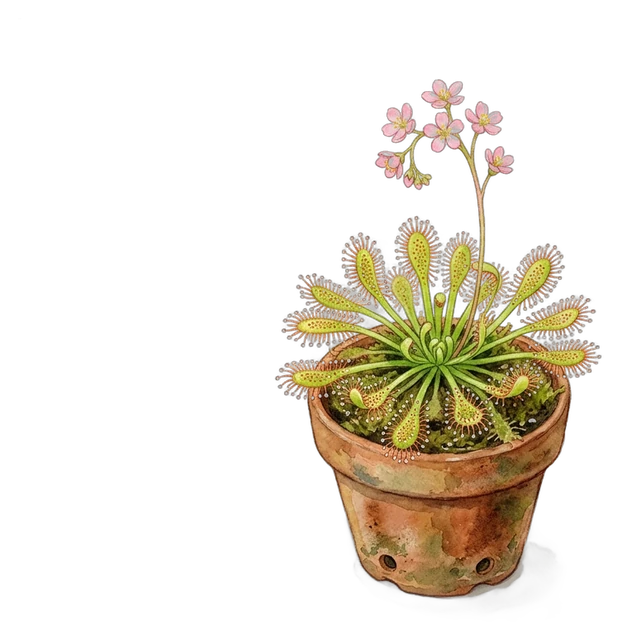
Compare with similar varieties
| Variety | Sowing | Harvest | Days | Spacing | Difficulty |
|---|---|---|---|---|---|
| Alice sundew (Drosera aliciae) | Mar–May | — | — | 10 cm | Easy |
| Wedge-leaved sundew (Drosera cuneifolia) | Mar–Apr, Sep–Oct | — | — | 10 cm | Moderate |
| Cape sundew | — | — | — | 12 cm | Easy |
| Madagascar sundew (Drosera madagascariensis) | Mar–Jun | — | — | 12 cm | Moderate |
| Nest sundew (Drosera nidiformis) | Mar–May | — | — | 10 cm | Moderate |
| Spoon-leaved sundew (Drosera spatulata) | Mar–Jun | — | — | 8 cm | Easy |
| Drosera × snyderi (hybrid sundew) | Mar–May | — | — | 10 cm | Easy |