
Credits and licences
- #1 — vueltaalhuerto illustration
- #2 — vueltaalhuerto illustration
- #3 — vueltaalhuerto illustration
- #4 — vueltaalhuerto illustration
- #5 — vueltaalhuerto illustration
- #6 — vueltaalhuerto illustration
- #7 — vueltaalhuerto illustration
- #8 — vueltaalhuerto illustration
- #9 — vueltaalhuerto illustration
- #10 — vueltaalhuerto illustration
Kalanchoe laciniata (cut-leaf kalanchoe)
and 1 more names
lace leaf kalanchoeKalanchoe laciniata (cut-leaf kalanchoe) is sown in seed trays from March to May, and planted out from April to June. Grow it in full sun, 40 cm apart, with little watering. Dates are for a mild temperate climate in the northern hemisphere; the calendar below adjusts them to your zone.
Kalanchoe laciniata is an upright succulent, somewhere between a subshrub and a shrub, which in cultivation usually grows 30 to 60 cm tall, and up to 1 m or a little more in the wild. Its most striking feature is its fleshy, matt green leaves, deeply divided into narrow, irregular lobes, almost like a fern or celery leaf, borne on reddish stems. In summer it produces dense, flat flower heads of pale orange-yellow tubular flowers that are slightly fragrant. Nurseries sometimes sell it under the name 'Maltese Cross'; I have not been able to confirm that this is a registered cultivar, so the growing information is that for the species. It is an easy, drought-resistant plant that appreciates gentle sun and a very free-draining potting mix. It is grown in pots, especially in areas with frost, and outdoors only in climates with very mild winters. LEGAL AND SAFETY NOTICE: Like other kalanchoes, it contains bufadienolides, cardiac glycosides similar to those in foxglove, which affect the heart. There are veterinary records of poisoning in dogs, cats and birds that nibble plants of this genus, and as a precaution it should be treated as toxic to people too. What to do: do not eat it or use it in herbal teas, keep it out of reach of children and pets, wash your hands after pruning it, and if a person or pet nibbles it, call the Toxicology Information Service (in Spain, 91 562 04 20) or the vet without waiting for symptoms. Legal status: it is not listed in the Spanish Catalogue of Invasive Alien Species (Real Decreto 630/2013) nor on the EU list of invasive species; even so, this species has become naturalised outside its native range and other kalanchoes go wild around the Mediterranean and in the Canary Islands, so do not dump prunings or leaves in the countryside.
Family and origin: Stonecrop family (Crassulaceae) · native to Tropical and eastern Africa (from Eritrea to north-west Namibia) and the Arabian Peninsula, in scrub and dry forest · More plants from Africa
01In your area
How will it do in your home?
Year calendar
| Task | J | F | M | A | M | J | J | A | S | O | N | D |
|---|---|---|---|---|---|---|---|---|---|---|---|---|
| Seed trayMar–May | no | no | yes | yes | yes | no | no | no | no | no | no | no |
| Plant / transplantApr–Jun | no | no | no | yes | yes | yes | no | no | no | no | no | no |
| CuttingsApr–Aug | no | no | no | yes | yes | yes | yes | yes | no | no | no | no |
Its life cycle at a glance
Swipe and tap a stage to see its details.
02Care
Care through the year
Sun and aspectFull sun · 6 h of sun · shade in summer
- Too little sun
- Ideal range
- Plenty of sun
South or south-west, with nothing casting shade at midday
Moderate sun: Copes with full sun, but give it some shade during heatwaves.
Plenty of light and some direct sun; in high summer it appreciates light shade at midday. It does not tolerate hard frost: protect it below about 5 °C.
- Common mistakeLack of light makes them stretch and go soft (etiolation).
WateringLet it dry out between waterings · summer: every 10 to 15 days, deeply, letting it dry out
- Summerevery 10 to 15 days, deeply, letting it dry out0.2 L per plant/week
- Spring / Autumnevery 10-14 days0.1 L per plant/week
- Winterevery 3 or 4 weeks or less0 L per plant/week
Let it dry out between waterings: A Mediterranean favourite: better thirsty than overwatered.
Water the potting mix, not the leaves, and let it dry out completely between waterings; cut watering right back in winter.
When to water? Push your finger 5 cm into the soil next to the base of the plant:
- Damp: soil sticks to your finger. Do not water yet. It has more than enough; wait for it to dry out more.
- Cool but clean, no mud. Wait another 1-2 days before watering.
- Dry and dusty. Water now, but moderately. Do not overdo it: it prefers thirst to excess.
- TipWatering, temperatures and timings are a guide only.
- TipWater thoroughly and leave long gaps: better thirsty than overwatered.
- Common mistakeWatering often rots the crown and the roots.
Potting mix and feedingpH 6–7.5 · Very gritty, free-draining mix
Very gritty, free-draining mix.
30 % multi-purpose compost · 40 % coarse sand · 30 % perlite or pumice.
Very high: standing moisture rots them.
This plant prefers a pH between 6.0 and 7.5 (slightly acidic to slightly alkaline).
- Multi-purpose compost on its own with no drainage: rot sets in quickly.
- Watering the rosette or the leaves marks them and causes rot.
- TipPlant it in a pot of cactus compost mixed with a third of coarse sand or perlite, in a very bright spot with gentle sun.
- TipWater deeply and let the potting mix dry out between waterings.
- TipVery free-draining mix (with sand/perlite) and pots with a drainage hole.
Pruning
- TipPinch out the stem tips in spring so it branches and cut off the dry flower head.
Common mistakes and tips
- TipWatch out for mealybug.
03Propagation
Make new plants
It propagates easily from stem-tip cuttings in spring and summer, and also from seed, which is tiny and sown on the surface. Sources give few details specific to this species.
Seeds: how to germinate them~14 days
04Uses and health
What it is used for, and with what care
Kalanchoes contain bufadienolides, cardiac glycosides similar to those in foxglove, which can disturb the heart rhythm; the genus is listed among plants toxic to dogs, cats and birds. There are no specific data on this species. It is treated as toxic out of caution: keep it out of reach of children and pets, wash your hands after pruning it and, if a person or pet nibbles it, call the Toxicology Information Service (in Spain, 91 562 04 20) or the vet without waiting for symptoms.
- Properties
- Ornamental succulent with no safe home medicinal uses.
- Uses
- Not edible. It has no culinary or medicinal uses; do not use it in herbal teas or eat it.
For guidance only; this is not medical treatment and does not replace advice from a doctor or vet.
05Companions and related plants
What to plant it with
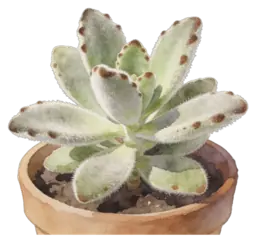
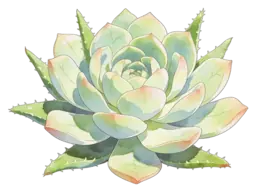
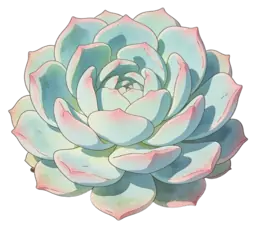
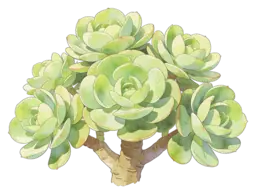
Compare with similar varieties
| Variety | Sowing | Harvest | Days | Spacing | Difficulty |
|---|---|---|---|---|---|
| Kalanchoe (flaming Katy) | — | — | — | 25 cm | Easy |
| Kalanchoe beharensis (felt bush) | Mar–May | — | — | 60 cm | Easy |
| Kalanchoe humilis (desert surprise) | Mar–May | — | — | 20 cm | Easy |
| Kalanchoe laciniata (cut-leaf kalanchoe) | Mar–May | — | — | 40 cm | Easy |
| Panda plant (pussy ears kalanchoe) | — | — | — | 20 cm | Easy |
| Kalanchoe orgyalis (copper spoons) | Mar–May | — | — | 40 cm | Easy |
| Kalanchoe thyrsiflora (paddle plant, flapjack) | Mar–May | — | — | 40 cm | Easy |
| Kalanchoe × kewensis (Kew kalanchoe) | Apr–Jun | — | — | 30 cm | Easy |