Credits and licences
- #1 — vueltaalhuerto illustration
- #2 — vueltaalhuerto illustration
- #3 — vueltaalhuerto illustration
- #4 — vueltaalhuerto illustration
- #5 — vueltaalhuerto illustration
- #6 — vueltaalhuerto illustration
- #7 — vueltaalhuerto illustration
- #8 — vueltaalhuerto illustration
- #9 — vueltaalhuerto illustration
- #10 — vueltaalhuerto illustration
Common evening primrose
Common evening primrose is sown in seed trays from February to March or directly outdoors from March to April and from September to October, and planted out from April to May and in October. It flowers from June to September. Grow it in full sun, 40 cm apart, with little watering. Dates are for a mild temperate climate in the northern hemisphere; the calendar below adjusts them to your zone.
What else to sow in February, March, April, September and October
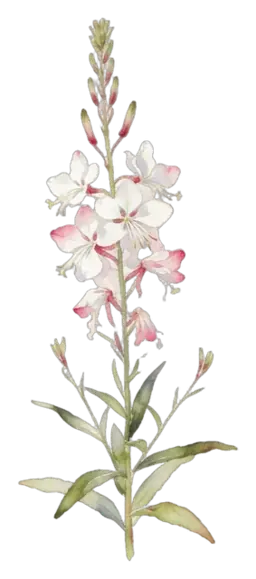
A biennial plant 1 to 1.5 m tall. In its first year it forms a low rosette of lance-shaped leaves with a reddish midrib, on top of a fleshy taproot; in the second year it sends up a tall, upright, hairy stem, and from June to September it fills with pale yellow flowers about 5 cm across, with four petals, a cross-shaped stigma and eight stamens, which open at dusk, hence the name "evening primrose", and wither the following day. Afterwards it dies, leaving elongated capsules with a huge number of small seeds. It copes well with drought, cold and poor soils, and attracts moths and night-flying bees. It is used in wildlife gardens, dry banks and path edges. Note: it is a naturalised plant that escapes easily. In Spain it is not regulated as invasive, but it naturalises easily and is best not planted near riverbanks, rivers or natural areas.
Family and origin: Evening primrose family (Onagraceae) · native to Eastern North America; naturalised in Europe, including Spain, for centuries · More plants from North America
01In your area
How will it do in your garden?
Year calendar
| Task | J | F | M | A | M | J | J | A | S | O | N | D |
|---|---|---|---|---|---|---|---|---|---|---|---|---|
| Seed trayFeb–Mar | no | yes | yes | no | no | no | no | no | no | no | no | no |
| Direct sowingMar–Apr, Sep–Oct | no | no | yes | yes | no | no | no | no | yes | yes | no | no |
| Plant / transplantApr–May, Oct | no | no | no | yes | yes | no | no | no | no | yes | no | no |
| HarvestJun–Sep | no | no | no | no | no | yes | yes | yes | yes | no | no | no |
| FloweringJun–Sep | no | no | no | no | no | yes | yes | yes | yes | no | no | no |
Its life cycle at a glance
Swipe and tap a stage to see its details.
02Planting
Where and how to plant it
Sow the seed 3 mm deep; leave 40 cm between plants and 50 cm between rows.
40 cm between plants · 50 cm between rows
Seed at a depth of 3 mm; seedlings go in with the root ball level with the soil.
- Transplanting
- Apr–May, Oct
- Seed tray
- Feb–Mar
- Direct sowing
- Mar–Apr, Sep–Oct
- Germination
- ~21 days
- TipTo have flowers every year, sow in two consecutive years.
- Common mistakeSowing out of season: many need warmth or a cold spell beforehand to sprout.
03Care
Care through the year
Sun and aspectFull sun · 8 h of sun · South or south-west, with nothing casting shade at midday
- Too little sun
- Ideal range
- Plenty of sun
South or south-west, with nothing casting shade at midday
Strong sun: Loves full midday sun and high temperatures.
Full sun, although it tolerates some shade; in poor light the stem stretches, flops over and produces fewer flowers.
WateringLet it dry out between waterings · summer: every 5-7 days
- Summerevery 5-7 days0.6 L per plant/week
- Spring / Autumnevery 10-14 days0.2 L per plant/week
- Winteronly in extreme drought (once a month)0.1 L per plant/week
Let it dry out between waterings: A Mediterranean favourite: better thirsty than overwatered.
Water only to help it establish in its first summer. Once settled it copes well with drought and with poor, sandy or stony soils. It prefers soil that drains; too much water and fertiliser make it soft and floppy.
When to water? Push your finger 5 cm into the soil next to the base of the plant:
- Damp: soil sticks to your finger. Do not water yet. It has more than enough; wait for it to dry out more.
- Cool but clean, no mud. Wait another 1-2 days before watering.
- Dry and dusty. Water now, but moderately. Do not overdo it: it prefers thirst to excess.
Soil and feedingpH 5.5–8 · Loose soil with organic matter and good drainage
Loose soil with organic matter and good drainage.
50 % topsoil · 30 % well-rotted compost · 20 % sand or perlite.
Medium/high.
This plant prefers a pH between 5.5 and 8.0 (slightly acidic to alkaline).
- Overfeeding gives lots of leaf and few flowers.
- Compacted, poorly drained soil rots the roots in winter.
- TipSow it in a sunny spot with poor, well-drained soil, and do not plant it next to rivers, riverbanks or natural areas, because it naturalises easily.
- TipIt needs no fertiliser.
- Common mistakeOverfeeding gives lush leaves but few flowers.
Pruning
- TipRemove faded flowers to prolong flowering.
Common mistakes and tips
- TipCut off spent flower spikes before the capsules open if you do not want it to self-seed, and pull up surplus seedlings while they are small.
- TipWatch out for aphids, and for powdery mildew in damp weather.
04Harvest
Harvesting and storing
Harvest in Jun–Sep; the first, about 420 days after sowing.
05Propagation
Make new plants
It is propagated only from its tiny seed, sown in spring or autumn and barely covered with fine soil, because light helps it germinate; it can also be sown in a tray and transplanted with its root ball about 25-40 cm apart. It comes up in two or three weeks at 15-25 °C. It is biennial: in the first year it forms the rosette and in the second it flowers and dies after setting seed. It self-seeds very readily, and to stop it escaping you need to cut off the spikes before the capsules open.
Seeds: how to germinate them~21 days
06Uses and health
What it is used for, and with what care
WARNING: although the root and young leaves have a traditional use, there is no reliable safety data to recommend eating it, and the seeds and oil should not be taken without medical advice, especially alongside medication. There is no reliable data for dogs and cats; do not let them chew the plant. It is a naturalised plant that escapes easily: do not release it into the wild and remove the capsules before they open. If a significant amount is swallowed, consult a doctor or vet.
- Properties
- It is a very tough plant that flowers as the sun goes down, with flowers that attract moths and night-flying bees, and it copes well with drought and poor soils; an oil is extracted from the seeds and sold as a supplement, although its effectiveness has not been demonstrated.
- Uses
- Traditionally the first-year root was eaten cooked, along with the young leaves, but today it is hardly used in cooking. No medicinal use or dose is given here: the seed oil is sold as a supplement with no demonstrated effectiveness, and anyone taking medication or who is pregnant should consult their doctor.
For guidance only; this is not medical treatment and does not replace advice from a doctor or vet.
07Companions and related plants