Credits and licences
- #1 — vueltaalhuerto illustration
- #2 — vueltaalhuerto illustration
- #3 — vueltaalhuerto illustration
- #4 — vueltaalhuerto illustration
- #5 — vueltaalhuerto illustration
- #6 — vueltaalhuerto illustration
- #7 — vueltaalhuerto illustration
- #8 — vueltaalhuerto illustration
- #9 — vueltaalhuerto illustration
Ceraria fruticulosa
Ceraria fruticulosa is planted from March to April. Grow it in full sun, 30 cm apart, with little watering. Dates are for a mild temperate climate in the northern hemisphere; the calendar below adjusts them to your zone.
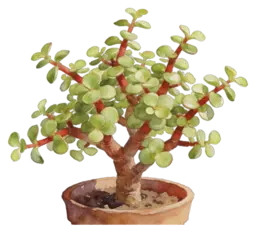
A small, irregularly branching succulent shrub which in cultivation usually stays at 30 to 60 cm and reaches a metre in its native habitat, with twisted, knotty stems, grey bark that peels off in thin papery flakes, and tiny, round, fleshy bluish-green leaves clustered along the branches. Over the years it develops a thick trunk that makes it highly prized as a bonsai. It produces short spikes of small pink flowers once or twice a year, followed by dry three-winged fruits. It comes from Namaqualand, a dry area of south-western Africa, and needs plenty of light, a free-draining mineral potting mix and moderate watering during growth and minimal watering while resting. In Spain it can only spend the winter outdoors on the Mediterranean coast and in the Canary Islands, where there is no frost; elsewhere, keep it under cover. Do not confuse it with Portulacaria afra (dwarf jade or elephant bush), which has larger leaves and reddish stems.
Family and origin: Didiereaceae · native to South Africa and southern Namibia (Namaqualand) · More plants from Africa
01In your area
How will it do in your home?
Year calendar
| Task | J | F | M | A | M | J | J | A | S | O | N | D |
|---|---|---|---|---|---|---|---|---|---|---|---|---|
| Plant / transplantMar–Apr | no | no | yes | yes | no | no | no | no | no | no | no | no |
| PruningApr–May | no | no | no | yes | yes | no | no | no | no | no | no | no |
| CuttingsApr–Jul, Sep | no | no | no | yes | yes | yes | yes | no | yes | no | no | no |
Its life cycle at a glance
Swipe and tap a stage to see its details.
02Care
Care through the year
Sun and aspectFull sun · 8 h of sun · South or south-west, with nothing casting shade at midday
- Too little sun
- Ideal range
- Plenty of sun
South or south-west, with nothing casting shade at midday
Strong sun: Loves full midday sun and high temperatures.
Full morning and afternoon sun and very bright light all day; indoors, next to the brightest window. If it is moved suddenly from indoors to outdoors, the midday summer sun can scorch the young leaves.
- Common mistakeLack of light makes them stretch and go soft (etiolation).
WateringLet it dry out between waterings · summer: every 10 to 14 days
- Summerevery 10 to 14 days0.2 L per plant/week
- Spring / Autumnevery 10-14 days0.1 L per plant/week
- Winteronce a month or less0 L per plant/week
Let it dry out between waterings: A Mediterranean favourite: better thirsty than overwatered.
Water thoroughly when the potting mix is completely dry and let it drain; in full growth it tolerates slightly more water than other succulents. In winter or in extreme heat, water minimally: too much water rots the base. If it drops leaves while resting, that is not a bad sign; water less often.
When to water? Push your finger 5 cm into the soil next to the base of the plant:
- Damp: soil sticks to your finger. Do not water yet. It has more than enough; wait for it to dry out more.
- Cool but clean, no mud. Wait another 1-2 days before watering.
- Dry and dusty. Water now, but moderately. Do not overdo it: it prefers thirst to excess.
Potting mix and feedingpH 6–7.5 · Very gritty, free-draining mix
Very gritty, free-draining mix.
30 % multi-purpose compost · 40 % coarse sand · 30 % perlite or pumice.
Very high: standing moisture rots them.
This plant prefers a pH between 6.0 and 7.5 (slightly acidic to slightly alkaline).
- Multi-purpose compost on its own with no drainage: rot sets in quickly.
- Watering the rosette or the leaves marks them and causes rot.
- TipUse a clay or ceramic pot with good drainage and a mineral cactus potting mix with perlite or coarse sand.
- TipFeed in spring and autumn with a diluted succulent fertiliser.
- TipVery free-draining mix (with sand/perlite) and pots with a drainage hole.
PruningWhen: Apr–May
Pruning time for this plant: Apr–May.
- TipPrune lightly in spring to shape it as a bonsai or to encourage branching, and use the trimmings as cuttings.
Common mistakes and tips
- TipPlace it in the brightest, well-ventilated spot.
- TipDo not let it drop below about 0 to 5 °C, especially in damp conditions.
03Propagation
Make new plants
It is easily propagated from stem cuttings: cut a sprig 8 to 12 cm long in spring or early summer, let the wound callus for a few days in a dry, shady place and insert it into a slightly moist mineral potting mix, in bright light. It roots within a few weeks (as a rough guide). Old plants thin out in the centre and are renewed from cuttings. Seed is possible, but it is rarely used and hard to find; the most practical option is to buy a nursery plant.
04Uses and health
What it is used for, and with what care
It is not edible and there are no reliable data on its toxicity. It is related to Portulacaria afra, which is said to be edible, but do not extrapolate that use: do not eat any part of Ceraria and do not let children, dogs or cats chew it. If someone has swallowed it, in Spain contact the Toxicology Information Service (Servicio de Información Toxicológica, 91 562 04 20) or call 112, and a vet if it is an animal. It is not regulated as an invasive species in Spain or the EU.
- Properties
- An ornamental plant: it is not grown for consumption and has no proven health uses.
- Uses
- It is not edible. It is grown as a collector's succulent, for pots, bright terraces and bonsai.
For guidance only; this is not medical treatment and does not replace advice from a doctor or vet.
05Companions and related plants