
Credits and licences
- #1 — vueltaalhuerto illustration
- #2 — vueltaalhuerto illustration
- #3 — vueltaalhuerto illustration
- #4 — vueltaalhuerto illustration
- #5 — vueltaalhuerto illustration
- #6 — vueltaalhuerto illustration
- #7 — vueltaalhuerto illustration
Aeonium cuneatum
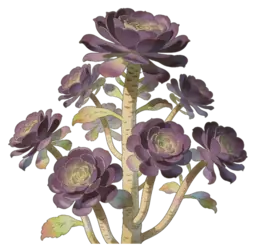
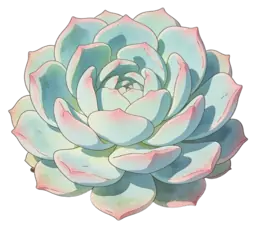
A Canary Island succulent that forms a large, flat, open rosette up to about 50 cm across, with fleshy, light green, wedge-shaped leaves with smooth edges and no visible stem or a very short one; it produces offsets readily and eventually forms clumps. In winter and spring it bears a tall, conical panicle of many small pale yellow flowers. It grows in winter and is almost dormant in summer, when it should be watered little. In frost-free areas it can be grown in a rock garden, on a terrace and in a pot; elsewhere, it is best grown in a bright pot and given shelter in winter. The rosette that flowers usually dies, but the offsets carry on. Do not confuse it with Aeonium arboreum, which forms branching stems, or with Echeveria, which is American.
Family and origin: Stonecrop family (Crassulaceae) · native to Canary Islands (endemic to Tenerife) · More plants from Africa
01In your area
How will it do in your home?
Year calendar
| Task | J | F | M | A | M | J | J | A | S | O | N | D |
|---|---|---|---|---|---|---|---|---|---|---|---|---|
| FloweringFeb–May | no | yes | yes | yes | yes | no | no | no | no | no | no | no |
| CuttingsMar–Apr, Oct–Nov | no | no | yes | yes | no | no | no | no | no | yes | yes | no |
| Divide the clumpMar–Apr, Oct–Nov | no | no | yes | yes | no | no | no | no | no | yes | yes | no |
Its life cycle at a glance
Swipe and tap a stage to see its details.
02Care
Care through the year
Sun and aspectFull sun · 8 h of sun · South or south-west, with nothing casting shade at midday
- Too little sun
- Ideal range
- Plenty of sun
South or south-west, with nothing casting shade at midday
Strong sun: Loves full midday sun and high temperatures.
Very bright light, with gentle sun. In high summer it appreciates light shade during the middle of the day; in poor light it stretches and loses its rosette shape.
- TipGive it plenty of light and good ventilation.
- Common mistakeLack of light makes them stretch and go soft (etiolation).
WateringLet it dry out between waterings · summer: very little (summer dormancy): once a month or less
- Summervery little (summer dormancy): once a month or less0.2 L per plant/week
- Spring / Autumnevery 10-14 days0.1 L per plant/week
- Winterevery 10 to 14 days while the plant is growing0 L per plant/week
Let it dry out between waterings: A Mediterranean favourite: better thirsty than overwatered.
Water from autumn to spring, when it is growing, and let the potting mix dry out between waterings. In summer, almost none. Protect it from heavy rain while dormant, as this rots it.
When to water? Push your finger 4 cm into the soil next to the base of the plant:
- Damp: soil sticks to your finger. Do not water yet. It has more than enough; wait for it to dry out more.
- Cool but clean, no mud. Wait another 1-2 days before watering.
- Dry and dusty. Water now, but moderately. Do not overdo it: it prefers thirst to excess.
- TipWater in the growing season and hardly at all in summer; excess water, especially in hot weather, rots it.
- TipThe watering and temperature figures are approximate and depend on climate and light.
- TipWater thoroughly and leave long gaps: better thirsty than overwatered.
- Common mistakeWatering often rots the crown and the roots.
Potting mix and feedingpH 6–7.5 · Very gritty, free-draining mix
Very gritty, free-draining mix.
30 % multi-purpose compost · 40 % coarse sand · 30 % perlite or pumice.
Very high: standing moisture rots them.
This plant prefers a pH between 6.0 and 7.5 (slightly acidic to slightly alkaline).
- Multi-purpose compost on its own with no drainage: rot sets in quickly.
- Watering the rosette or the leaves marks them and causes rot.
- TipPlant it in a very free-draining potting mix, such as cactus compost with coarse sand or perlite, in a pot with drainage holes.
- TipVery free-draining mix (with sand/perlite) and pots with a drainage hole.
03Propagation
Make new plants
It is propagated by offsets, which are separated with a little root or a small piece of base, or by rosette cuttings, in autumn or spring, when the plant is growing. Leave them to callus for a few days in the shade and plant them in free-draining potting mix, watering sparingly until they root. In high summer they root less well. The seed is very fine and rarely used.
04Uses and health
What it is used for, and with what care
It is not edible. There is no reliable data on its toxicity to people or pets; to be safe, do not eat any part and keep it out of reach of children, dogs and cats. The sap can irritate the skin or mouth of sensitive people: wear gloves when cutting or dividing it. If a pet nibbles it or a person swallows it, consult the vet or, in Spain, call the Toxicology Information Service (91 562 04 20) or 112. It is a plant native to the Canary Islands and is not regulated as invasive.
- Properties
- An ornamental plant: it is not grown for consumption and has no proven health uses.
- Uses
- It is not edible. It is grown as an ornamental plant for rock gardens, terraces and pots.
For guidance only; this is not medical treatment and does not replace advice from a doctor or vet.
05Companions and related plants
What to plant it with
Compare with similar varieties
| Variety | Sowing | Harvest | Days | Spacing | Difficulty |
|---|---|---|---|---|---|
| Aeonium ‘Sunburst’ | — | — | — | 30 cm | Easy |
| Tree aeonium (Aeonium arboreum) | — | — | — | 40 cm | Easy |
| Aeonium cuneatum | — | Feb–May | — | 40 cm | Easy |
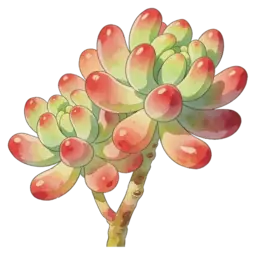
| Haworth's aeonium (Aeonium haworthii) | Mar–May, Sep–Oct | — | — | 40 cm | Easy |