
Credits and licences
- #1 — vueltaalhuerto illustration
- #2 — vueltaalhuerto illustration
- #3 — vueltaalhuerto illustration
- #4 — vueltaalhuerto illustration
- #5 — vueltaalhuerto illustration
- #6 — vueltaalhuerto illustration
- #7 — vueltaalhuerto illustration
- #8 — vueltaalhuerto illustration
- #9 — vueltaalhuerto illustration
- #10 — vueltaalhuerto illustration
Cat palm
Cat palm is sown in seed trays from March to May, and planted out from April to June. Grow it in sun or partial shade, 100 cm apart, with moderate watering. Dates are for a mild temperate climate in the northern hemisphere; the calendar below adjusts them to your zone.
A small clump-forming palm: many thin, cane-like stems grow from the base and form a dense clump 1 to 1.5 m tall and almost as wide. The leaves are pinnate and arching, with broad, lance-shaped, glossy dark green leaflets, larger and thicker than those of the parlour palm (Chamaedorea elegans). In its native habitat it grows beside streams and waterfalls, hence the species name (cataractarum), which is why it appreciates a constantly moist potting mix and fairly humid air. It is a very rewarding indoor palm: it tolerates low light and looks good for years in a pot, and in frost-free areas it can be put outdoors in partial shade. It is slow-growing. Mature plants may produce small yellow flowers in clusters on orange stalks, followed by fruits that turn from green to black, although they are rarely seen indoors. Do not confuse it with the parlour palm (Chamaedorea elegans), which is smaller and has finer leaves, or with the areca palm (Dypsis lutescens).
Family and origin: Palm family (Arecaceae) · native to South-eastern Mexico (Veracruz and Chiapas), in humid forests beside streams and waterfalls · More plants from Mesoamerica
01In your area
How will it do in your home?
Year calendar
| Task | J | F | M | A | M | J | J | A | S | O | N | D |
|---|---|---|---|---|---|---|---|---|---|---|---|---|
| Seed trayMar–May | no | no | yes | yes | yes | no | no | no | no | no | no | no |
| Plant / transplantApr–Jun | no | no | no | yes | yes | yes | no | no | no | no | no | no |
| Divide the clumpApr–Jun | no | no | no | yes | yes | yes | no | no | no | no | no | no |
Its life cycle at a glance
Swipe and tap a stage to see its details.
02Care
Care through the year
Sun and aspectSun and shade · 5 h of sun · shade in summer
- Too little sun
- Ideal range
- Plenty of sun
East, or south with light shade during the middle of the day
Moderate sun: Copes with full sun, but give it some shade during heatwaves.
Bright indirect light or partial shade. It tolerates corners with little light, but grows more slowly; direct midday sun through glass scorches the leaves. In frost-free areas it can live outdoors, in a partly shaded spot.
- TipPlace it in a bright spot, without strong direct sun, at 15 to 25 °C and away from cold draughts and radiators.
WateringConstantly moist · summer: every 2-3 days
- Summerevery 2-3 days10 L per plant/week
- Spring / Autumnevery 4-5 days5 L per plant/week
- Winterevery 2-3 weeks1.5 L per plant/week
Constantly moist: The soil should always feel cool and damp. Ideal with mulch and drip irrigation. Mulch: straw or dry plant material cuts watering by 30-50 %.
Keep the potting mix evenly moist, without waterlogging it: water when the surface starts to dry, once a week or more in summer and less in winter, and always empty the saucer. It appreciates a humid atmosphere: if the leaf tips turn brown, it is almost always due to dry air, central heating or irregular watering.
When to water? Push your finger 3 cm into the soil next to the base of the plant:
- Damp: soil sticks to your finger. Do not water, although for this plant it is just right — check again tomorrow.
- Cool but clean, no mud. Water today: it likes to stay constantly moist.
- Dry and dusty. Water urgently and add mulch to hold in moisture.
- TipMist the leaves or stand the pot on a tray of pebbles and water to raise the humidity.
- TipThe heights, watering frequency and temperature limits are only a guide.
Potting mix and feedingpH 5.5–7 · Free-draining, somewhat gritty mix
Free-draining, somewhat gritty mix.
50 % multi-purpose compost · 30 % coarse sand · 20 % perlite or pumice.
High.
This plant prefers a pH between 5.5 and 7.0 (slightly acidic to neutral).
- Give a balanced granular fertiliser in spring and summer.
- Water generously but let the surface dry between waterings.
- Burying the trunk causes rot.
- Cutting off all the green fronds weakens the palm.
- TipUse a palm or multipurpose potting mix with perlite so it drains well, and feed it once a month in spring and summer with a liquid fertiliser for foliage plants; not in winter.
- TipFree-draining soil and regular watering in hot weather; it does not like constant waterlogging.
Pruning
- Common mistakeOver-pruning weakens the palm and opens the door to pests.
Common mistakes and tips
- TipBelow about 10 °C the foliage is damaged, and frost kills it.
- TipDo not cut green stems, only dead leaves.
- TipWatch out for red spider mite, which appears in dry air, and scale insects; wipe the dust off the leaves with a damp cloth.
- TipDo not cut off green fronds: the palm feeds on them.
- Common mistakeBurying the trunk causes rot.
03Propagation
Make new plants
The simplest method with a mature plant is dividing the clump: in spring, take the plant out of its pot, carefully separate it into two or three pieces, each with several stems and good roots, and plant each one in its own pot with a light, moist potting mix. Palms do not readily grow new roots, so break as few as possible. It can also be grown from seed, which must be fresh and is sown at 24-30 °C with bottom heat; it germinates very slowly, in two to four months or more.
Seeds: how to germinate them~90 days
04Uses and health
What it is used for, and with what care
WARNING: the flesh of the fruits contains calcium oxalate crystals that can irritate the skin and mouth, so wear gloves if you handle the fruits and wash your hands. None of the toxic-plant databases consulted lists it as dangerous to dogs and cats, but there are no reliable studies and sources disagree, so as a precaution stop them from chewing the leaves or fruits. If a significant amount is swallowed, consult a doctor, a vet or, in Spain, the National Institute of Toxicology (Instituto Nacional de Toxicología, 91 562 04 20).
- Properties
- It is a decorative indoor palm with broad, glossy leaves that tolerates low light and gives a corner a tropical feel. It is not used in cooking or in remedies, and there is no evidence that it purifies the air to any noticeable degree.
- Uses
- It is not edible: do not eat its fruits or leaves or use them in infusions.
For guidance only; this is not medical treatment and does not replace advice from a doctor or vet.
05Companions and related plants
What to plant it with

Compare with similar varieties
| Variety | Sowing | Harvest | Days | Spacing | Difficulty |
|---|---|---|---|---|---|
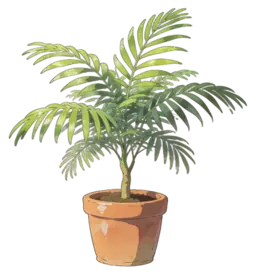
| Parlour palm | — | — | — | 60 cm | Easy |
| Cat palm | Mar–May | — | — | 100 cm | Easy |