
Credits and licences
- #1 — vueltaalhuerto illustration
- #2 — vueltaalhuerto illustration
- #3 — vueltaalhuerto illustration
- #4 — vueltaalhuerto illustration
- #5 — vueltaalhuerto illustration
- #6 — vueltaalhuerto illustration
- #7 — vueltaalhuerto illustration
- #8 — vueltaalhuerto illustration
- #9 — vueltaalhuerto illustration
- #10 — vueltaalhuerto illustration
Cardboard palm (Zamia furfuracea)
and 2 more names
zamia, cardboard plantCardboard palm (Zamia furfuracea) is sown in seed trays from April to June, and planted out from April to May and from September to October. Grow it in sun or partial shade, 100 cm apart, with little watering. Dates are for a mild temperate climate in the northern hemisphere; the calendar below adjusts them to your zone.
What else to sow in April, May and June
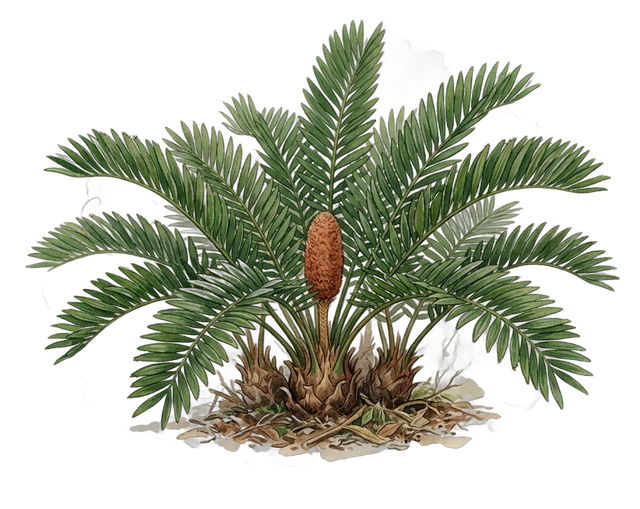
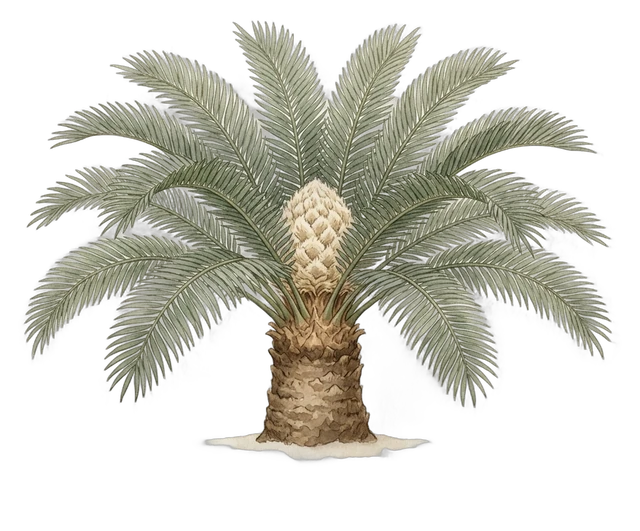
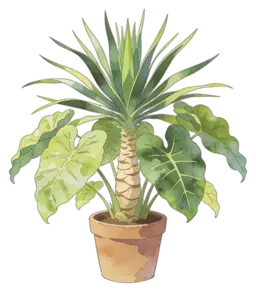
The cardboard palm is not a palm but a cycad: a very ancient group of plants with separate sexes that resembles a palm because of its crown of leaves. It forms a short, thick stem, almost at ground level, from which arching pinnate leaves 50 to 150 cm long emerge, with six to twelve pairs of broad, stiff, leathery leaflets, toothed at the tip and with a velvety, greyish-brown texture when young, hence the name furfuracea. Over the years it forms a rounded clump up to 1.3 m tall and about 2 m wide. Mature specimens produce cones: the male ones small and clustered; the female ones egg-shaped, brown and felted, which open when ripe to reveal fleshy orange-red seeds. It grows very slowly, copes well with sun, drought and salt, and is grown in pots, on terraces and in gardens with a mild climate; it must be protected from frost. LEGAL AND SAFETY NOTICE: all cycads (order Cycadales) are listed in Appendix II of the CITES convention, which the EU includes in Annex B of Regulation (EC) 338/97, and the cardboard palm is also a threatened species in the wild: it is endemic to south-eastern Veracruz (Mexico) and the IUCN classifies it as Endangered (EN), according to Kew (POWO). It is forbidden to take plants or seeds from the wild, and a CITES permit is needed to take them out of the EU; within the EU nursery-grown specimens may be bought and sold, but it is advisable to keep the receipt as proof of legal origin. It is not listed in the Spanish Catalogue of Invasive Alien Species. Safety: the whole plant, and above all the seeds, is highly toxic because of cycasin and other toxins; one or two seeds can be fatal to a dog or cat, with vomiting, jaundice, bloody diarrhoea and liver failure, and there is no specific antidote. In people the damage can affect the liver, kidneys and nervous system. Do not plant it where young children or pets have access, remove the cones before the seeds ripen, wear gloves when handling it and do not taste any part. If a person or pet has bitten or swallowed it, call 112 immediately, or in Spain the Toxicology Information Service (91 562 04 20), or your vet.
Family and origin: Zamiaceae · native to South-eastern Veracruz, on the Gulf of Mexico coast (endemic), on dunes and sandy soils in coastal scrub · More plants from Mesoamerica
01In your area
How will it do in your garden?
Year calendar
| Task | J | F | M | A | M | J | J | A | S | O | N | D |
|---|---|---|---|---|---|---|---|---|---|---|---|---|
| Seed trayApr–Jun | no | no | no | yes | yes | yes | no | no | no | no | no | no |
| Plant / transplantApr–May, Sep–Oct | no | no | no | yes | yes | no | no | no | yes | yes | no | no |
| Divide the clumpApr–May, Sep–Oct | no | no | no | yes | yes | no | no | no | yes | yes | no | no |
Its life cycle at a glance
Swipe and tap a stage to see its details.
02Planting
Where and how to plant it
Sow the seed 2.5 cm deep; leave 1 m between plants and 1 m between rows.
1 m between plants · 1 m between rows
Seed at a depth of 2.5 cm; seedlings go in with the root ball level with the soil.
- Transplanting
- Apr–May, Sep–Oct
- Seed tray
- Apr–Jun
- Germination
- ~90 days
03Care
Care through the year
Sun and aspectSun and shade · 5 h of sun · shade in summer
- Too little sun
- Ideal range
- Plenty of sun
East, or south with light shade during the middle of the day
Moderate sun: Copes with full sun, but give it some shade during heatwaves.
Sun or bright partial shade. Sources give a minimum of about -2 to -4 °C for mature plants kept dry, but as a precaution protect it below 0 °C, especially if it is young or in a pot.
WateringLet it dry out between waterings · summer: every 5-7 days
- Summerevery 5-7 days5 L per plant/week
- Spring / Autumnevery 10-14 days2 L per plant/week
- Winteronly in extreme drought (once a month)0.8 L per plant/week
Let it dry out between waterings: A Mediterranean favourite: better thirsty than overwatered.
Water when the potting mix is dry to a depth of about five centimetres: every one or two weeks in summer and once a month or less in winter. It needs a very free-draining mix; too much water rots the stem.
When to water? Push your finger 5 cm into the soil next to the base of the plant:
- Damp: soil sticks to your finger. Do not water yet. It has more than enough; wait for it to dry out more.
- Cool but clean, no mud. Wait another 1-2 days before watering.
- Dry and dusty. Water now, but moderately. Do not overdo it: it prefers thirst to excess.
Soil and feedingpH 5.5–7.5 · Free-draining, somewhat gritty mix
Free-draining, somewhat gritty mix.
50 % multi-purpose compost · 30 % coarse sand · 20 % perlite or pumice.
High.
This plant prefers a pH between 5.5 and 7.5 (slightly acidic to slightly alkaline).
- Give a balanced granular fertiliser in spring and summer.
- Water generously but let the surface dry between waterings.
- Burying the trunk causes rot.
- Cutting off all the green fronds weakens the palm.
- TipPlant it in a pot with a drainage hole and a very free-draining mix of coarse sand, perlite or pumice with a little soil, or in a garden where water does not collect.
- TipFeed it twice between spring and summer with a slow-release palm fertiliser.
- TipFree-draining soil and regular watering in hot weather; it does not like constant waterlogging.
Pruning
- Common mistakeOver-pruning weakens the palm and opens the door to pests.
Common mistakes and tips
- TipWatch out for mealybugs and armoured scale insects, which settle at the base of the leaves.
- TipCut off only leaves that are already dry and, always wearing gloves, remove the cones before they ripen if there are children or pets around.
- TipThe figures are only a guide.
- TipDo not cut off green fronds: the palm feeds on them.
- Common mistakeBurying the trunk causes rot.
04Propagation
Make new plants
It is propagated by seed and, with patience, by offsets. The seed, fresh and with its fleshy coat removed while wearing gloves, is sown in a sandy mix at about 25-30 °C and germinates slowly and irregularly, often over months. Over the years the clump produces offsets or side crowns that can be separated with a clean knife, left to callus and planted in a mineral mix. Seed-raised plants take many years to reach a good size.
Seeds: how to germinate them~90 days
05Uses and health
What it is used for, and with what care
SERIOUS WARNING: a highly toxic plant. The whole plant, and especially the seeds, contains cycasin and other compounds that damage the liver and nervous system. It is considered toxic to dogs and cats and points out that one or two seeds can be fatal: it causes vomiting, jaundice, bloody diarrhoea and liver failure. In people it can cause liver, kidney and neurological damage, and there is no specific antidote. Do not eat any part, do not use it in herbal teas or for any other purpose, do not grow it where there are young children or pets, and wear gloves when handling it. In the event of ingestion or a bite, in Spain call 112 or the Toxicology Information Service (91 562 04 20) immediately, or call your vet.
- Properties
- A slow-growing ornamental cycad. It has no recommended medicinal or household uses.
- Uses
- It is not edible: no part of the plant should be eaten, and we give no preparation instructions because it is very dangerous.
For guidance only; this is not medical treatment and does not replace advice from a doctor or vet.
06Companions and related plants
What to plant it with
Compare with similar varieties
| Variety | Sowing | Harvest | Days | Spacing | Difficulty |
|---|---|---|---|---|---|
| Bamboo palm (Chamaedorea seifrizii) | Apr–Jun | — | — | 60 cm | Easy |
| Cardboard palm (Zamia furfuracea) | Apr–Jun | — | — | 100 cm | Moderate |