Credits and licences
- #1 — vueltaalhuerto illustration
- #2 — vueltaalhuerto illustration
- #3 — vueltaalhuerto illustration
- #4 — vueltaalhuerto illustration
- #5 — vueltaalhuerto illustration
- #6 — vueltaalhuerto illustration
- #7 — vueltaalhuerto illustration
- #8 — vueltaalhuerto illustration
- #9 — vueltaalhuerto illustration
- #10 — vueltaalhuerto illustration
Dioon edule (chestnut dioon)
and 2 more names
Mexican cycad, chamalDioon edule (chestnut dioon) is sown in seed trays from April to June, and planted out from April to May and from September to October. Grow it in full sun, 150 cm apart, with little watering. Dates are for a mild temperate climate in the northern hemisphere; the calendar below adjusts them to your zone.
What else to sow in April, May and June
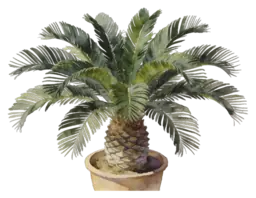
A very slow-growing cycad which, despite appearances, is neither a palm nor a fern. It has a short, thick trunk that over the years can reach 1 m or more, topped by a crown of stiff, arching leaves 0.5 to 1.5 m long, greyish-green or bluish, with many narrow, leathery leaflets. Plants are either male or female: once mature, and only after many years, they produce a large, woolly, cream-coloured cone in the centre; the female cone bears oval, ivory-coloured seeds the size of a plum. It copes well with sun, heat, drought and light frosts. LEGAL AND SAFETY NOTICE: the whole plant, and the seeds in particular, is highly toxic (cycasin and other substances damage the liver and the nervous system). In its native region the seeds have traditionally been eaten after a long leaching process, but this is dangerous and unreliable: do not try it and do not use them as food. Do not plant it where there are small children or pets, especially dogs. It is threatened in the wild and protected under the CITES convention (Appendix II): buy only nursery-grown plants with their paperwork, never plants or seeds collected from the wild. If anyone has swallowed any part of it, in Spain call the Toxicology Information Service (91 562 04 20) or 112 straight away; if a pet has, take it to the vet without waiting for symptoms to appear.
Family and origin: Zamiaceae · native to Eastern Mexico (Tamaulipas, San Luis Potosí, Veracruz and Hidalgo), in dry oak woodland and on stony slopes · More plants from Mesoamerica
01In your area
How will it do in your garden?
Year calendar
| Task | J | F | M | A | M | J | J | A | S | O | N | D |
|---|---|---|---|---|---|---|---|---|---|---|---|---|
| Seed trayApr–Jun | no | no | no | yes | yes | yes | no | no | no | no | no | no |
| Plant / transplantApr–May, Sep–Oct | no | no | no | yes | yes | no | no | no | yes | yes | no | no |
| PruningMar–Apr | no | no | yes | yes | no | no | no | no | no | no | no | no |
Its life cycle at a glance
Swipe and tap a stage to see its details.
02Planting
Where and how to plant it
Sow the seed 2.5 cm deep; leave 1.5 m between plants and 2 m between rows.
1.5 m between plants · 2 m between rows
Seed at a depth of 2.5 cm; seedlings go in with the root ball level with the soil.
- Transplanting
- Apr–May, Sep–Oct
- Seed tray
- Apr–Jun
- Germination
- ~60 days
- TipIt grows very slowly, so buying an established plant saves many years.
- TipIf you have dogs or children, do not plant it where they play, and remember that the cones and seeds are the most dangerous parts.
03Care
Care through the year
Sun and aspectFull sun · 6 h of sun · South or south-west, with nothing casting shade at midday
- Too little sun
- Ideal range
- Plenty of sun
South or south-west, with nothing casting shade at midday
Strong sun: Loves full midday sun and high temperatures.
Full sun or very bright light. It tolerates light, short-lived frosts, down to about -5 °C if the soil is dry, preferably with the growing point protected; when cold and wet come together it rots.
WateringLet it dry out between waterings · summer: every 10 to 15 days
- Summerevery 10 to 15 days5 L per plant/week
- Spring / Autumnevery 10-14 days2 L per plant/week
- Winterhardly at all0.8 L per plant/week
Let it dry out between waterings: A Mediterranean favourite: better thirsty than overwatered.
Water sparingly but deeply, letting the soil dry out between waterings. Once established it copes well with drought; too much water and heavy, waterlogged soil are its greatest dangers. It needs very free-draining, sandy or stony soil.
When to water? Push your finger 5 cm into the soil next to the base of the plant:
- Damp: soil sticks to your finger. Do not water yet. It has more than enough; wait for it to dry out more.
- Cool but clean, no mud. Wait another 1-2 days before watering.
- Dry and dusty. Water now, but moderately. Do not overdo it: it prefers thirst to excess.
- TipDo not overwater, and remove only dead leaves, never green ones.
Soil and feedingpH 6–7.5 · Free-draining, somewhat gritty mix
Free-draining, somewhat gritty mix.
50 % multi-purpose compost · 30 % coarse sand · 20 % perlite or pumice.
High.
This plant prefers a pH between 6.0 and 7.5 (slightly acidic to slightly alkaline).
- Give a balanced granular fertiliser in spring and summer.
- Water generously but let the surface dry between waterings.
- Burying the trunk causes rot.
- Cutting off all the green fronds weakens the palm.
- TipPlant it in spring, in full sun and in very free-draining soil; in cold climates it is better in a pot that you can move under cover.
- TipFree-draining soil and regular watering in hot weather; it does not like constant waterlogging.
PruningWhen: Mar–Apr
Pruning time for this plant: Mar–Apr.
- TipWear gloves when pruning or removing leaves: old leaves can have hard tips.
- Common mistakeOver-pruning weakens the palm and opens the door to pests.
Common mistakes and tips
- TipThe figures for growth, cold tolerance and timings are approximate.
- TipDo not cut off green fronds: the palm feeds on them.
- Common mistakeBurying the trunk causes rot.
04Propagation
Make new plants
It is almost always propagated from seed, which must be fresh because it soon loses viability. The seeds are toxic: handle them with gloves and keep them out of reach of children and pets. Sow them lying on their side, half buried, in a very free-draining mix (coarse sand and perlite) at 25-32 °C; they germinate erratically, in one to three months or more, and the seedlings grow very slowly. More rarely it produces offsets at the base, which can be carefully separated. Seed-grown plants take more than fifteen years to reach maturity and produce cones.
Seeds: how to germinate them~60 days
05Uses and health
What it is used for, and with what care
SERIOUS WARNING: a highly toxic plant. The seeds, and to a lesser extent the rest of the plant, contain cycasin and other compounds that damage the liver and the nervous system; if swallowed they can cause vomiting, diarrhoea, seizures, liver damage and, in severe cases, death. Cycads, this one included, are considered very dangerous for dogs and cats, which may chew the seeds or leaves. Do not eat any part of it, do not use it in infusions or for any other purpose, do not plant it where there are small children or pets, and wear gloves when handling the seeds. If anyone has swallowed any part of it, in Spain call the Toxicology Information Service (91 562 04 20) or 112 straight away and go to A&E; for an animal, go to the vet without waiting for symptoms. It is protected under the CITES convention (Appendix II): buy only nursery-grown plants with their paperwork. It is not regulated as an invasive species in Spain or the EU.
- Properties
- An ornamental cycad with a very sculptural habit and slow growth. It has no home medicinal uses, nor any that could be recommended.
- Uses
- We do not recommend it as an edible plant. In its native region the seeds have traditionally been eaten after a long process of leaching and preparation, but this is dangerous and we give no instructions: any part of the plant or seed that has not been processed is highly toxic. If in doubt, do not eat it.
For guidance only; this is not medical treatment and does not replace advice from a doctor or vet.
06Companions and related plants