Credits and licences
- #1 — vueltaalhuerto illustration
- #2 — vueltaalhuerto illustration
- #3 — vueltaalhuerto illustration
- #4 — vueltaalhuerto illustration
- #5 — vueltaalhuerto illustration
- #6 — vueltaalhuerto illustration
- #7 — vueltaalhuerto illustration
- #8 — vueltaalhuerto illustration
- #9 — vueltaalhuerto illustration
- #10 — vueltaalhuerto illustration
Blue lupin
and 1 more names
Lupinus angustifoliusBlue lupin is sown directly outdoors from February to March and from October to November. It flowers from April to June. Grow it in full sun, 15 cm apart, with little watering. Dates are for a mild temperate climate in the northern hemisphere; the calendar below adjusts them to your zone.
What else to sow in February, March, October and November
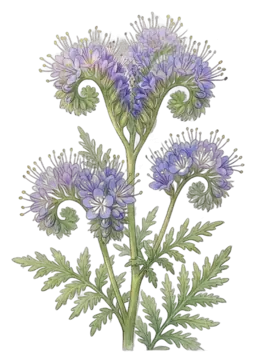
An annual 30 to 80 cm tall, with an upright stem and palmate leaves made up of five to nine very narrow, linear leaflets. In spring, from April to June, it produces spikes of small, pea-like flowers in violet-blue, sometimes pink or white, which attract bees. Afterwards it forms flattened, hairy, narrow pods holding a few rounded seeds mottled cream, grey and brown, which burst open as they dry. As a legume it fixes nitrogen in its roots, which is why it is used as a green manure to enrich poor, acid soils, as well as a bedding and wildflower plant. Be careful: it is a toxic plant. The seeds and the plant contain bitter alkaloids and are not eaten. The lupin beans sold as a snack come from other species and from treated sweet varieties, which are not what is sold as a flower or as garden seed.
Family and origin: Pea family (Fabaceae) · native to The Mediterranean region and western Europe; it grows wild in Spain, in pastures and on acid, sandy soils · More plants from Mediterranean basin
01In your area
How will it do in your garden?
Year calendar
| Task | J | F | M | A | M | J | J | A | S | O | N | D |
|---|---|---|---|---|---|---|---|---|---|---|---|---|
| Direct sowingFeb–Mar, Oct–Nov | no | yes | yes | no | no | no | no | no | no | yes | yes | no |
| HarvestApr–Jun | no | no | no | yes | yes | yes | no | no | no | no | no | no |
| FloweringApr–Jun | no | no | no | yes | yes | yes | no | no | no | no | no | no |
Its life cycle at a glance
Swipe and tap a stage to see its details.
02Planting
Where and how to plant it
Sow the seed 2.5 cm deep; leave 15 cm between plants and 40 cm between rows.
15 cm between plants · 40 cm between rows
Seed at a depth of 2.5 cm.
- Direct sowing
- Feb–Mar, Oct–Nov
- Germination
- ~14 days
- Common mistakeSowing out of season: many need warmth or a cold spell beforehand to sprout.
03Care
Care through the year
Sun and aspectFull sun · 8 h of sun · South or south-west, with nothing casting shade at midday
- Too little sun
- Ideal range
- Plenty of sun
South or south-west, with nothing casting shade at midday
Strong sun: Loves full midday sun and high temperatures.
Full sun. In partial shade it grows tall and floppy and produces few spikes.
WateringLet it dry out between waterings · summer: every 5-7 days
- Summerevery 5-7 days0.6 L per plant/week
- Spring / Autumnevery 10-14 days0.2 L per plant/week
- Winteronly in extreme drought (once a month)0.1 L per plant/week
Let it dry out between waterings: A Mediterranean favourite: better thirsty than overwatered.
It is a dry-land plant that copes well with drought once it has come up. Water only to get it to germinate and, if the spring is very dry, sparingly. Overwatering rots the roots. It prefers loose, acid or neutral soils and does not tolerate lime well.
When to water? Push your finger 5 cm into the soil next to the base of the plant:
- Damp: soil sticks to your finger. Do not water yet. It has more than enough; wait for it to dry out more.
- Cool but clean, no mud. Wait another 1-2 days before watering.
- Dry and dusty. Water now, but moderately. Do not overdo it: it prefers thirst to excess.
Soil and feedingpH 5–7 · Loose soil with organic matter and good drainage
Loose soil with organic matter and good drainage.
50 % topsoil · 30 % well-rotted compost · 20 % sand or perlite.
Medium/high.
This plant prefers a pH between 5.0 and 7.0 (acidic to neutral).
- Overfeeding gives lots of leaf and few flowers.
- Compacted, poorly drained soil rots the roots in winter.
- TipSow in full sun in loose, lime-free soil and let it cover itself in flowers.
- TipIf you are using it as a green manure, cut it down and dig the stems in when it is in full flower, before the seeds form, and wait a few weeks before sowing the next crop.
- Common mistakeOverfeeding gives lush leaves but few flowers.
Pruning
- TipRemove faded flowers to prolong flowering.
Common mistakes and tips
- TipStore the seeds away from children and animals, and do not use them in the kitchen.
- TipIt can suffer from aphids and, in wet years, anthracnose and other fungal diseases.
04Harvest
Harvesting and storing
Harvest in Apr–Jun; the first, about 160 days after sowing.
- TipGather the dry pods before they split, because the seeds are flung out.
05Propagation
Make new plants
It is propagated only by seed, sown directly where it is to grow because it does not take kindly to transplanting. Sow in autumn in areas with mild winters, or at the end of winter inland, about 2 to 3 cm deep and about 15 cm between plants. Soaking for about 12 to 24 hours, and nicking or scratching the coat of the harder seeds, speeds up germination, which takes two to three weeks. In soils where legumes have not been grown before, it is worth inoculating the seeds with rhizobia so that it fixes nitrogen. Collect the seeds when the pods are dry and store them somewhere dry and cool.
Seeds: how to germinate them~14 days
06Uses and health
What it is used for, and with what care
WARNING: the plant and, above all, the seeds contain alkaloids (such as lupanine) that are toxic if eaten. They cause malaise, vomiting, dizziness, blurred vision, palpitations and, in severe cases, breathing problems, especially in children. Do not eat them or give them to animals. In dogs, cats and livestock the poisoning can be serious: do not let them graze on the plant, and keep the seeds out of their reach. In addition, lupin is a recognised allergen in the EU and can cause a cross-reaction in people allergic to peanuts. In the event of any ingestion, in Spain call the Toxicology Information Service (91 562 04 20) or 112.
- Properties
- It improves the soil by fixing nitrogen with its roots and, when dug in while flowering, adds organic matter; its flowers also attract bees and other pollinators.
- Uses
- This plant is not used in cooking. The seeds of the wild species and those of garden varieties contain bitter alkaloids and are not fit to eat, either raw or after being boiled at home. The lupin beans sold as a snack come from other species and from sweet varieties, or ones that have had the bitterness removed through controlled processes.
For guidance only; this is not medical treatment and does not replace advice from a doctor or vet.
07Companions and related plants