
Credits and licences
- #1 — vueltaalhuerto illustration
- #2 — vueltaalhuerto illustration
- #3 — vueltaalhuerto illustration
- #4 — vueltaalhuerto illustration
- #5 — vueltaalhuerto illustration
- #6 — vueltaalhuerto illustration
- #7 — vueltaalhuerto illustration
- #8 — vueltaalhuerto illustration
- #9 — vueltaalhuerto illustration
- #10 — vueltaalhuerto illustration
Allium aflatunense (Persian onion)
and 2 more names
ornamental allium, allium 'Purple Sensation'Allium aflatunense (Persian onion) is sown directly outdoors from October to December. It flowers from May to June. Grow it in full sun, 20 cm apart, with little watering. Dates are for a mild temperate climate in the northern hemisphere; the calendar below adjusts them to your zone.
What else to sow in October, November and December
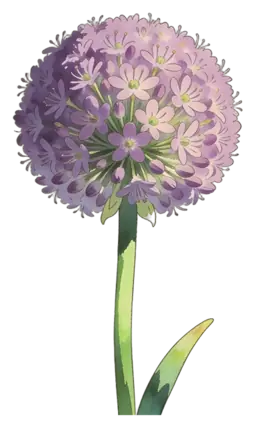
An ornamental bulb with broad, strap-shaped, bluish-green leaves that form a rosette in spring and start to wither as the plant flowers. From it rises a straight stem 80 to 100 cm tall topped by a perfect sphere, about 10 cm across, of dozens of starry violet or purple florets. It flowers between May and June, attracts bees and bumblebees and looks very good among roses, lavenders and grasses, which hide the withered leaves. Afterwards the flower heads dry and stay standing, and can be used as dried flowers. It is an ornamental plant, not an edible garlic, and it is best kept out of reach of dogs and cats, because like all Allium it is bad for them.
Family and origin: Amaryllis family (Amaryllidaceae) · native to Mountains of Central Asia (Tian Shan) · More plants from Central Asia
01In your area
How will it do in your garden?
Year calendar
| Task | J | F | M | A | M | J | J | A | S | O | N | D |
|---|---|---|---|---|---|---|---|---|---|---|---|---|
| Direct sowingOct–Dec | no | no | no | no | no | no | no | no | no | yes | yes | yes |
| Plant / transplantOct–Nov | no | no | no | no | no | no | no | no | no | yes | yes | no |
| FloweringMay–Jun | no | no | no | no | yes | yes | no | no | no | no | no | no |
| Divide the clumpJul–Sep | no | no | no | no | no | no | yes | yes | yes | no | no | no |
Its life cycle at a glance
Swipe and tap a stage to see its details.
02Planting
Where and how to plant it
Sow the seed 13 cm deep; leave 20 cm between plants and 25 cm between rows.
20 cm between plants · 25 cm between rows
Seed at a depth of 13 cm; seedlings go in with the root ball level with the soil.
- Transplanting
- Oct–Nov
- Direct sowing
- Oct–Dec
- Germination
- ~30 days
- TipPlant them in groups of five or more for impact.
- TipThe leaves deteriorate before the flower opens, so place them behind other plants that disguise them.
- Common mistakeSowing out of season: many need warmth or a cold spell beforehand to sprout.
03Care
Care through the year
Sun and aspectFull sun · 8 h of sun · South or south-west, with nothing casting shade at midday
- Too little sun
- Ideal range
- Plenty of sun
South or south-west, with nothing casting shade at midday
Strong sun: Loves full midday sun and high temperatures.
Full sun. In shade the stem stretches and leans and the flower head is smaller.
WateringLet it dry out between waterings · summer: every 5-7 days
- Summerevery 5-7 days0.6 L per plant/week
- Spring / Autumnevery 10-14 days0.2 L per plant/week
- Winteronly in extreme drought (once a month)0.1 L per plant/week
Let it dry out between waterings: A Mediterranean favourite: better thirsty than overwatered.
Water sparingly from the time the leaves emerge until flowering ends, and only if the spring is dry. When the leaves yellow the plant goes dormant and needs no water: too much moisture in summer rots the bulb.
When to water? Push your finger 5 cm into the soil next to the base of the plant:
- Damp: soil sticks to your finger. Do not water yet. It has more than enough; wait for it to dry out more.
- Cool but clean, no mud. Wait another 1-2 days before watering.
- Dry and dusty. Water now, but moderately. Do not overdo it: it prefers thirst to excess.
Soil and feedingpH 6–7.5 · Loose soil with organic matter and good drainage
Loose soil with organic matter and good drainage.
50 % topsoil · 30 % well-rotted compost · 20 % sand or perlite.
Medium/high.
This plant prefers a pH between 6.0 and 7.5 (slightly acidic to slightly alkaline).
- Overfeeding gives lots of leaf and few flowers.
- Compacted, poorly drained soil rots the roots in winter.
- TipPlant the bulbs between October and November, pointed end up, about 12 to 15 cm deep (three times their height) and about 20 cm apart, in loose, well-drained soil in full sun.
- Common mistakeOverfeeding gives lush leaves but few flowers.
Pruning
- TipRemove faded flowers to prolong flowering.
Common mistakes and tips
- TipAfter flowering do not cut the leaves until they are completely dry, so the bulb can build up its reserves.
- TipIf you do not want it to self-seed, cut off the flower heads before they shed their seed, or leave them to dry for decoration.
- TipWatch out for onion fly and allium leaf miner.
04Propagation
Make new plants
It is propagated mainly by offsets, the small bulbs that form attached to the base of the mother bulb: lift them once the leaves have dried, in early summer, separate them and replant at the end of summer or in autumn. Seed can also be sown in autumn, outdoors, because it needs cold to germinate; it comes up slowly and the plants take three or four years to flower.
Seeds: how to germinate them~30 days
05Uses and health
What it is used for, and with what care
WARNING: it is an ornamental onion (Allium) and is not used as food. The bulbs and leaves can cause digestive upset in people if eaten, and the sap can irritate some people's skin. For dogs and cats it is toxic, like onions and garlic: it can damage red blood cells and cause anaemia, vomiting and lethargy. Plant the bulbs where animals will not dig them up and, if you suspect they have eaten any, consult a vet as soon as possible.
- Properties
- An ornamental plant with a large spherical flower head, much visited by bees and bumblebees; its value is decorative and it is not grown for food.
For guidance only; this is not medical treatment and does not replace advice from a doctor or vet.
06Companions and related plants
What to plant it with

Compare with similar varieties
| Variety | Sowing | Harvest | Days | Spacing | Difficulty |
|---|---|---|---|---|---|
| Allium aflatunense (Persian onion) | Oct–Dec | May–Jun | — | 20 cm | Easy |
| Giant allium | Oct–Nov | May–Jun | — | 30 cm | Easy |