
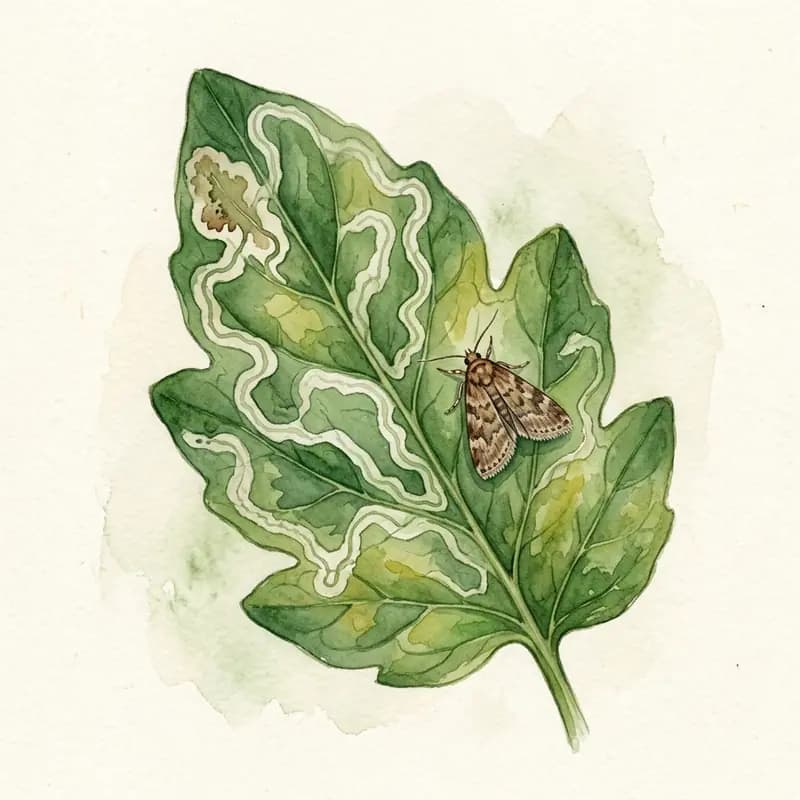
Tomato leaf miner (Tuta absoluta)
Also known as: tuta absoluta, tomato leafminer, tomato pinworm, South American tomato moth, tomato borer, Tuta absoluta
A moth whose caterpillars tunnel through the leaves, stems and fruit of tomatoes, leaving winding galleries. It is one of the most persistent visitors of Mediterranean tomatoes. The first step is to put up a pheromone trap to learn when the moths fly and to remove the leaves with mines.
Its best ally
Parasitic wasp
A natural predator that helps to keep this pest under control. Tap to see how to attract it.

How to recognise it at every stage
Shares your gardenIt likes your tomatoes: leaves, stems and fruit.
Life cycle: Complete metamorphosis: egg (4-6 days), caterpillar living inside the leaf or fruit (2-3 weeks), pupa (1-2 weeks) and moth. In warm weather, one cycle a month: ten or more generations a year, especially under cover.
Tap a stage to see it full size. The photos are AI reference images checked against real photographs; stages without a reliable photo are shown as text only.
Life-stage calendar
| Jan | Feb | Mar | Apr | May | Jun | Jul | Aug | Sep | Oct | Nov | Dec | |
|---|---|---|---|---|---|---|---|---|---|---|---|---|
| Eggs | ||||||||||||
| Leaf-mining caterpillar | ||||||||||||
| Pupa | ||||||||||||
| Moth | ||||||||||||
| Mines in the leaves |
Approximate months for mainland Spain; in cold areas they start later and in warm areas they last longer. Garden creatures this month
No reliable photo yet
1Keep an eye on itEggs
· 0.4 mmCylindrical, cream or yellowish, laid singly; almost invisible without a lens.
- Where to find it
- On leaf undersides, tender shoots and the sepals of small fruits.
- When: Mar–Nov
- What to do
- Hang a pheromone trap from planting time to know when they start flying.
- 2Protect your plants
Leaf-mining caterpillar
· 1-8 mmA tiny cream caterpillar that turns greenish or pinkish, with a dark head and a thin black band behind it.
- Where to find it
- Inside the leaves (wide transparent mines with droppings), in stems and under the fruit calyx.
- When: Apr–Nov
- What to do
- Remove leaflets with mines and holed fruits and put them in a closed bag. Mesh over openings and ally bugs (Nesidiocoris, Macrolophus).
- Often confused with
- Tomato fruitworm (Helicoverpa). Much bigger (3-4 cm), lives outside and makes large holes in the fruit. See profile
- 3Keep an eye on it
Pupa
· 4-5 mmGreen turning brown, sometimes inside a thin silk cocoon.
- Where to find it
- On leaves, in the mines or in the soil.
- When: Apr–Nov
- What to do
- Clearing crop remains at the end of summer stops them carrying over to next year.
- 4Protect your plants
Moth
· 6-7 mmA tiny silvery-grey moth with dark speckles and long antennae; folded wings form a little tube.
- Where to find it
- Hidden among leaves by day; flies at dusk and at night.
- When: Mar–Nov
- What to do
- Pheromone traps and mesh in greenhouses. Mirid bugs and Trichogramma wasps are its allies.
Nests, egg clutches and shelters
- Protect your plants
Mines in the leaves
Wide transparent patches in the leaf, like windows, with dark droppings and the caterpillar inside.
- Where to find it
- On tomato leaves, first at the top.
- When: Apr–Nov
- What to do
- Remove the mined leaflet as soon as you see it, so the caterpillar never reaches the fruit.
- Often confused with
- Leaf miner (Liriomyza). It makes thin winding tunnels like a scribble, not wide patches; its larva has no head or legs. See profile
Often confused with
- Leaf miner (Liriomyza). It makes thin winding tunnels like a scribble, not wide patches; its larva has no head or legs. See profile
- Tomato fruitworm (Helicoverpa). Much bigger (3-4 cm), lives outside and makes large holes in the fruit. See profile
How to recognise it (symptoms)
- Transparent, irregular galleries inside the leaves (mines)
- Small dark droppings inside the galleries, which confirm that a live larva is there
- Holes and galleries in the fruit, which end up rotting
- Shoots and stems that are hollow or damaged inside
Crops affected
 TomatoMarmande tomato, flattened and ribbed, a good size for salads.
 PotatoThe 'Kennebec' potato is versatile in the kitchen, with pale skin.
 AubergineAn aubergine with glossy black fruit, for warm climates.
 PepperCalifornia Wonder pepper, a blocky bell type with thick flesh, for stuffing or eating fresh.
What favours it
- Heat, which speeds up its cycle and allows several generations a year
- Continuous growing of tomatoes or other nightshades without rotation
- Infested crop remains left on the plot
Prevention
- Pheromone traps: they detect the flight of the males and, used for mass trapping, help reduce egg-laying
- Fine-mesh insect netting on the sides of the greenhouse, to stop adults getting in
- Rotate crops and remove infested remains to break the cycle of pupae and larvae that stay on the plot
- Check leaves and fruit often: the mines show early and you can remove the affected spots by hand
Organic treatment
Always start here: these remedies are kind to the garden, the soil and pollinators.
- First: put up a pheromone trap to learn when the moths fly and remove the leaves with mines right away, putting them in a closed bag to throw in the rubbish
- Spray Bacillus thuringiensis kurstaki (a registered product) on young larvae, before they get into the fruit. It affects caterpillars, not predators or bees
- Pheromone traps with water or with a sticky plate for mass trapping, following the density the manufacturer indicates
- In a greenhouse, you can release predatory bugs such as Macrolophus pygmaeus, which eat eggs and small larvae. Ask the supplier, because other species can harm the plant if there are many
Chemical treatment (with caution)
It develops resistance very quickly. If insecticides are used, use only products registered for tomatoes, rotate active ingredients and combine them with Bt and pheromones.
Don't confuse it with…
Its mines are mistaken for those of the leaf miner. In tuta, the galleries are wide and irregular and reach the fruit.
In-depth guide: tomato leaf miner (Tuta absoluta)
In a Mediterranean climate it has several generations a year. Keep watch with pheromones and act at the first mines, before the larva gets into the fruit.
Pheromone traps
Put them up from spring, before transplanting, following the density the manufacturer indicates. Count the catches every week: a sudden rise means it is time to step up your checks and treat with Bt.
Biological control
- Bacillus thuringiensis kurstaki on young larvae, before they get into the fruit.
- Predatory bugs (Macrolophus) in a greenhouse, or egg parasitoids such as Trichogramma, which are used in protected crops.
- Avoid broad-spectrum insecticides, which harm natural helpers.
Strict hygiene
- Remove leaves with mines and perforated fruit in a closed bag and put them in the rubbish, not in the compost.
- Do not leave tomato remains on the ground after the harvest.
- Alternate with crops that are not nightshades for at least a year.
Netting and barriers
Use fine-mesh insect netting on the windows and sides of the greenhouse and seal the gaps at ground level. Check seedlings before transplanting them, so you do not bring the moth in with them.
When to act
A mine on a young leaf or a fruit with an early gallery is already reason enough to act on that plant: remove the leaf or the fruit and keep an eye on the rest. Waiting until you see dozens of mines makes it much harder to control.
Use plant protection products responsibly, even organic ones. Always read and follow the label, the doses and the harvest interval, and never treat plants in flower or while bees are flying, in order to protect pollinators. If in doubt, put prevention and organic methods first.

In the plant catalogue you'll see what to plant, how and when: a well-tended plant resists pests much better.