
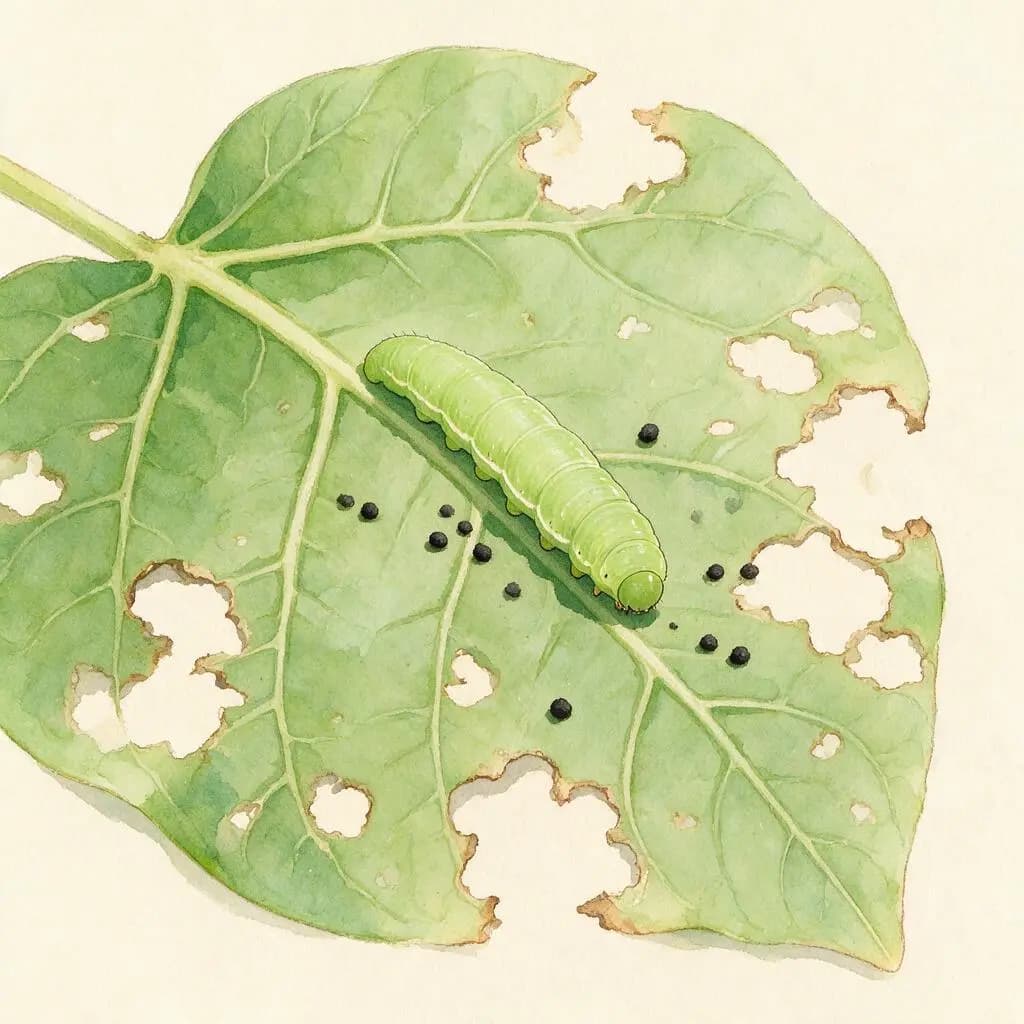
Beet armyworm
Also known as: beet armyworm, small mottled willow moth, Spodoptera exigua, armyworm, green armyworm
Green caterpillars, up to about 3 cm long, that devour leaves and fruit in groups. In heavy infestations they leave the plant skeletonised within a few days. The first step is to squash the egg clusters on the undersides of the leaves and pick off the caterpillars by hand.
Its best ally
Ground beetle
A natural predator that helps to keep this pest under control. Tap to see how to attract it.

How to recognise it at every stage
Shares your gardenIt likes your peppers, lettuces, chard and tomatoes.
Life cycle: Complete metamorphosis: egg (2-5 days), caterpillar (2-3 weeks), pupa in the soil (1-2 weeks) and moth. Many generations from spring to autumn, and all year round under cover in the south.
Tap a stage to see it full size. The photos are AI reference images checked against real photographs; stages without a reliable photo are shown as text only.
Life-stage calendar
| Jan | Feb | Mar | Apr | May | Jun | Jul | Aug | Sep | Oct | Nov | Dec | |
|---|---|---|---|---|---|---|---|---|---|---|---|---|
| Egg clutch | ||||||||||||
| Caterpillar | ||||||||||||
| Pupa | ||||||||||||
| Moth |
Approximate months for mainland Spain; in cold areas they start later and in warm areas they last longer. Garden creatures this month
- 1Protect your plants
Egg clutch
· Groups of 5-10 mmSmall groups of eggs covered with whitish or pinkish fluff, like a tiny piece of cotton.
- Where to find it
- On the undersides of low leaves.
- When: Apr–Oct
- What to do
- Remove the leaf with the clutch: the caterpillars hatch together, so it is easy to take them all at once.
- 2Protect your plants
Caterpillar
· Up to 3 cmGreen (sometimes brown), smooth, with a white line along each side and a small dark dot above the front legs.
- Where to find it
- At first in groups scraping the leaf underside; later on their own, eating leaves and fruit.
- When: May–Nov
- What to do
- Pick them off by hand and move them away; Bacillus thuringiensis while they are small.
- Often confused with
- Cotton bollworm and other armyworms. Bigger and variable in colour; the beet armyworm is the smallest and has the white side line. See profile
- 3Keep an eye on it
Pupa
· 1.5 cmReddish-brown and shiny, in a small soil cell.
- Where to find it
- In the soil under the plant.
- When: May–Nov
- What to do
- Nothing needed.
- 4Keep an eye on it
Moth
· 2.5-3 cm wingspanA small grey-brown moth with a round pale spot and a kidney-shaped one on each forewing.
- Where to find it
- Flies at night.
- When: Apr–Oct
- What to do
- Pheromone traps to know when to check the leaves.
Often confused with
- Cotton bollworm and other armyworms. Bigger and variable in colour; the beet armyworm is the smallest and has the white side line. See profile
How to recognise it (symptoms)
- Leaves gnawed down to the midrib
- Fruit with shallow bites and black droppings
- Clusters of yellowish eggs covered in fine hairs on the undersides of the leaves
- Green caterpillars with a pale stripe and a darker stripe along the side
Crops affected
 TomatoMarmande tomato, flattened and ribbed, a good size for salads.
 PepperCalifornia Wonder pepper, a blocky bell type with thick flesh, for stuffing or eating fresh.
 BeansA dwarf green bean that does not need a support and is easy to grow in a bed.
 Globe artichokeAn artichoke with a green head and a cleft at the top, tender and with no choke, good for eating almost raw.
 SweetcornMaize with tender, sugary kernels for eating on the cob.
 OnionThe Figueres onion is a sweet onion with purplish skin, typical of Catalonia in Spain.
What favours it
- Very hot summers, which shorten its life cycle and increase the number of generations a year
- Lush, heavily watered crops, which offer constant shelter and food
- Neighbouring crops (sweetcorn, cotton, artichoke) that share the pest and reintroduce it to your plot
Prevention
- Insect-proof mesh on seed trays and young crops, to stop the moths laying eggs
- A weekly check of the undersides of the leaves to remove egg clusters
- Pheromone traps to find out when the adults are flying
Organic treatment
Always start here: these remedies are kind to the garden, the soil and pollinators.
- First: look for egg clusters on the undersides of the leaves, squash them and pick off the young caterpillars by hand after dark. This stops the generation before it strips the plants
- Bacillus thuringiensis (Bt kurstaki or aizawai, a registered product) at dusk, on small caterpillars
- Spinosad, which is accepted in organic farming, only as a registered product, following the label, and only if the attack is severe, because it is toxic to bees and beneficial insects
- Encourage tiny parasitoid wasps (such as Trichogramma) with a variety of flowers along the edge of the garden
Don't confuse it with…
With the tomato fruitworm (Helicoverpa), which bores into the fruit and is more reddish. The beet armyworm strips leaves and hardly ever gets into the fruit.
In-depth guide — beet armyworm
This caterpillar eats leaves and fruit, mainly at night, and can wipe out a crop in a few days if you do not keep an eye on it.
Identification
Leaves eaten down to the veins, green caterpillars up to about 3 cm long and egg clusters covered in fine hairs on the undersides of the leaves.
- Look on the leaves and fruit after dark with a torch.
- Do not confuse it with slugs, which leave a silvery slime trail.
Control
Mesh, hand-picking and Bacillus on infested patches.
- Squash the egg clusters on the undersides of the leaves every week.
- Pick the caterpillars off by hand after dark in light infestations.
- Keep the bed clear of debris and weeds, where they shelter.
Use plant protection products responsibly, even organic ones. Always read and follow the label, the doses and the harvest interval, and never treat plants in flower or while bees are flying, in order to protect pollinators. If in doubt, put prevention and organic methods first.

In the plant catalogue you'll see what to plant, how and when: a well-tended plant resists pests much better.