
Lizards: a dry-stone wall
Lizards eat spiders, crickets, flies, beetles and caterpillars. A dry-stone wall (no cement) gives them shelter, sun and a place to spend the winter. It is also a refuge for spiders, solitary bees and other allies.
- Difficulty: medium
- Base: a trench 15–20 cm deep filled with gravel
- Profile: Wall lizard
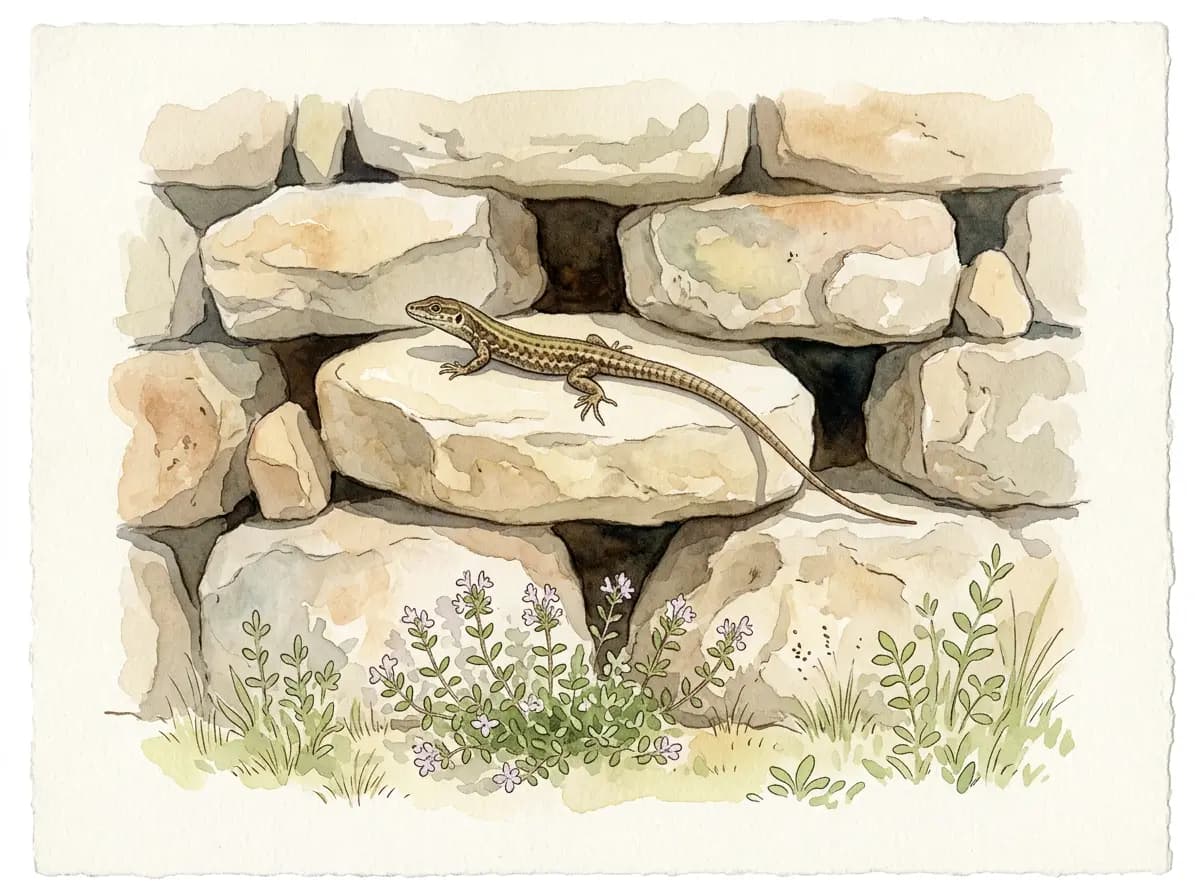
What it helps with
- They eat insects, spiders, small caterpillars, small snails and other invertebrates.
- The wall also serves as a refuge for beetles, spiders and solitary bees.
- It gives structure to the garden without cement.
Materials
- Local stone of different sizes (10–40 cm), uncut
- Gravel for the base
- Soil and sand to fill gaps inside
- Spade, spirit level and gloves
- A large flat stone for sunbathing
Measurements
- Base
- a trench 15–20 cm deep filled with gravel
- Wall
- 50–60 cm wide at the base and 50–100 cm high
- Batter
- slightly inward (about 10°) on both faces
- Gaps
- cracks of 2–5 cm that go deep, without cement
Step by step
1. Choose a sunny spot
A wall in the sun, facing south or south-east, with low shrubs nearby. Avoid walkways and places cats use.

2. Prepare the base
Dig a trench 15–20 cm deep and 50–60 cm wide. Fill with gravel and compact it.

3. Raise the wall in layers
Lay the largest stones first. Each stone must rest on at least two points and cross the joints of the layer below. Widen the wall towards the base and let it lean inwards. Fill the centre with small stones and dry soil.

4. Leave gaps
Every few stones leave a crack of 2–5 cm that goes deep. Do not use mortar or cement: air and drainage are needed.

5. Finish off
Put a flat stone on top or beside it for sunbathing. Plant thyme, rosemary and low plants along the base, without covering the whole sunny face.

How to recognise it at every stage
Garden allyGarden ally: it hunts grasshoppers, flies, spiders and insects in the sun.
Life cycle: No metamorphosis: the female buries a few soft-shelled eggs in spring or summer, and after 6-10 weeks young hatch that are already miniature lizards. They spend the winter dormant in crevices.
Tap a stage to see it full size. The photos are AI reference images checked against real photographs; stages without a reliable photo are shown as text only.
Life-stage calendar
| Jan | Feb | Mar | Apr | May | Jun | Jul | Aug | Sep | Oct | Nov | Dec | |
|---|---|---|---|---|---|---|---|---|---|---|---|---|
| Eggs | ||||||||||||
| Young | ||||||||||||
| Adult |
Approximate months for mainland Spain; in cold areas they start later and in warm areas they last longer. Garden creatures this month
- 1Protect it
Eggs
· 1-1.5 cmTwo to eight white, oval, soft-shelled eggs, like parchment.
- Where to find it
- Under stones, in loose soil, in wall crevices and sometimes in the compost.
- When: May–Aug
- What to do
- If you find them while digging, bury them again just as they were (without turning them).
- Often confused with
- Snake eggs. Snake eggs are bigger and more elongated, in larger groups, often in the compost. See profile
- 2Protect it
Young
· 3-5 cmTiny lizards; in the long-tailed lizard the young have a reddish or orange tail.
- Where to find it
- In the sun on walls, stones and bed edges.
- When: Jul–Oct
- What to do
- Beware of cats: they are their greatest danger.
- 3Protect it
Adult
· 12-25 cm with the tailBrown or greyish with stripes or spots, very fast; it can drop its tail if caught.
- Where to find it
- Basking on stone walls, rocks and log piles.
- When: Feb–Nov
- What to do
- Protect it (protected species): a dry-stone wall or a pile of stones in the sun is its home.
Often confused with
- Snake eggs. Snake eggs are bigger and more elongated, in larger groups, often in the compost. See profile
Where and when to put it
- Build it in autumn or winter so it is ready for spring.
- In the sun, sheltered from the wind, with an area of low grass around it.
- Best away from cats and with an area of deep gaps.
Maintenance
- Check the gaps every year and remove any grass that grows if it blocks them.
- Do not touch it from October to March: they overwinter inside.
- Avoid insecticides and herbicides around it.
- If a stone falls, put it back carefully outside the active season.
Common mistakes
What comes up most often, so you can avoid it from the start.
Joining the stones with cement or mortar.
Cement fills the cracks, which are exactly where lizards hide and spend the winter. A dry-stone wall, with nothing between the stones, leaves those gaps free.
Making a very compact wall, with no deep gaps.
Lizards need to get deep inside to escape cats and birds and to avoid freezing in winter. Shallow cracks do not protect them.
Putting it in shade or facing north.
Lizards do not produce their own heat: they need to bask in the sun to warm up so they can move and hunt. A wall with no sun is no use to them.
Surrounding it with very short lawn or with plants that cover the stone.
With a shaved lawn they have nowhere to hide when they move away from the wall, and if plants cover the stone, it does not warm up in the sun. Leave somewhat tall grass around it and the sunny face clear.
Hunting or catching lizards.
They are protected by law and, if you grab them by the tail, they drop it to escape. It grows back, but shorter, and they lose the fat they stored in it.
Plants that help
 ThymePerennial thyme for poor, dry soil, ideal for sunny borders.
A low shrub that does not cover the stone; it gives shade to cool off in summer and its flowers attract insects that lizards hunt.
 RosemaryA Mediterranean shrub that is very tough once established.
It withstands sun and drought at the foot of the wall and, since it flowers almost all year, there are always insects around.
More information on the site
Sources
The measurements are a synthesis of these conservation guides; where each author gives different figures, they appear as a range.