
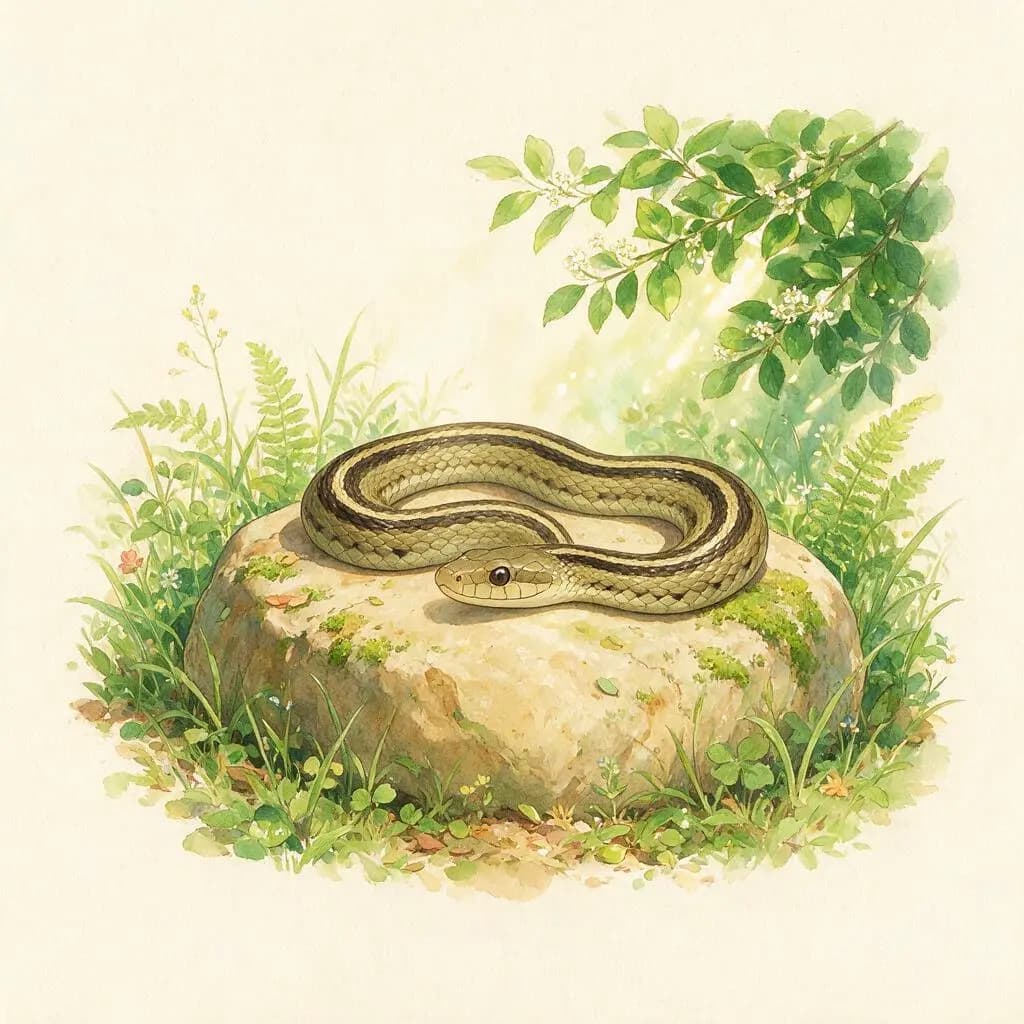
Garden snakes
Rhinechis scalaris, Malpolon monspessulanus
Also called: ladder snake, Montpellier snake, Rhinechis, Zamenis, snake
Native Iberian snakes that feed mainly on rodents (mice, voles, young rats). They help keep tuber-eating rodents in check. The ladder snake is not venomous; the Montpellier snake (Malpolon) has a mild venom in its back teeth: it almost never affects people, but they should not be handled.

How to recognise it at every stage
Garden allyGarden ally: it keeps mice and voles in check.
Life cycle: No metamorphosis: the female lays 5 to 20 eggs in summer, often in the warmth of the compost or manure; after two months little snakes hatch and shed their skin several times a year.
Tap a stage to see it full size. The photos are AI reference images checked against real photographs; stages without a reliable photo are shown as text only.
Life-stage calendar
| Jan | Feb | Mar | Apr | May | Jun | Jul | Aug | Sep | Oct | Nov | Dec | |
|---|---|---|---|---|---|---|---|---|---|---|---|---|
| Eggs | ||||||||||||
| Young snake | ||||||||||||
| Adult | ||||||||||||
| Shed skin |
Approximate months for mainland Spain; in cold areas they start later and in warm areas they last longer. Garden creatures this month
- 1Protect it
Eggs
· 3-5 cmWhite, elongated eggs with a soft, leathery shell, stuck together in a heap.
- Where to find it
- In the compost, manure heaps, under stones or stumps.
- When: Jun–Sep
- What to do
- If they turn up when you turn the compost, cover them again carefully and leave that heap alone for a few weeks.
- 2Protect it
Young snake
· 20-30 cmSmall snakes; the young ladder snake has an "H" or ladder pattern on its back.
- Where to find it
- Under stones and in stone walls.
- When: Aug–Oct
- What to do
- Let it go: they are not venomous to people.
- 3Protect it
Adult
· 1-2 mLadder snake: light brown with two dark stripes along its length. Montpellier snake: olive green or grey, with big eyes and marked "eyebrows".
- Where to find it
- On banks, stone walls and garden edges, in the sun.
- When: Mar–Oct
- What to do
- Protect it (it is protected). If it gets into an awkward spot, open an exit and step back: it will leave by itself.
- Often confused with
- Vipers. Vipers are short and thick (under 70 cm), with a vertical pupil, a triangular head and a zigzag along the back. In gardens they are rare.
Nests, egg clutches and shelters
- Protect it
Shed skin
A "shirt" of thin, transparent skin with the scale pattern, sometimes whole.
- Where to find it
- Among stones, branches and scrub.
- When: Apr–Sep
- What to do
- It is the sign that you have an ally nearby against mice.
Often confused with
- Vipers. Vipers are short and thick (under 70 cm), with a vertical pupil, a triangular head and a zigzag along the back. In gardens they are rare.
What it eats
- Mice and voles (main diet)
- Lizards and geckos
- Bird eggs and young chicks (occasionally in the hen run)
How it helps in the garden
How to attract this ally to your garden
- Dry-stone walls, log piles and leaf litter where they can take shelter.
- A pond or water point for reptiles and amphibians: they attract predators of slugs and insects.
- Do not disturb them if you see them: they leave on their own.
What to avoid so you do not harm it by accident
- Killing any snake out of fear: in the garden they are usually allies and several species are protected by law. Watch them without touching them.
- Rodenticides: they are poisoned when they eat the poisoned mouse.
- Mowers and strimmers in spring and summer without checking the area first: they can hurt snakes and their clutches.
How to recognise it
Ladder snake: up to 160 cm, the adults have two dark stripes along the back and the young a ladder-shaped pattern. Montpellier snake: up to 200 cm, grey or brown, with a large eye and a kind of prominent brow above it.
Risk to people: The ladder snake is not venomous. The Montpellier snake is opisthoglyphous (mild venom, teeth at the back): the risk to people is very low if you do not handle it; in the rare event of a bite, see a doctor. Vipers (snub-nosed viper, asp viper) are dangerous: if you are not sure which snake it is, keep your distance, and after a viper bite go straight to A&E.
Many allies are protected by Spanish law: do not capture or keep in captivity toads, hedgehogs, bats or native reptiles. Attract them, watch them and thank them from a distance. Rules in other countries differ: check your local regulations.

Allies do better if the garden is varied. Learn to identify each visitor and to prevent problems with good habits.