
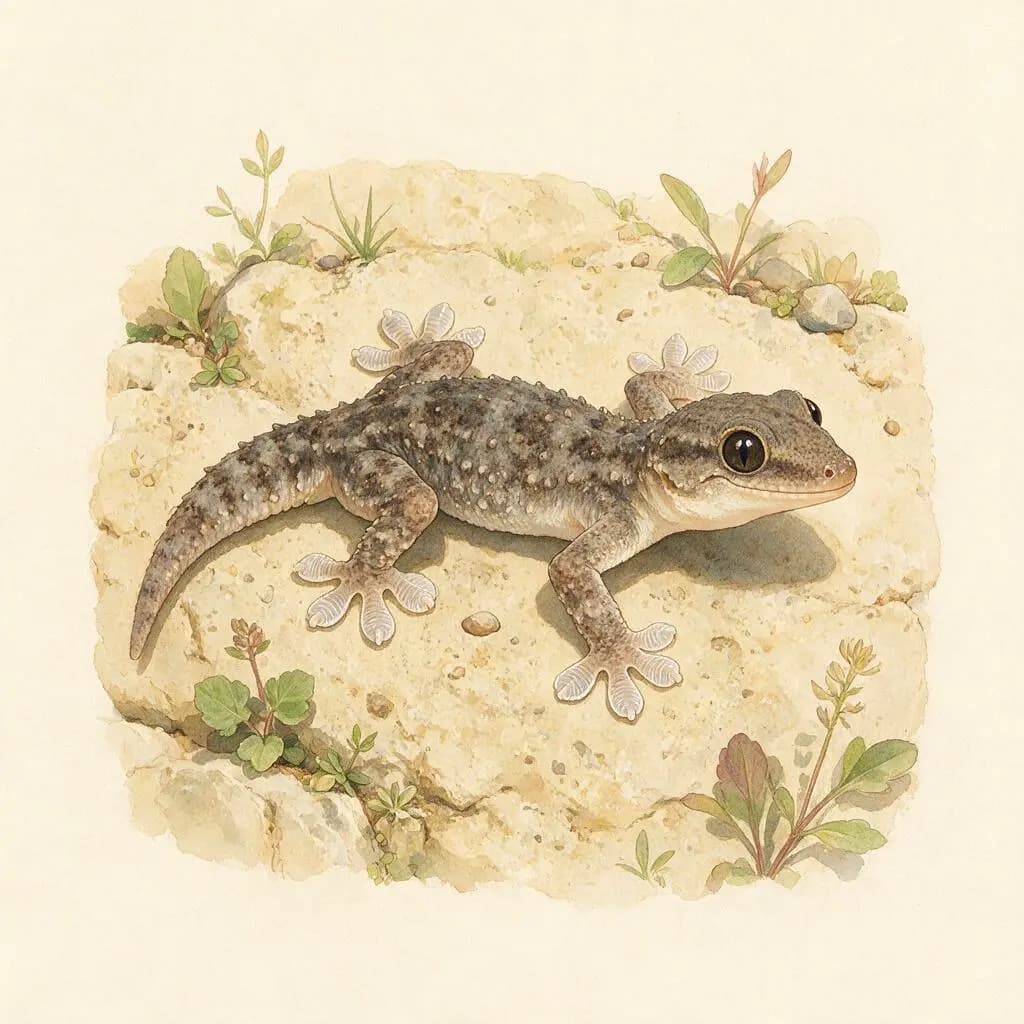
Moorish gecko
Tarentola mauritanica
Also called: common wall gecko, gecko, Tarentola mauritanica, house gecko
A night-time reptile that hunts mosquitoes, moths and spiders drawn to the light. It is very common in homes across the Iberian Peninsula and the Mediterranean. It is harmless and beneficial, even though many people feel wary of it.

How to recognise it at every stage
Garden allyAlly of the house and garden: at night it hunts mosquitoes and moths by the lights.
Life cycle: No metamorphosis: the female lays one or two hard-shelled eggs, several times over the summer, in crevices; after two or three months young hatch that are already miniature geckos.
Tap a stage to see it full size. The photos are AI reference images checked against real photographs; stages without a reliable photo are shown as text only.
Life-stage calendar
| Jan | Feb | Mar | Apr | May | Jun | Jul | Aug | Sep | Oct | Nov | Dec | |
|---|---|---|---|---|---|---|---|---|---|---|---|---|
| Eggs | ||||||||||||
| Young | ||||||||||||
| Adult |
Approximate months for mainland Spain; in cold areas they start later and in warm areas they last longer. Garden creatures this month
- 1Protect it
Eggs
· 1 cmOne or two white, almost round, hard-shelled eggs, stuck together.
- Where to find it
- In wall crevices, under roof tiles, behind shutters and in log piles.
- When: May–Aug
- What to do
- Leave them in place.
- Often confused with
- Lizard eggs. Lizard eggs are soft and buried; gecko eggs are hard and sit in crevices. See profile
- 2Protect it
Young
· 4-5 cmTiny geckos, with the tail in pale and dark bands.
- Where to find it
- On walls and in crevices.
- When: Jul–Oct
- What to do
- Nothing; watch out for cats.
- 3Protect it
Adult
· 10-15 cmGrey or brown, flattened, with granular skin and wide toes with adhesive lamellae: it climbs smooth walls.
- Where to find it
- On walls at night, next to street lamps and lights; by day, in crevices.
- When: Mar–Nov
- What to do
- Protect it: it is not venomous and passes on nothing. A crack in a sunny wall is its shelter.
Often confused with
- Lizard eggs. Lizard eggs are soft and buried; gecko eggs are hard and sit in crevices. See profile
What it eats
- Mosquitoes, gnats and midges
- Night moths
- Spiders and small beetles
- Young cockroaches
How it helps in the garden
How to attract this ally to your garden
- Cracks and stone walls where they can hide by day.
- A dim outdoor light in summer: it attracts insects and they hunt them.
- Do not disturb them or pick them up: to escape they shed their tail, which grows back shorter, and they lose the fat reserve stored in it.
What to avoid so you do not harm it by accident
- Household insecticides: they kill their prey and poison them indirectly.
- Glue traps for rodents: they die stuck by accident.
How to recognise it
10-15 cm, brownish grey with a rough back, widened toes with sticky lamellae that let it climb walls and ceilings. Nocturnal and silent.
Risk to people: None. They are not venomous; if you grab one it may bite, but with no consequences.
Many allies are protected by Spanish law: do not capture or keep in captivity toads, hedgehogs, bats or native reptiles. Attract them, watch them and thank them from a distance. Rules in other countries differ: check your local regulations.

Allies do better if the garden is varied. Learn to identify each visitor and to prevent problems with good habits.