
Earwigs: the upturned pot with straw
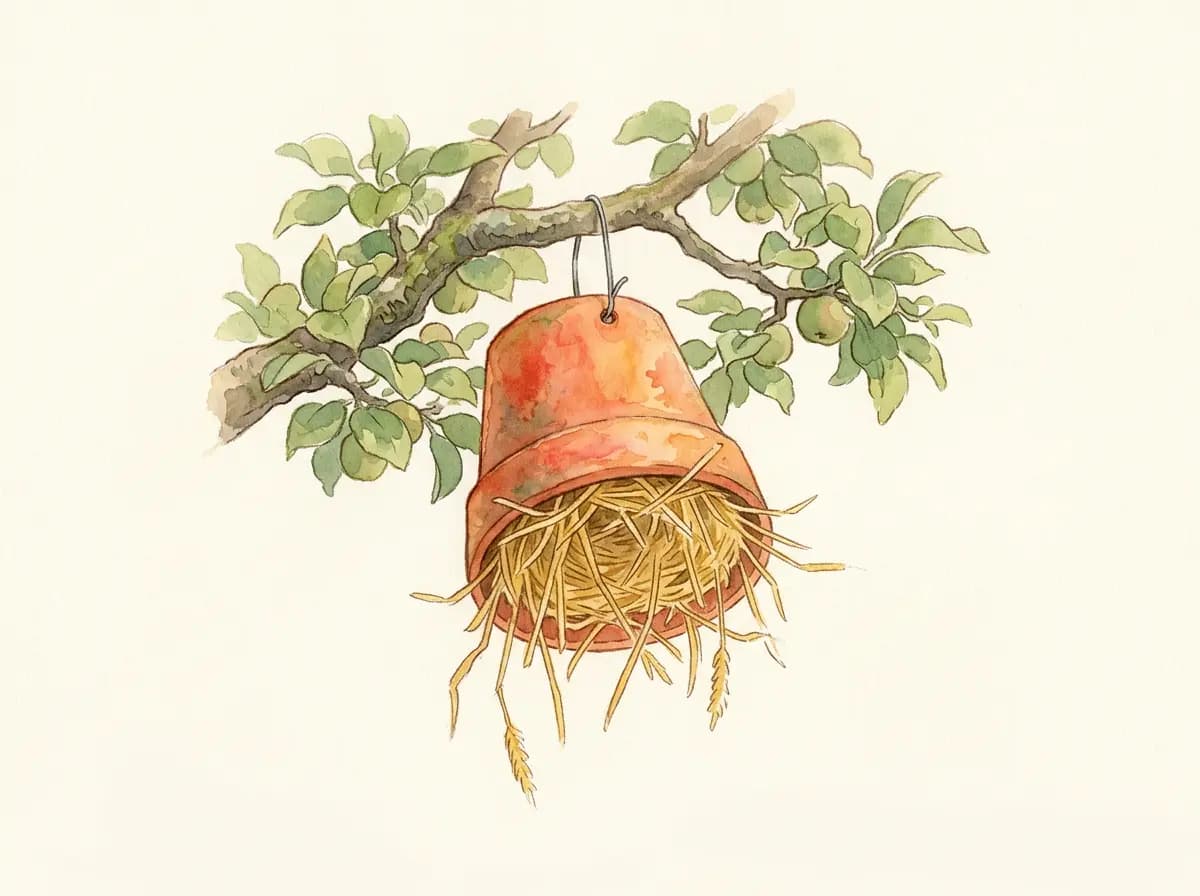
The common earwig is a night hunter of aphids, mites and insect eggs on fruit trees. By day it hides in dark crevices. An upturned pot with straw is its best-known “hotel”.
- Difficulty: easy
- Pot: 10–12 cm in diameter and 10–12 cm high, clay, with a drainage hole
- Profile: Earwig
What it helps with
- They eat aphids, young scale insects, mites and the eggs of other insects, especially on fruit trees.
- They settle into a simple, cheap box.
Materials
- A clay pot 10–12 cm in diameter
- Straw, dry hay or untreated wood shavings
- Wire or cord
- A stick or a branch (to hang it from) and a piece of mesh
Measurements
- Pot
- 10–12 cm in diameter and 10–12 cm high, clay, with a drainage hole
- Filling
- straw or shavings, not packed, filling 80%
- Height
- 1–1.5 m on a trunk or branch, touching the branch so they can climb up that way
Step by step
1. Prepare the filling
Fill the pot with straw or shavings, not packed, so gaps remain. Put a mesh over the mouth so the filling does not fall out.

2. Thread the wire
Pass a wire through the drainage hole of the pot and make a loop or knot inside so it does not come out. Leave a long piece outside for hanging.

3. Hang it upside down
Hang the pot mouth down, touching the trunk or a main branch of the fruit tree. That way they climb up the bark to the crown.

4. Observe
In a few days you will be able to see earwigs inside. If at some point you want to move them to another plant with aphids, move the pot and put it somewhere else.

How to recognise it at every stage
Garden allyGarden ally (it eats aphids and the eggs of other insects), although it sometimes nibbles petals and ripe fruit.
Life cycle: Incomplete metamorphosis: egg, four nymph stages and adult, with no pupa. The mother looks after the eggs and the young in a chamber underground. One or two clutches a year; the adult lives for about a year.
Tap a stage to see it full size. The photos are AI reference images checked against real photographs; stages without a reliable photo are shown as text only.
Life-stage calendar
| Jan | Feb | Mar | Apr | May | Jun | Jul | Aug | Sep | Oct | Nov | Dec | |
|---|---|---|---|---|---|---|---|---|---|---|---|---|
| Eggs (cared for by the mother) | ||||||||||||
| Nymph | ||||||||||||
| Adult | ||||||||||||
| Shelter pot |
Approximate months for mainland Spain; in cold areas they start later and in warm areas they last longer. Garden creatures this month
- 1Protect it
Eggs (cared for by the mother)
· 1 mmA little heap of 30-50 white, oval eggs, with the female on top cleaning them.
- Where to find it
- In a chamber a few centimetres underground, under stones or pots.
- When: May–Jun, Dec–Mar
- What to do
- If you lift a stone and see a mother with her eggs, put it back carefully.
- 2Protect it
Nymph
· 4-12 mmSmall wingless earwigs, whitish or greyish at first and then brown, with straight pincers.
- Where to find it
- Under stones, in flowers and among leaves, mostly at night.
- When: Mar–Jul
- What to do
- Leave them: they eat aphids, mites and decomposing matter.
- 3Keep an eye on it
Adult
· 12-15 mmShiny reddish brown, elongated, with short wing cases and pincers at the end: curved in the male, straight in the female. The pincers do no harm.
- Where to find it
- By day hidden in cracks, flowers and fruit; at night, active.
- When: Apr–Oct
- What to do
- Keep an eye on it only if it nibbles petals (dahlias) or seedlings: set a shelter away from those plants and empty it in the morning into a fruit tree with aphids. In apple and pear trees it is a great help.
- Often confused with
- Rove beetle (the beetle with the raised abdomen). Black, it raises its abdomen like a scorpion but has no pincers at the end. It is also an ally.
- Two-pronged bristletails or silverfish. White or silvery, with no curved pincers, and they live in the soil or indoors. Neither harms the garden.
Nests, egg clutches and shelters
- Protect it
Shelter pot
An upside-down pot stuffed with dry straw, hung from a stick: by day it fills up with earwigs.
- Where to find it
- In fruit trees with aphids or woolly aphid, or away from the flowers they nibble.
- When: Apr–Oct
- What to do
- Put it up in spring; move it with its tenants to wherever you want them to work.
Often confused with
- Rove beetle (the beetle with the raised abdomen). Black, it raises its abdomen like a scorpion but has no pincers at the end. It is also an ally.
- Two-pronged bristletails or silverfish. White or silvery, with no curved pincers, and they live in the soil or indoors. Neither harms the garden.
Where and when to put it
- Spring to autumn: put it up in April–May, when aphids begin.
- On fruit trees (apple, pear, peach) and on rose bushes or plants with aphids.
- Away from dahlias, soft flowers and ripe fruit: they sometimes nibble the petals.
Maintenance
- Check it every month and change the straw if it is damp or mouldy.
- In autumn, leave them in peace: they spend the winter in the ground or in crevices.
- If there are too many on the fruit, move the pot to another branch; few of them do any damage.
Common mistakes
What comes up most often, so you can avoid it from the start.
Leaving the pot on the ground.
On the ground the straw gets soaked and ants get in. Earwigs look for a dry shelter and, besides, hanging from the branch they have their food right next to them: the aphids.
Overfilling it or filling it with paper.
If the straw is packed there is no gap for them to get in, and paper gets wet, clumps and rots. Fill it with loose straw, without squashing it.
Spraying insecticide on the tree where you have hung it.
You wipe out the earwigs living in the pot, which were precisely the ones eating that tree’s aphids.
Putting it near dahlias or very ripe apricots.
Earwigs also nibble soft petals and ripe fruit. Hang it in fruit trees with aphids and away from the flowers and fruit you want to protect.
More information on the site
Sources
The measurements are a synthesis of these conservation guides; where each author gives different figures, they appear as a range.