
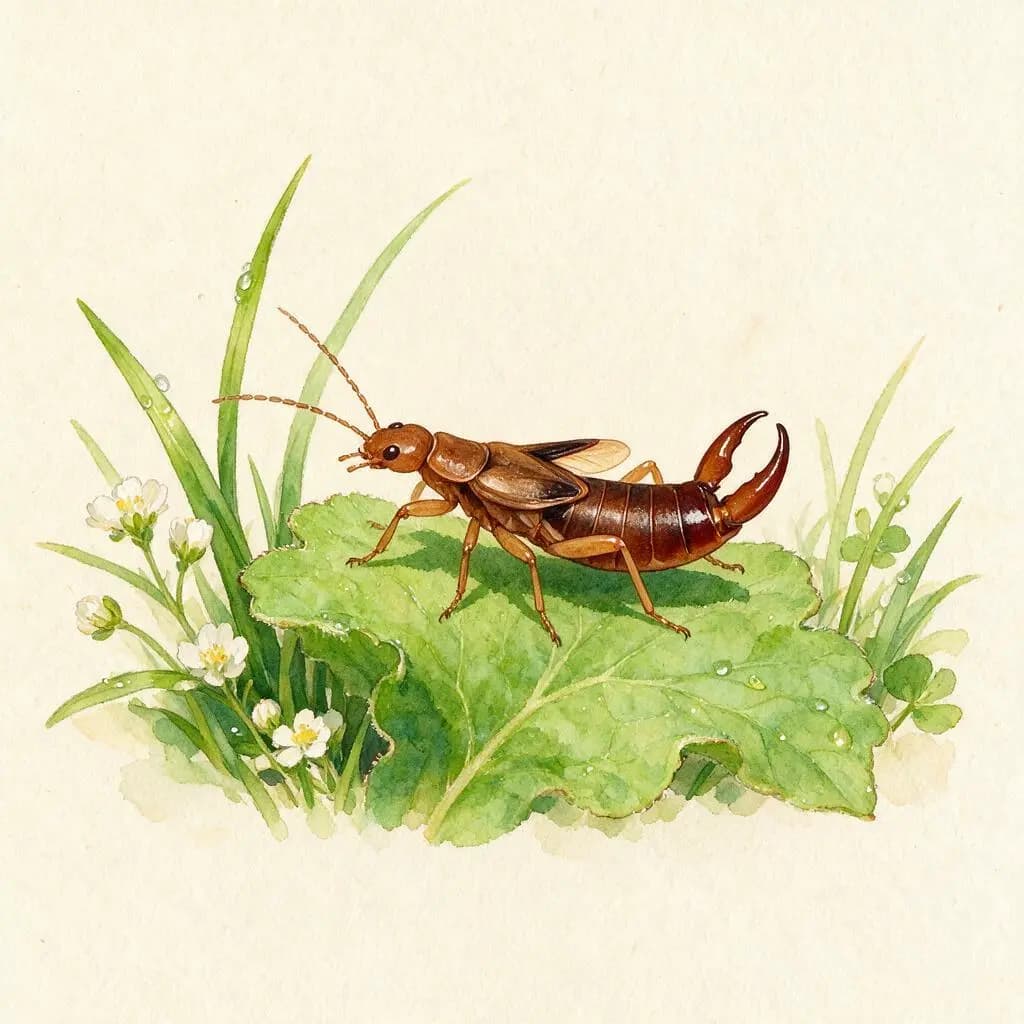
Earwig
Forficula auricularia
Also called: Forficula, European earwig, common earwig, pincher bug
A night-time insect with pincers on its abdomen that frightens people for no reason. It is omnivorous: it eats aphids, pest eggs, small caterpillars and plant remains, and sometimes soft fruit or flowers. In fruit trees, it helps keep aphids in check.

How to recognise it at every stage
Garden allyGarden ally (it eats aphids and the eggs of other insects), although it sometimes nibbles petals and ripe fruit.
Life cycle: Incomplete metamorphosis: egg, four nymph stages and adult, with no pupa. The mother looks after the eggs and the young in a chamber underground. One or two clutches a year; the adult lives for about a year.
Tap a stage to see it full size. The photos are AI reference images checked against real photographs; stages without a reliable photo are shown as text only.
Life-stage calendar
| Jan | Feb | Mar | Apr | May | Jun | Jul | Aug | Sep | Oct | Nov | Dec | |
|---|---|---|---|---|---|---|---|---|---|---|---|---|
| Eggs (cared for by the mother) | ||||||||||||
| Nymph | ||||||||||||
| Adult | ||||||||||||
| Shelter pot |
Approximate months for mainland Spain; in cold areas they start later and in warm areas they last longer. Garden creatures this month
- 1Protect it
Eggs (cared for by the mother)
· 1 mmA little heap of 30-50 white, oval eggs, with the female on top cleaning them.
- Where to find it
- In a chamber a few centimetres underground, under stones or pots.
- When: May–Jun, Dec–Mar
- What to do
- If you lift a stone and see a mother with her eggs, put it back carefully.
- 2Protect it
Nymph
· 4-12 mmSmall wingless earwigs, whitish or greyish at first and then brown, with straight pincers.
- Where to find it
- Under stones, in flowers and among leaves, mostly at night.
- When: Mar–Jul
- What to do
- Leave them: they eat aphids, mites and decomposing matter.
- 3Keep an eye on it
Adult
· 12-15 mmShiny reddish brown, elongated, with short wing cases and pincers at the end: curved in the male, straight in the female. The pincers do no harm.
- Where to find it
- By day hidden in cracks, flowers and fruit; at night, active.
- When: Apr–Oct
- What to do
- Keep an eye on it only if it nibbles petals (dahlias) or seedlings: set a shelter away from those plants and empty it in the morning into a fruit tree with aphids. In apple and pear trees it is a great help.
- Often confused with
- Rove beetle (the beetle with the raised abdomen). Black, it raises its abdomen like a scorpion but has no pincers at the end. It is also an ally.
- Two-pronged bristletails or silverfish. White or silvery, with no curved pincers, and they live in the soil or indoors. Neither harms the garden.
Nests, egg clutches and shelters
- Protect it
Shelter pot
An upside-down pot stuffed with dry straw, hung from a stick: by day it fills up with earwigs.
- Where to find it
- In fruit trees with aphids or woolly aphid, or away from the flowers they nibble.
- When: Apr–Oct
- What to do
- Put it up in spring; move it with its tenants to wherever you want them to work.
Often confused with
- Rove beetle (the beetle with the raised abdomen). Black, it raises its abdomen like a scorpion but has no pincers at the end. It is also an ally.
- Two-pronged bristletails or silverfish. White or silvery, with no curved pincers, and they live in the soil or indoors. Neither harms the garden.
What it eats
- Aphids (especially in fruit trees)
- Eggs and young caterpillars
- Thrips and small mites
- Decomposing plant material
How it helps in the garden
How to attract this ally to your garden
- Simple shelters: upside-down flowerpots stuffed with straw, hung in fruit trees.
- Areas with organic mulch where they can hide by day.
- Leave some leaf litter in the corners: it shelters useful predators without stripping away the whole habitat.
What to avoid so you do not harm it by accident
- Broad-spectrum insecticides: they kill pests and allies alike; use only localised treatments if needed.
- Over-tidying the garden: it leaves them nowhere to hide.
How to recognise it
1-2 cm, shiny brown, with those pincers on the tail. The female has them straight and the male curved. They are not dangerous to people.
Risk to people: None. If you grab one it may pinch you with its pincers, but it hardly hurts and they pass on nothing. The idea that they crawl into ears is just a legend.
Many allies are protected by Spanish law: do not capture or keep in captivity toads, hedgehogs, bats or native reptiles. Attract them, watch them and thank them from a distance. Rules in other countries differ: check your local regulations.

Allies do better if the garden is varied. Learn to identify each visitor and to prevent problems with good habits.