
Bumblebees: where they nest and how to help them
Bumblebees are great pollinators, able to “buzz” a tomato or pepper flower to release the pollen. They nest in small holes in the ground or among the grass, and the queens wake at the end of winter hungry. You help them more with a wild corner and flowers on time than with boxes.
- Difficulty: easy
- Wild corner: 1 m² or more, uncut from March to September
- Profile: Bumblebee
What it helps with
- They pollinate tomato, aubergine, pepper, broad beans, fruit trees and strawberries.
- They work in cold and wind, when honey bees no longer go out.
- They are docile; they only sting if crushed or if the nest is disturbed.
Materials
- A corner of tall, uncut grass (at least 1 m²)
- Optional: a clay pot of 15–20 cm, a tube 2–3 cm in diameter and 30–50 cm long, and dry filling (moss, untreated cotton wool or straw)
- Stones, logs or a pile of leaf litter to provide cavities
- Plants that flower early and for a long time
Measurements
- Wild corner
- 1 m² or more, uncut from March to September
- Buried nest (optional)
- 15–20 cm pot buried upside down, with a tunnel 2–3 cm in diameter and 30–50 cm long
- Entrance
- facing south or south-east, with the tunnel sloping gently upwards so water does not get in
- Flowering
- from February to October without gaps
Step by step
1. Leave a corner uncut
Choose a sunny, sheltered corner and let the grass grow from March to September. Here the species that nest on the surface make their nest under the tussocks, and those that nest underground look for empty mouse and mole galleries.

2. Offer dry cavities
A pile of stones, a stump or a heap of dry leaves to one side. Do not disturb the soil in the corner in spring or summer.

3. If you want to try a box
Bury a 15–20 cm clay pot upside down, filled with moss or untreated wool, with a tube of 2–3 cm and 30–50 cm to act as a tunnel. Face the tunnel south or south-east and leave a little slope. Be patient: many years it is not occupied. It is safer to look after the habitat than to rely on the box.

4. Flowers from February
The queens come out in February–March, very hungry. Rosemary, heather, almond, borage, sage, lavender, broad beans, clover and comfrey feed them afterwards. Cover from winter to autumn without gaps.

5. A little dish of water with stones
A shallow dish with water and stones so they can drink without drowning.

How to recognise it at every stage
PollinatorPollinator: it works in the cold and is key for tomatoes, strawberries and broad beans.
Life cycle: Complete metamorphosis inside the nest: egg, larva, pupa in a silk cocoon and adult, in about 4-5 weeks. The colony lasts a year: the queen founds the nest in spring, and in autumn only the new queens survive, spending the winter buried.
Tap a stage to see it full size. The photos are AI reference images checked against real photographs; stages without a reliable photo are shown as text only.
Life-stage calendar
| Jan | Feb | Mar | Apr | May | Jun | Jul | Aug | Sep | Oct | Nov | Dec | |
|---|---|---|---|---|---|---|---|---|---|---|---|---|
| Eggs | ||||||||||||
| Larvae | ||||||||||||
| Cocoons | ||||||||||||
| Adult | ||||||||||||
| Bumblebee nest |
Approximate months for mainland Spain; in cold areas they start later and in warm areas they last longer. Garden creatures this month
- 1Protect it
Eggs
White eggs in small groups inside wax cells. They cannot be seen from outside.
- Where to find it
- Inside the nest.
- When: Mar–Aug
- What to do
- If you find a nest, leave it: it comes to an end by itself in autumn.
- 2Protect it
Larvae
White larvae that grow together inside a wax pouch, fed on pollen and nectar.
- Where to find it
- Inside the nest.
- When: Mar–Aug
- What to do
- More early flowers (rosemary, heather, willow) = more well-fed larvae.
- 3Protect it
Cocoons
Oval, yellowish silk cocoons, crowded together like an irregular bunch.
- Where to find it
- Inside the nest.
- When: Apr–Sep
- What to do
- Leave them: the empty cocoons are reused as honey pots.
- 4Protect it
Adult
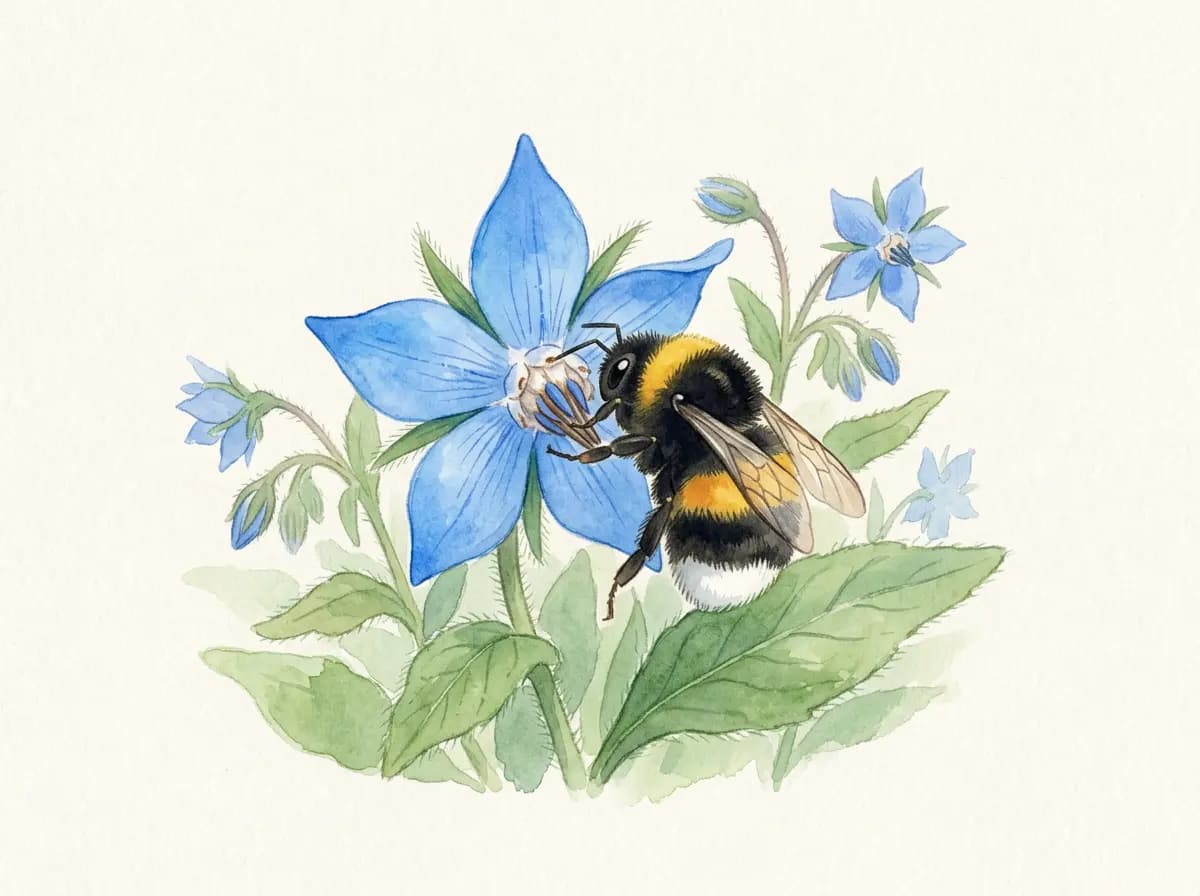
· 1-2.5 cm (queens, the biggest)Big and very furry, black with a yellow band on the thorax and another on the abdomen, and a white or cream tip.
- Where to find it
- On flowers: rosemary, lavender, tomato, broad beans, clover. The queens come out first, at the end of winter.
- When: Feb–Oct
- What to do
- Protect it: it is very peaceful. If you see a sluggish queen in a cold spring, offer her a drop of sugar water.
- Often confused with
- Carpenter bee (Xylocopa). Big, shiny bluish black, with no yellow bands. It nests in dry wood. It pollinates too.
- Hoverflies that mimic bumblebees (Volucella). They are flies: one pair of wings and short antennae. See profile
Nests, egg clutches and shelters
- Protect it
Bumblebee nest
Bumblebees coming and going through a hole in the ground; inside, a tangle of wax cells, cocoons and moss.
- Where to find it
- In abandoned mouse holes, under hedges, in compost, log piles or nest boxes.
- When: Mar–Sep
- What to do
- Do not block it or water it: it is a temporary colony of 50 to 400 bumblebees that disappears in autumn.
Often confused with
- Carpenter bee (Xylocopa). Big, shiny bluish black, with no yellow bands. It nests in dry wood. It pollinates too.
- Hoverflies that mimic bumblebees (Volucella). They are flies: one pair of wings and short antennae. See profile
Where and when to put it
- Queens: they appear between February and April; the colony grows in spring and summer.
- Uncut corner: from March to September; mow in October or November.
- Buried box (optional): put in place in winter, before the queens come out.
Maintenance
- Do not move or open an occupied nest; the colony lasts only one season and dies in autumn. Young queens hibernate in the ground.
- In autumn, do not dig over the soil of the corner: the queens hibernate there.
- Keep flowers all year, with something in winter (rosemary, heather).
- Check there are no ants or damp inside the pot.
Common mistakes
What comes up most often, so you can avoid it from the start.
Mowing the whole lawn and strimming the edges.
Many queens nest in tall grass and at the edges, and the flowers they feed on, such as clover, grow there too. If you mow everything, you destroy nests and take away their food. Leave a strip uncut until autumn.
Buying a commercial colony to release outdoors.
They are usually bumblebees reared in other countries, sometimes of another subspecies, which can bring parasites and diseases and compete with the bumblebees of your area until they displace them.
Using insecticides on flowering plants, including those sold in the supermarket.
The product stays in the nectar and pollen; the bumblebee drinks it or takes it to the nest and poisons the young. If there is no alternative, treat only the affected plant and never with open flowers.
Placing the box facing north or in a damp spot.
Without sun, the pot stays cold; with damp, the filling goes mouldy, and the queens do not choose it or the colony does not thrive. Face the entrance south or south-east, in a place that does not flood.
Removing stumps, logs and stones from the edges.
Under and between them are old mouse burrows, where many queens found their nest. Take them away and they have nowhere to breed.
Plants that help
 RosemaryA Mediterranean shrub that is very tough once established.
It flowers in midwinter and early spring, when the queens wake hungry and there are hardly any other flowers.
 BorageA leaf and flower vegetable, very hardy and typical of Aragon and Navarre in northern Spain, where the stems…
Its blue, downward-facing flowers fill with nectar very quickly; bumblebees hang from them with no trouble and visit them non-stop in spring.
 SageCommon sage is a woody subshrub with velvety, very aromatic grey-green leaves and spikes of violet flowers…
Its tube-shaped flowers, at the end of spring, hold the nectar deep down, and bumblebees reach it easily with their long tongues.
 LavenderA Mediterranean aromatic shrub with blue-violet spikes much loved by bees, indispensable in dry gardens and…
It flowers in summer for weeks, when the colony already has many workers to feed.
 White cloverA low-growing legume that covers the ground all year round and fixes nitrogen, so it works in paths between…
It grows in the lawn and flowers from spring to autumn if you do not mow it too short; it is one of their most important sources of nectar and pollen.
 PhaceliaA green manure with violet-blue flowers that grows fast and attracts bees like few other plants.
It can be sown in any gap and flowers 6–8 weeks later with lots of nectar; it fills in the months when there are no other flowers.
More information on the site
Sources
The measurements are a synthesis of these conservation guides; where each author gives different figures, they appear as a range.