
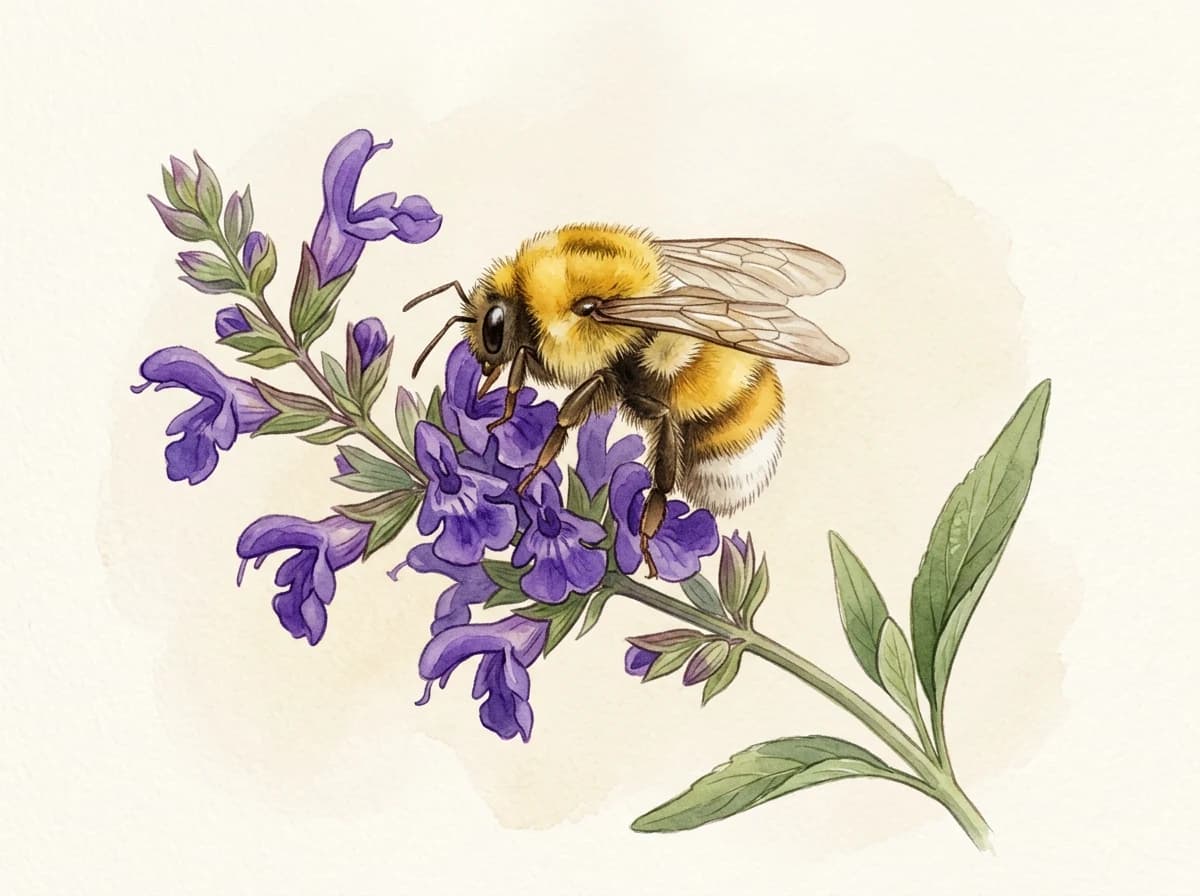
Bumblebee
Bombus terrestris
Also called: bumble bee, humble bee, Bombus, buff-tailed bumblebee
Big, furry and clumsy fliers. They work in weather when honey bees stay in the hive (cold, wind and light rain). They are excellent tomato pollinators: they buzz the flower to shake the pollen loose.

How to recognise it at every stage
PollinatorPollinator: it works in the cold and is key for tomatoes, strawberries and broad beans.
Life cycle: Complete metamorphosis inside the nest: egg, larva, pupa in a silk cocoon and adult, in about 4-5 weeks. The colony lasts a year: the queen founds the nest in spring, and in autumn only the new queens survive, spending the winter buried.
Tap a stage to see it full size. The photos are AI reference images checked against real photographs; stages without a reliable photo are shown as text only.
Life-stage calendar
| Jan | Feb | Mar | Apr | May | Jun | Jul | Aug | Sep | Oct | Nov | Dec | |
|---|---|---|---|---|---|---|---|---|---|---|---|---|
| Eggs | ||||||||||||
| Larvae | ||||||||||||
| Cocoons | ||||||||||||
| Adult | ||||||||||||
| Bumblebee nest |
Approximate months for mainland Spain; in cold areas they start later and in warm areas they last longer. Garden creatures this month
- 1Protect it
Eggs
White eggs in small groups inside wax cells. They cannot be seen from outside.
- Where to find it
- Inside the nest.
- When: Mar–Aug
- What to do
- If you find a nest, leave it: it comes to an end by itself in autumn.
- 2Protect it
Larvae
White larvae that grow together inside a wax pouch, fed on pollen and nectar.
- Where to find it
- Inside the nest.
- When: Mar–Aug
- What to do
- More early flowers (rosemary, heather, willow) = more well-fed larvae.
- 3Protect it
Cocoons
Oval, yellowish silk cocoons, crowded together like an irregular bunch.
- Where to find it
- Inside the nest.
- When: Apr–Sep
- What to do
- Leave them: the empty cocoons are reused as honey pots.
- 4Protect it
Adult
· 1-2.5 cm (queens, the biggest)Big and very furry, black with a yellow band on the thorax and another on the abdomen, and a white or cream tip.
- Where to find it
- On flowers: rosemary, lavender, tomato, broad beans, clover. The queens come out first, at the end of winter.
- When: Feb–Oct
- What to do
- Protect it: it is very peaceful. If you see a sluggish queen in a cold spring, offer her a drop of sugar water.
- Often confused with
- Carpenter bee (Xylocopa). Big, shiny bluish black, with no yellow bands. It nests in dry wood. It pollinates too.
- Hoverflies that mimic bumblebees (Volucella). They are flies: one pair of wings and short antennae. See profile
Nests, egg clutches and shelters
- Protect it
Bumblebee nest
Bumblebees coming and going through a hole in the ground; inside, a tangle of wax cells, cocoons and moss.
- Where to find it
- In abandoned mouse holes, under hedges, in compost, log piles or nest boxes.
- When: Mar–Sep
- What to do
- Do not block it or water it: it is a temporary colony of 50 to 400 bumblebees that disappears in autumn.
Often confused with
- Carpenter bee (Xylocopa). Big, shiny bluish black, with no yellow bands. It nests in dry wood. It pollinates too.
- Hoverflies that mimic bumblebees (Volucella). They are flies: one pair of wings and short antennae. See profile
What it eats
- Nectar and pollen from a huge range of flowers
How to attract this ally to your garden
- Tubular flowers where they push in their tongues: sage, rosemary, foxglove, snapdragon.
- Leave patches of bare, sunny soil: many solitary bees nest in the ground and cannot do so under a continuous mulch.
- Plant low, dense hedges of lavender and thyme: they give nectar and shelter to solitary bees and butterflies.
- In a greenhouse: if you grow tomatoes under plastic, you can install a commercial bumblebee hive, which improves fruit set.
Plants in the catalogue that attract it
 Pineapple sageA perennial Salvia whose leaves have a fruity pineapple scent.
 RosemaryA Mediterranean shrub that is very tough once established.
 FoxgloveA biennial with tall spikes of bell-shaped flowers speckled inside, perfect for woodland areas and partly…
 SnapdragonA plant with upright spikes of curious flowers that open when squeezed, like a dragon's mouth.
 ThymePerennial thyme for poor, dry soil, ideal for sunny borders.
 GauraA perennial with slender stems and tiny flowers that look like a cloud of butterflies fluttering above the…
What to avoid so you do not harm it by accident
- Avoid watering that floods underground nests: it drowns the broods of solitary bees and of some useful beetles.
- Broad-spectrum insecticides: they also kill this ally and leave the garden without natural defences.
How to recognise it
20-25 mm, very furry, black with yellow bands and a white tail tip (the commonest species). Noisy, clumsy flight, from flower to flower.
Risk to people: Very peaceful. They only sting if they feel trapped or threatened, and they can sting several times without dying.
Many allies are protected by Spanish law: do not capture or keep in captivity toads, hedgehogs, bats or native reptiles. Attract them, watch them and thank them from a distance. Rules in other countries differ: check your local regulations.

Allies do better if the garden is varied. Learn to identify each visitor and to prevent problems with good habits.