
Bats: a roost box with its measurements
A pipistrelle can eat thousands of mosquitoes and small moths in a night. In Spain all bats are protected. A well-placed roost box offers them shelter, especially where holes in buildings and trees are lacking.
- Difficulty: medium
- Back board (indicative): 260 × 520 mm, with horizontal grooves every 10 mm and 2 mm deep on the inner face
- Profile: Bat
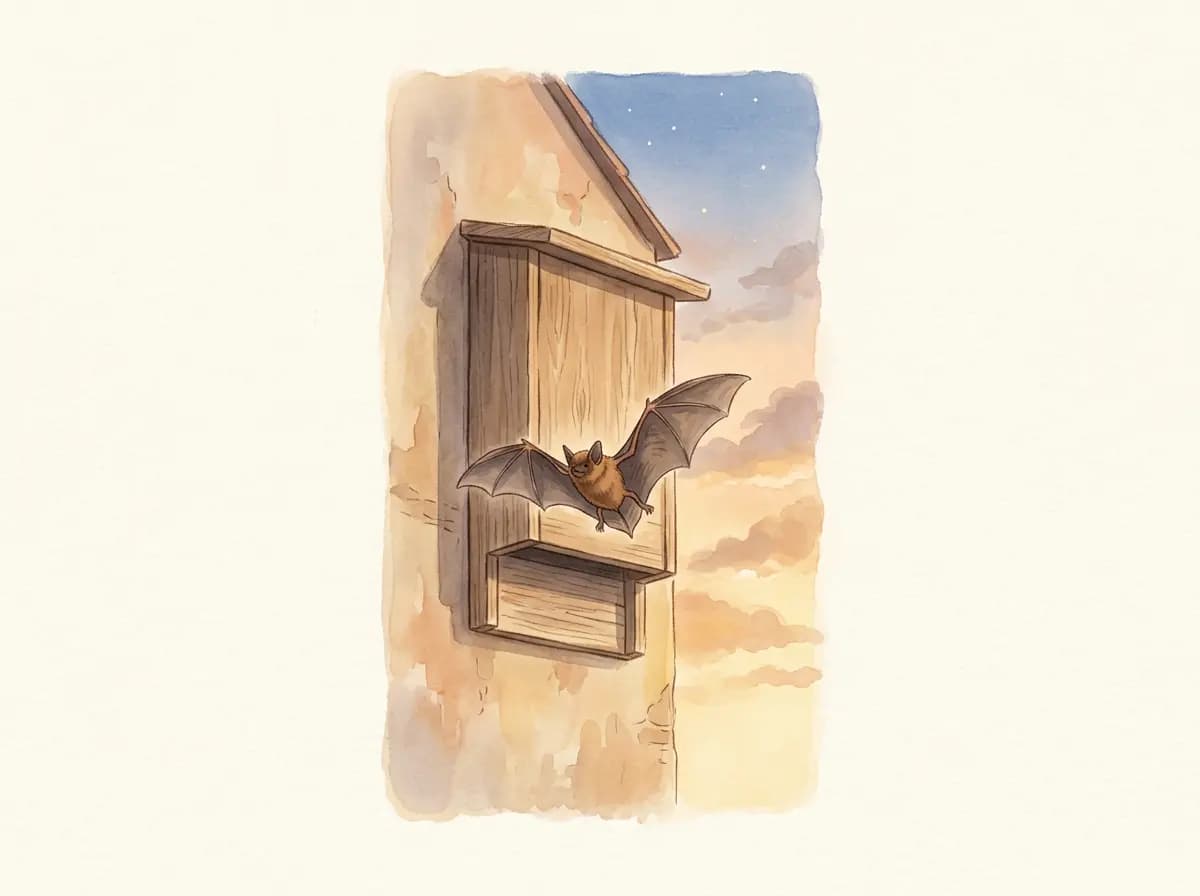
What it helps with
- They eat mosquitoes, moths (many of them the adults of caterpillars), beetles and other night-flying insects.
- A good roost helps their colonies when natural cavities are lacking.
- It is a silent night-time ally that needs no care.
Materials
- Untreated 20 mm wooden boards (pine or fir), rough on the inside
- Stainless steel screws (not nails)
- 20 mm battens for the side spacers
- Water-based, non-toxic exterior paint or stain (on the outside only)
- Saw, drill, tape measure and square
Measurements
- Back board (indicative)
- 260 × 520 mm, with horizontal grooves every 10 mm and 2 mm deep on the inner face
- Front board
- 260 × 400 mm; it leaves 120 mm of the back board visible as a “landing strip”
- Slot
- 20 mm wide between back and front
- Entrance
- 20 mm slot open at the bottom
- Roof
- sloping, with a 40 mm overhang at the front
- Hanging height
- 3.5 to 6 m, with a clear flight path about 3 m in front
Diagram drawn by a program with the same measurements as the table. The figures are indicative: each author proposes slightly different values.
Step by step
1. Cut the pieces
Cut the boards: back 260 × 520 mm, front 260 × 400 mm, two side battens of 20 × 20 mm and about 400 mm, and a sloping roof.

2. Make the grooves
On the inner face of the back and the front make horizontal grooves 2 mm deep every 10 mm, so they can grip. The landing strip should also be rough.

3. Assemble the slot
Screw the side battens to the back and fix the front on top, leaving a gap of 20 mm. Leave the entrance slot open at the bottom. Do not leave side gaps where air can get in.

4. Close with the roof
Fit a sloping roof that overhangs 40 mm at the front, waterproofed on the outside. Paint only the outside with water-based paint.

5. Hang it high up
Fix it with long screws to a wall, a façade or a thick trunk, at 3.5–6 m high, with no branches in front. Put up 2 or 3 boxes facing different directions (south, south-east and east).

How to recognise it at every stage
Garden allyGarden ally: every night it eats hundreds of mosquitoes and moths.
Life cycle: Mammal: each female has one pup a year, in early summer, in maternity colonies; the pup flies at 3-4 weeks. They hibernate in winter and can live for more than ten years.
Tap a stage to see it full size. The photos are AI reference images checked against real photographs; stages without a reliable photo are shown as text only.
Life-stage calendar
| Jan | Feb | Mar | Apr | May | Jun | Jul | Aug | Sep | Oct | Nov | Dec | |
|---|---|---|---|---|---|---|---|---|---|---|---|---|
| Pup | ||||||||||||
| Adult | ||||||||||||
| Roost box and colonies |
Approximate months for mainland Spain; in cold areas they start later and in warm areas they last longer. Garden creatures this month
- 1Protect it
Pup
· 2-3 cmBaby bats almost without fur, clinging to the mother or hanging together in the roost.
- Where to find it
- In maternity colonies in roofs, roost boxes and crevices.
- When: Jun–Jul
- What to do
- Do not carry out roof work where there are colonies in June and July. If you find a pup on the ground, call a wildlife centre.
- 2Protect it
Adult
· 3-5 cm (20 cm wingspan)Small, brown, with wings of skin; it flies in a zigzag at dusk.
- Where to find it
- Hunting over the garden, around street lamps and over water at dusk.
- When: Mar–Oct
- What to do
- Protect it (all species are protected): put up a south-facing roost box more than 3 m high.
- Often confused with
- Swallows and swifts at dusk. Birds fly straighter and higher and go to roost as it gets dark; bats come out when it is almost night and make sudden turns. See profile
Nests, egg clutches and shelters
- Protect it
Roost box and colonies
Wooden boxes with the entrance at the bottom; below them or under crevices, dry droppings appear that crumble into a shiny powder.
- Where to find it
- On façades, trees, roofs and shutters.
- When: all year
- What to do
- Their droppings (guano) are an excellent fertiliser. Do not block the cracks where they shelter.
Often confused with
- Swallows and swifts at dusk. Birds fly straighter and higher and go to roost as it gets dark; bats come out when it is almost night and make sudden turns. See profile
Where and when to put it
- It can be put up in autumn or winter, and will be ready for spring.
- Orientation: south-east or south in cool areas; east or south-east, with some afternoon shade, in very warm areas.
- Near water, hedges or trees, and away from artificial light and noise.
- With no cats able to climb up.
Maintenance
- Do not open or clean it: you could disturb the colony. No maintenance is needed.
- Check from below, quietly, whether there are droppings under the box (a sign of occupation).
- If they take a while to arrive, be patient: it can take years and depends on the area.
If you find a bat on the ground, do not pick it up with bare hands, because in very rare cases they carry a virus similar to rabies: call your region’s wildlife rescue centre.
Common mistakes
What comes up most often, so you can avoid it from the start.
Hanging it lower than 3 m or with branches in front.
Bats drop down when they leave and need clear space to take flight. Low, or hidden by branches, it can also be reached by cats and other predators.
Leaving the inside walls smooth.
Bats rest hanging and need to grip with their claws. Without grooves or roughness they cannot hold on or climb up inside.
Making the inner slot wider than 25 mm or narrower than 15 mm.
They like narrow cracks, where they feel protected and stay warm. If it is too wide they do not occupy it; if it is too narrow, they do not fit.
Using treated wood, solvent-based paint or varnish.
They spend many hours pressed against the wood and breathe its fumes; those products are toxic to them. If you paint, do it only on the outside and with water-based paint.
Putting it near a street lamp or a floodlight.
Most bats avoid artificial light, because it exposes them to predators: they do not leave a lit box or never occupy it.
Opening it “to have a look” or cleaning it.
You disturb them and they may abandon the roost, even with young inside. It is also prohibited. It needs no cleaning: the droppings fall out on their own through the slot at the bottom.
More information on the site
Sources
The measurements are a synthesis of these conservation guides; where each author gives different figures, they appear as a range.