
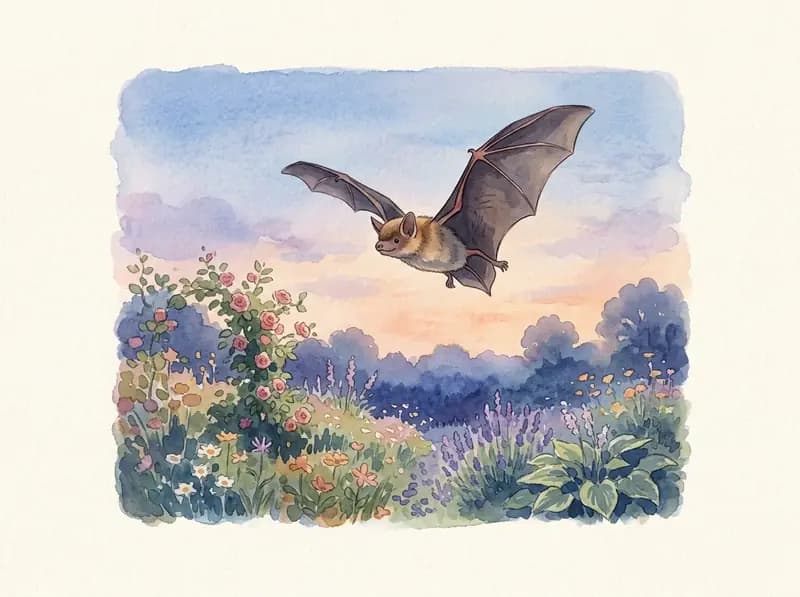
Bat
Pipistrellus pipistrellus and others
Also called: pipistrelle, common pipistrelle, insect-eating bat, chiropteran
A small bat can eat, depending on the species and the season, up to about 3,000 tiny insects every night. They help reduce the tomato leafminer and the mosquitoes on the terrace. All European bats are protected by law.

How to recognise it at every stage
Garden allyGarden ally: every night it eats hundreds of mosquitoes and moths.
Life cycle: Mammal: each female has one pup a year, in early summer, in maternity colonies; the pup flies at 3-4 weeks. They hibernate in winter and can live for more than ten years.
Tap a stage to see it full size. The photos are AI reference images checked against real photographs; stages without a reliable photo are shown as text only.
Life-stage calendar
| Jan | Feb | Mar | Apr | May | Jun | Jul | Aug | Sep | Oct | Nov | Dec | |
|---|---|---|---|---|---|---|---|---|---|---|---|---|
| Pup | ||||||||||||
| Adult | ||||||||||||
| Roost box and colonies |
Approximate months for mainland Spain; in cold areas they start later and in warm areas they last longer. Garden creatures this month
- 1Protect it
Pup
· 2-3 cmBaby bats almost without fur, clinging to the mother or hanging together in the roost.
- Where to find it
- In maternity colonies in roofs, roost boxes and crevices.
- When: Jun–Jul
- What to do
- Do not carry out roof work where there are colonies in June and July. If you find a pup on the ground, call a wildlife centre.
- 2Protect it
Adult
· 3-5 cm (20 cm wingspan)Small, brown, with wings of skin; it flies in a zigzag at dusk.
- Where to find it
- Hunting over the garden, around street lamps and over water at dusk.
- When: Mar–Oct
- What to do
- Protect it (all species are protected): put up a south-facing roost box more than 3 m high.
- Often confused with
- Swallows and swifts at dusk. Birds fly straighter and higher and go to roost as it gets dark; bats come out when it is almost night and make sudden turns. See profile
Nests, egg clutches and shelters
- Protect it
Roost box and colonies
Wooden boxes with the entrance at the bottom; below them or under crevices, dry droppings appear that crumble into a shiny powder.
- Where to find it
- On façades, trees, roofs and shutters.
- When: all year
- What to do
- Their droppings (guano) are an excellent fertiliser. Do not block the cracks where they shelter.
Often confused with
- Swallows and swifts at dusk. Birds fly straighter and higher and go to roost as it gets dark; bats come out when it is almost night and make sudden turns. See profile
What it eats
- Mosquitoes (a great many)
- Night moths and their caterpillars
- Flying beetles
How it helps in the garden
How to attract this ally to your garden
- Hang a roost box 3-4 m up, facing south: bats use it to rest by day and go out to hunt at night.
- Cut down on outdoor lighting; if you need it, make it dim, warm in tone and aimed at the ground.
- Open water nearby, such as a pond or a big tray: they drink on the wing and there are plenty of insects to catch over the water.
- Keep old trees with hollows and cracks: natural dormitories.
What to avoid so you do not harm it by accident
- Sealing up attics and barns without checking there is no colony inside (disturbing their colonies is forbidden).
- Very blue or very strong LED floodlights at night: they disorient moths and other useful night insects.
- Systemic insecticides: they poison the prey and, with it, the bat, bird or hedgehog that eats it.
How to recognise it
The small ones, like the pipistrelle, have a body only a few centimetres long and a wingspan of about 20 cm, and an erratic flight. They only come out at dusk and at night.
Risk to people: None if you do not touch them: they do not attack. Do not pick up a fallen or injured bat with your bare hand, because in very rare cases they can carry a virus similar to rabies. If one bites or scratches you, wash the wound with soap and water and see a doctor; notify your region's environment service or call 112.
Many allies are protected by Spanish law: do not capture or keep in captivity toads, hedgehogs, bats or native reptiles. Attract them, watch them and thank them from a distance. Rules in other countries differ: check your local regulations.

Allies do better if the garden is varied. Learn to identify each visitor and to prevent problems with good habits.