
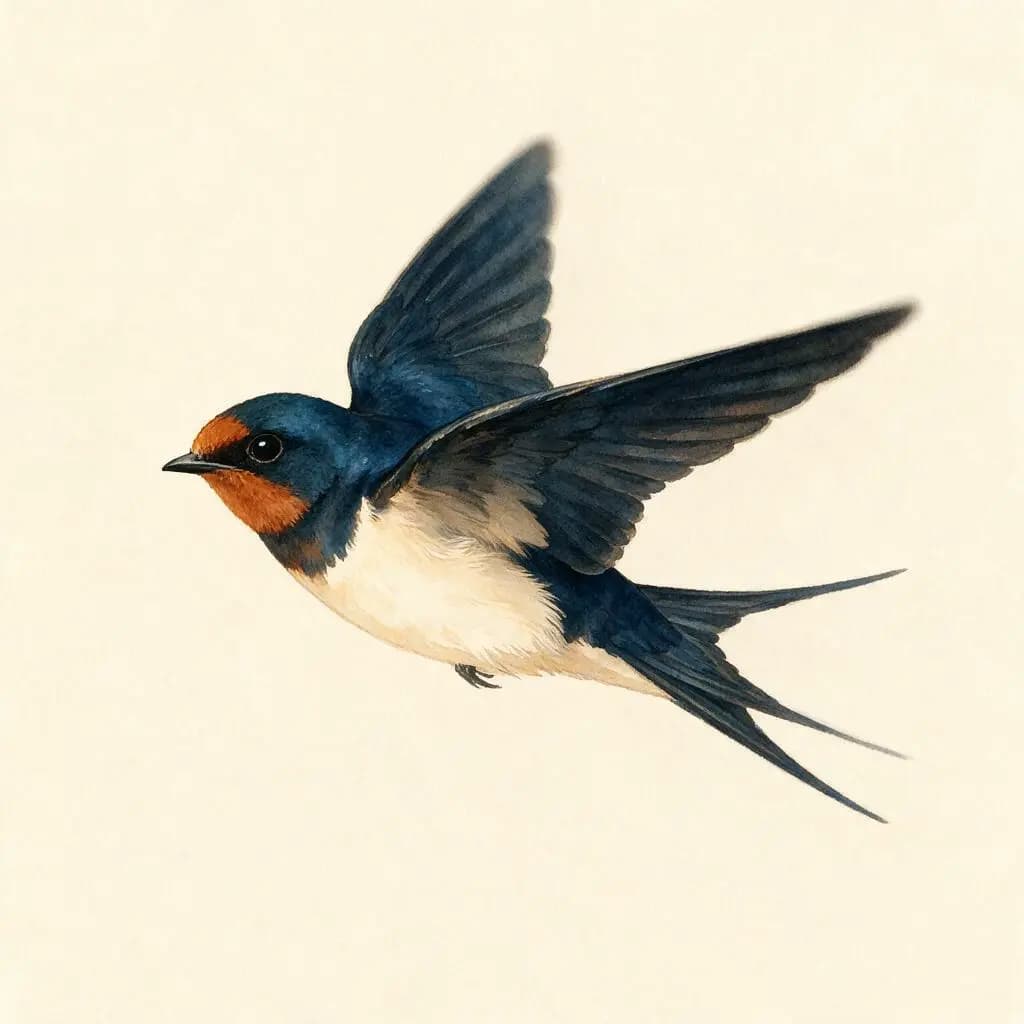
Swallows and swifts
Hirundo rustica, Apus apus
Also called: barn swallow, house martin, swift, Hirundo rustica, swallow
Migratory birds that hunt mosquitoes, flies, winged aphids and moths on the wing; between them they catch thousands of insects a day during the breeding season.

How to recognise it at every stage
Garden allyGarden ally: it catches mosquitoes, flies and winged aphids on the wing.
Life cycle: Migratory bird: it arrives in spring, builds or repairs its mud nest, lays 4 to 6 eggs and the chicks fly after three weeks. Two broods a year; in September it returns to Africa.
Tap a stage to see it full size. The photos are AI reference images checked against real photographs; stages without a reliable photo are shown as text only.
Life-stage calendar
| Jan | Feb | Mar | Apr | May | Jun | Jul | Aug | Sep | Oct | Nov | Dec | |
|---|---|---|---|---|---|---|---|---|---|---|---|---|
| Eggs | ||||||||||||
| Chicks | ||||||||||||
| Adult | ||||||||||||
| Mud nest |
Approximate months for mainland Spain; in cold areas they start later and in warm areas they last longer. Garden creatures this month
- 1Protect it
Eggs
· 2 cmWhite (with reddish speckles in the barn swallow).
- Where to find it
- In mud nests under eaves, in stables and porches.
- When: Apr–Jul
- What to do
- Do not remove the nests: it is forbidden and they reuse them every year.
- 2Protect it
Chicks
Little heads with a yellow mouth peeping over the edge of the nest.
- Where to find it
- In the nest.
- When: May–Aug
- What to do
- If the droppings bother you, put a board under the nest.
- 3Protect it
Adult
· 15-19 cmBarn swallow: shiny blue-black, red throat and a tail with two long streamers. House martin: white rump and short tail.
- Where to find it
- Flying low over the garden and the water.
- When: Mar–Sep
- What to do
- Leave a mud puddle in spring: they need it for the nest.
- Often confused with
- Swift. All dark brown, sickle-shaped wings and it never perches on wires. It is also an ally.
Nests, egg clutches and shelters
- Protect it
Mud nest
A cup (swallow) or a closed ball with a hole (martin) made of little pellets of mud stuck together.
- Where to find it
- Under eaves, in stable beams and porches.
- When: all year
- What to do
- Respect it all year, including when it is empty in winter: they will come back to it.
Often confused with
- Swift. All dark brown, sickle-shaped wings and it never perches on wires. It is also an ally.
What it eats
- Mosquitoes and flies in flight
- Winged aphids and other flying insects
- Flying ants and other high-flying insects (swifts)
How it helps in the garden
How to attract this ally to your garden
- Leave their nests under eaves and rafters alone: they come back to the same nest every year, and rebuilding it costs them hundreds of trips carrying mud.
- Put up artificial nest cups under sheltered eaves before they arrive, around March.
- Mud puddles in spring so they can build the nest.
- Do not put spikes, netting or repellent paint on the eaves where they usually nest: you take away the place they return to every year to breed.
Plants in the catalogue that attract it
What to avoid so you do not harm it by accident
- Destroying birds' nests, even empty ones: it is forbidden and you also lose allies that eat caterpillars and mosquitoes.
- Broad-spectrum insecticides: they kill pests and allies alike; use only localised treatments if needed.
How to recognise it
Barn swallow: long forked tail, reddish throat. House martin: short tail, white rump. Swift: all black, sickle-shaped wings, never lands on the ground.
Risk to people: None.
Many allies are protected by Spanish law: do not capture or keep in captivity toads, hedgehogs, bats or native reptiles. Attract them, watch them and thank them from a distance. Rules in other countries differ: check your local regulations.

Allies do better if the garden is varied. Learn to identify each visitor and to prevent problems with good habits.