
Credits and licences
- #1 — vueltaalhuerto illustration
- #2 — vueltaalhuerto illustration
- #3 — vueltaalhuerto illustration
- #4 — vueltaalhuerto illustration
- #5 — vueltaalhuerto illustration
- #6 — vueltaalhuerto illustration
- #7 — vueltaalhuerto illustration
- #8 — vueltaalhuerto illustration
- #9 — vueltaalhuerto illustration
- #10 — vueltaalhuerto illustration
Wavy rib cactus (brain cactus)
and 2 more names
Echinofossulocactus multicostatus, StenocactusWavy rib cactus (brain cactus) is sown in seed trays from March to May, and planted out from April to June. It flowers from March to April. Grow it in full sun, 15 cm apart, with little watering. Dates are for a mild temperate climate in the northern hemisphere; the calendar below adjusts them to your zone.
Many shops sell it as Echinocactus multicostatus, but the name accepted today (Kew, POWO) is Stenocactus multicostatus; that is why this profile keeps the shop name in the web address and the aliases, even though it is not an Echinocactus. It is a globular cactus 6 to 15 cm across, almost as tall as it is wide, with 50 to 100 extremely thin, wavy, tightly packed ribs, like the gills of a mushroom or the folds of a brain. Each rib has areoles with flattened, papery, straw-coloured spines, the central ones longer. In spring and summer flowers about 2.5 to 5 cm across appear at the crown, white or pink with a violet stripe on each petal. It grows slowly, copes well with a little neglect in watering and is very rewarding in a pot, on a very bright windowsill or a sunny balcony. LEGAL AND SAFETY NOTICE: like all cacti, it is listed in Appendix II of the CITES convention (Annex B of Regulation (EC) 338/97 in the European Union): international trade in wild plants and seeds is regulated and removing plants from the wild is prohibited. Nursery-propagated plants can be bought and sold normally within the EU. Buy only from registered nurseries and be wary of large specimens or plants of unclear origin. It is not listed in the Spanish Catalogue of Invasive Alien Species (Catálogo español de especies exóticas invasoras). Risks: the spines, although flat, are sharp and stick into the skin; handle it with thick gloves or a strip of folded paper. It is not edible.
Family and origin: Cactus family (Cactaceae) · native to Arid areas of northern and central Mexico · More plants from Mesoamerica
01In your area
How will it do in your home?
Year calendar
| Task | J | F | M | A | M | J | J | A | S | O | N | D |
|---|---|---|---|---|---|---|---|---|---|---|---|---|
| Seed trayMar–May | no | no | yes | yes | yes | no | no | no | no | no | no | no |
| Plant / transplantApr–Jun | no | no | no | yes | yes | yes | no | no | no | no | no | no |
| FloweringMar–Apr | no | no | yes | yes | no | no | no | no | no | no | no | no |
Its life cycle at a glance
Swipe and tap a stage to see its details.
02Care
Care through the year
Sun and aspectFull sun · 8 h of sun · South or south-west, with nothing casting shade at midday
- Too little sun
- Ideal range
- Plenty of sun
South or south-west, with nothing casting shade at midday
Strong sun: Loves full midday sun and high temperatures.
Full sun or very bright light. Kept dry and unwatered, it withstands brief frosts of about -5 °C according to some sources, but it is more sensitive to cold when it is in growth; to be safe, protect it below 0 °C and from cold, damp conditions.
WateringLet it dry out between waterings · summer: every 5-7 days
- Summerevery 5-7 days0.2 L per plant/week
- Spring / Autumnevery 10-14 days0.1 L per plant/week
- Winteronly in extreme drought (once a month)0 L per plant/week
Let it dry out between waterings: A Mediterranean favourite: better thirsty than overwatered.
Water regularly in summer, but only when the potting mix is completely dry, and cut back from the end of September. In winter keep it dry and well ventilated. Use a very mineral mix and a pot with good drainage and enough depth for the taproot.
When to water? Push your finger 5 cm into the soil next to the base of the plant:
- Damp: soil sticks to your finger. Do not water yet. It has more than enough; wait for it to dry out more.
- Cool but clean, no mud. Wait another 1-2 days before watering.
- Dry and dusty. Water now, but moderately. Do not overdo it: it prefers thirst to excess.
- TipWatch out for mealybugs, which hide between the tightly packed ribs, and for rot at the base from too much water.
- TipThe figures for size, cold and watering are approximate.
- TipA dry winter rest: with hardly any water they flower better in spring.
- Common mistakeWatering in cold winter weather is the fast track to rot.
Potting mix and feedingpH 6–7.5 · Mineral mix with almost no organic matter
Mineral mix with almost no organic matter.
20 % multi-purpose compost · 40 % silica sand · 40 % pumice or lava rock.
Extreme.
This plant prefers a pH between 6.0 and 7.5 (slightly acidic to slightly alkaline).
- Rich, compact mix: certain rot within a few months.
- Watering in cold winter weather: the first step towards rot.
- TipPlant it in a fairly deep pot, with cactus compost mixed with gravel or volcanic grit (picón), in full sun and with good ventilation.
- TipFeed it once or twice between spring and summer with cactus fertiliser.
- TipPlenty of light and a free-draining mineral mix.
- Common mistakeA mix that holds water drowns the roots.
Common mistakes and tips
- TipOn the frost-free Spanish Mediterranean coast it can live outdoors all year round in a spot sheltered from rain; elsewhere in Spain, put it out on the terrace from spring and bring it into a bright, cool, dry place in winter.
03Propagation
Make new plants
It is almost always propagated from seed, because it hardly produces offsets. The small, dark brown seeds are sown on the surface of a fine mineral mix, with gentle warmth (18 to 26 °C) and plenty of light, and germinate in about two weeks. The seedlings struggle with strong sun and dryness: protect them at first and transplant them frequently. If a mature plant produces an offset, separate it, leave it to callus for a few days and plant it in a mineral mix.
Seeds: how to germinate them~14 days
04Uses and health
What it is used for, and with what care
No serious toxins are known, but the spines stick into the skin and are awkward to remove: handle it with thick gloves and place it away from walkways, children and pets. There is no reliable data on its effect if swallowed, so do not eat it. It is listed in CITES Appendix II: buy nursery-grown plants.
- Properties
- A collector's and ornamental cactus, with no medicinal or food uses.
- Uses
- It is not edible: do not use it in home preparations.
For guidance only; this is not medical treatment and does not replace advice from a doctor or vet.
05Companions and related plants
What to plant it with
Compare with similar varieties
| Variety | Sowing | Harvest | Days | Spacing | Difficulty |
|---|---|---|---|---|---|
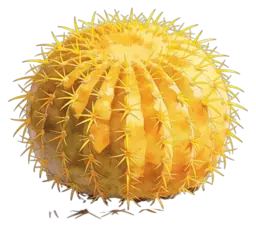
| Golden barrel cactus (mother-in-law's cushion) | — | — | — | 30 cm | Easy |
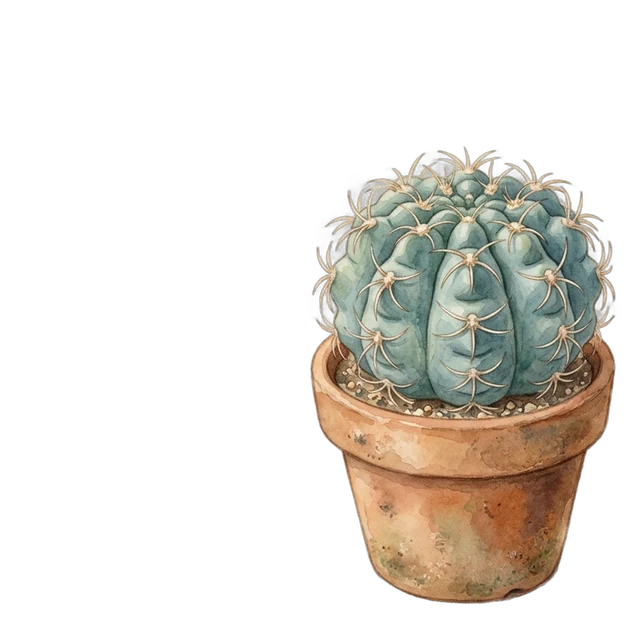
| Wavy rib cactus (brain cactus) | Mar–May | — | — | 15 cm | Easy |